

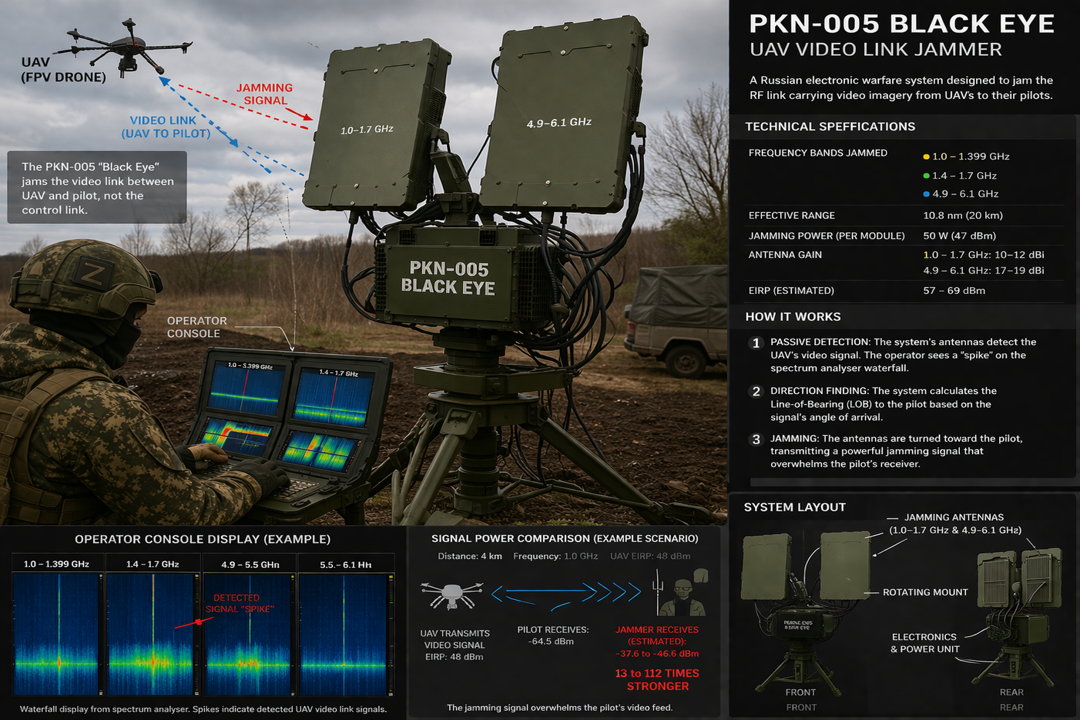

Details are emerging concerning the Russian military’s PKN-005 Black Eye uninhabited aerial vehicle jammer which began to appear on Ukraine’s battlefields last year.
The PKN-005 Black Eye Uninhabited Aerial Vehicle (UAV) jammer is believed to have first been deployed in Ukraine from mid-2024, its appearance confirmed in early 2025, Armada understands. Initial indications of the PKN-005’s deployment was from Ukrainian First Person View (FPV) UAV operators. FPV UAV pilots reported their aircraft’s video signal being jammed. Jamming the video transmission from a UAV to its pilot contrasts with orthodox UAV jamming tactics. The latter emphasises attacking the Radio Frequency (RF) link connecting the aircraft with its pilot and Ground Control Station (GCS).
Attacking the RF video link between the UAV and the GCS has two effects: Firstly, the UAV pilot can no longer collect imagery intelligence if this link is severed. Secondly, a lack of visual situational awareness deprives the pilot of seeing potential threats to their aircraft.
Such was the potency of the PKN-005 that this counter-UAV system became a high priority for Ukrainian tactical units at, and near, the zero line. Armada has obtained Russian language documents purporting to be operating manuals for the PKN-005. These documents give some useful clues regarding the system’s capabilities, and tactics of employment.
PKN-005 tactics
The PKN-005 can jam video link frequencies across the following wavebands: one gigahertz/GHz to 1.399GHz, 1.4GHz to 1.7GHZ and 4.9GHz to 6.1GHz. UAV RF video link frequencies are targeted by three modules each covering one of these wavebands. Two jamming antennas equip the PKN-005; one covering a waveband of one gigahertz to 1.7GHz and a second covering 4.9GHz to 6.1GHz. The manual claims the system has an effective range of 10.8 nautical miles/nm (20 kilometres/km).
A notable feature of the PKN-005 is that it is not designed to jam the aircraft but instead attacks the RF link carrying video imagery between the aircraft and pilot. It is a golden rule in electronic warfare that the aggressor does not jam the transmitter, as this would need too much power, but jams the receiver: The targeted signal is much weaker by the time it arrives at the receiving antenna. The Black Eye therefore directs its jamming signal against the pilot’s video feed receiving antenna.
The PKN-005’s operator console has four screens each of which shows a waterfall display from the system’s spectrum analyser. The operator will see a ‘spike’ representing the aircraft control radio signal between the pilot and UAV. The passive receiving antenna provides a Line-of-Bearing (LOB) towards the pilot based on the angle of arrival of that radio signal. Once pilot’s LOB is determined the PKN-005’s jamming antennas are turned in their direction.
Armada understands from Ukrainian sources that each of the modules generates 50 watts (47 decibels-per-milliwatt/dBm) of jamming signal strength. Each of the Black Eye’s two antennas is believed to have a 0.2 square metre surface area. The antenna covering the one gigahertz to 1.7GHz waveband is believed to provide between ten and twelve decibels-relative-to-isotropic (dBi) of antenna gain. Gain is a measure of how much signal strength an antenna focuses. The 4.9GHz to 6.1GHz antenna is thought to have a gain of between 17dBi and 19dBi. Taking these figures together, this would provide an Effective Isotropic Radiated Power (EIRP/the amount of power leaving the antenna) of between 57dBm and 69dBm.
Suppose the PKN-005 is transmitting a jamming signal on a frequency of one gigahertz against a UAV pilot four kilometres away. This scenario will assume the pilot’s video receiving antenna has a ten decibels-relative-to-isotropic gain. This receiving antenna would be hit by between -37.58dBm and -46.6dBm of jamming power depending on the jamming antenna used. As a ballpark figure, we will assume the UAV is transmitting a signal with an EIRP of 48dBm. The pilot receives a signal from their UAV with a strength of -64.5dBm. The jamming signals the pilot receives are between 13 to 112 times stronger than the UAV video signal.
Battlefield threat
Armada understands that the PKN-005 is one of the systems deployed by the Russian military’s elite Rubicon UAV unit. In this guise, the jamming system will provide protection against Ukrainian FPV UAVs reconnoitring Russian forces. One of the dangers of Black Eye is that the UAV operator may try to change the frequency of their RF video feed to avoid the jamming. However, if the new frequency is within the PKN-005’s wavebands, it can still be jammed. The tactic of jamming the pilot rather than the aircraft is an interesting approach. Black Eye, and its innovative UAV video feed jamming tactic, is something that allied nations need to contemplate should they face Russian forces on the battlefield.
by Dr. Thomas Withington
