

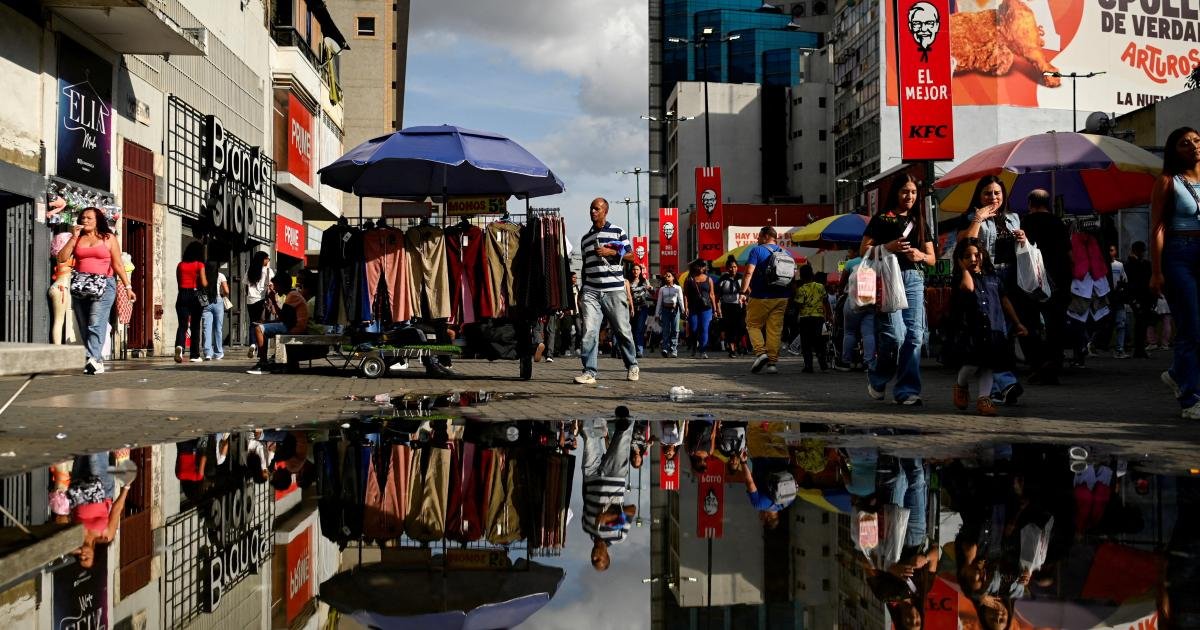
For more than a decade, Venezuela has had the world’s worst-performing economy. Misguided policies pursued by the country’s strongman, Nicolás Maduro, and his predecessor, Hugo Chávez, stifled growth and productivity, while punitive U.S. sanctions severely damaged the economy by severing its links to global trade and financial markets. As a result, the country’s GDP shrank by over 70 percent between 2012 and 2020—the largest economic contraction ever documented in a country not at war.
But now that Maduro is gone—snatched from Caracas in a controversial overnight American military operation of disputed legality—and sanctions have been eased, Venezuela has an opportunity to bounce back. In fact, given the economy’s high dependence on oil revenue, some kind of recovery is all but certain. U.S. President Donald Trump has allowed Venezuela to begin selling its oil in global markets. As export revenues increase, living standards should rise, and poverty rates should decrease. If Venezuela returns to its pre-crisis oil output, its per capita income could triple over the course of the next decade. Under the right conditions, the country could become the fastest-growing economy in the region.
Yet it is one thing for the economy to undergo a mechanical rebound. It is quite another to build the foundations for sustained and equitable growth. To attract the long-term inflows of capital that Venezuela needs to rebuild its economy, the government in Caracas must credibly commit to a stable set of rules governing private investment. But the interim authorities now running the country are not well positioned to do so. These officials, including the acting president, Delcy Rodríguez, were appointed by Maduro and are unpopular. Investors know that these authorities could well lose power if elections are held in Venezuela and that any commitments they made could easily be undone.
Some might argue that this means the Trump administration should push for rapid elections and allow a credible, opposition-led government to come into power as soon as possible. Yet this assumes that such a transition would be smooth—and that is far from certain. If the new government questions the legality of the previous administration’s contracts, for example, investors might be spooked. New authorities could also move to purge Maduro’s and Chávez’s supporters from government institutions and the military, ushering in another period of instability. These officials have enough popular support and material power to organize potentially serious challenges to their successors.
There is only one clear way Venezuelans can provide investors with a credible guarantee of stability: through a political agreement between the government and the opposition on the country’s economic strategy. Such a deal will require political factions to put aside their broader differences and agree on the reforms needed to sustainably improve the living conditions of Venezuelans. They would need to work together on rebuilding institutions, reestablishing the rule of law, restoring investment in human capital and infrastructure, providing social protections to vulnerable groups, securing property rights, and restoring faith in the country’s currency.
Chávez, Maduro, and Rodríguez’s allies have been at odds for decades with Venezuela’s opposition, so there are reasons to be skeptical that such a deal can be reached. Yet Maduro’s ouster has changed the political equilibrium, and Rodríguez has already embarked on some economic and political reforms that the opposition had long requested. The United States clearly has leverage over both sides, and Trump has suggested that he would like to see the opposition leader María Corina Machado play a role in the country’s future. There is, then, a real path forward—one that the country must follow. Otherwise, Venezuela’s recovery will remain shallow and vulnerable.
SHAKY GROUND
After years of contraction and stagnation, Venezuela’s economy has begun a slow rebound. Following Maduro’s capture on January 3, the Trump administration reached an agreement with a new interim government in Caracas that gave Venezuela renewed access to oil markets, provided that Washington ultimately controlled the country’s oil sales. So far, $500 million from oil sales has been channeled to Venezuelan importers, helping to ease pressure in the foreign exchange market—where Venezuela’s currency is traded for dollars—and stabilizing the country’s currency. Although it is too early to say exactly what Venezuela’s pace of recovery will be, analysts expect the economy to grow by double digits this year. If they are right, it will be the country’s strongest growth performance in over two decades.
But there are many problems with the present course. The first, and most obvious, is the current government’s lack of electoral legitimacy. Rodríguez became Venezuela’s leader not through a democratic contest, but thanks to American military intervention. She was in a position to take power only because she had been appointed vice president by Maduro—who himself had only held power because he brazenly stole the country’s 2024 election. Although the leftist “Chavista” movement (named for Chávez) to which Rodríguez belongs is still supported by an important segment of the population, opinion polls confirm that most Venezuelans would prefer to see it out of office. This unpopularity means that Rodríguez’s rule is unstable, which constrains her ability to implement meaningful economic reforms.
Consider, again, the all-important oil sector. Oil industry analysts estimate that Venezuela needs around $10 billion a year to restore production to pre-2016 levels of around three million barrels per day. Economically speaking, this figure isn’t daunting. At that level of output, the country could generate more than $60 billion in export earnings. In fact, Venezuela devoted comparable sums to oil-sector investment in the decade before its economic crash. But before investors flood Venezuela’s oil industry with cash, they must be confident that policies and contracts will be respected once Rodríguez is no longer in office—and that is not an assurance she or her associates can credibly provide. For example, although Rodríguez has introduced a law that allows the state-owned oil company to contract production out to foreign companies, offers a lower royalty rate for investors, and would subject contracts to international arbitrators, investors know that those protections could evaporate if her government loses power.
Analysts expect Venezuela’s economy to grow by double digits this year.
The inherent instability of Venezuela’s current political arrangement will also make it hard for the country to restructure its $145 billion in external debt. The acting president will certainly try, as it is difficult to envision a viable economic transition in Venezuela if the country remains in arrears. But if Rodríguez were ousted, one could easily imagine a future opposition government questioning the legality of her decisions on the state’s debt. Indeed, the opposition has a history of doing that: after Maduro won reelection in a 2018 vote that most observers deemed rigged, the majority leader in the National Assembly, Juan Guaidó, temporarily claimed the presidency, set up a parallel government, and disavowed certain financial obligations issued under Maduro. That memory will weigh heavily on any decision by creditors to participate in a debt restructuring now.
The same credibility problem will make it much harder to tame inflation. The country has experienced double-digit inflation for more than 40 years, which means that low confidence in its currency, the bolivar, is deeply entrenched. To stabilize prices, for instance, the government could promise that it will not print money to cover the fiscal deficit, in the hope that companies will stop preemptively charging more for goods and services. But the state has made and broken such promises many times before. The government could also try to reduce inflation by raising interest rates and thereby suppress demand. But that would risk causing a recession. Finally, the government could attempt to tame inflation by selling dollars. Increasing the dollar supply would lower Venezuelan prices and strengthen the currency, and since many imported goods are priced in dollars, this could temporarily slow the growth in domestic prices. But if households and firms believe that the exchange rate is not sustainable, they will rush to protect their savings by purchasing foreign currencies. The result would be a run on the bolivar, the depletion of foreign exchange reserves, and a large devaluation ending in both recession and continued inflation.
And these are just the domestic obstacles to recovery. There are also problems created by Washington. The United States may claim that its extraction of Maduro will better the lives of Venezuelans, but the Trump administration has so far emphasized security concerns (including drug trafficking) and gaining control over Venezuela’s oil to justify its intervention, making little mention of democracy. That suggests that the Trump administration would feel comfortable with an outcome in which it indefinitely dictates decisions to Caracas, making Venezuela a subservient authoritarian client state that never undergoes political liberalization. This would both undermine Venezuelans’ political rights and channel a disproportionate share of the country’s oil wealth to foreign companies. Venezuela would be left with a narrow enclave-style energy sector disconnected from the broader economy. The few people who work on rigs, at refineries, or in some other outpost of the industry might see their living standards improve, but almost everyone else would see only limited benefits.
The U.S. government’s control over Venezuela’s oil revenue only heightens this risk. Funds generated by the country’s sales are being deposited in accounts that nominally belong to Caracas but are in fact managed by Trump administration officials. It is not hard to envision how the president might misuse this authority to benefit himself. In fact, one of the first two oil trading contracts authorized by the administration went to a firm whose senior trader had donated $6 million to groups backing Trump’s 2024 presidential campaign. Even if the president proves uncharacteristically aboveboard in handling Venezuela’s assets, his insistence that the oil proceeds be used exclusively to purchase American goods limits the gains for Venezuela. Enforcing such a requirement will require a complex system of monitoring that would result in administrative bottlenecks with incentives for arbitrage, corruption, and the inefficient allocation of resources.
SHARING IS CARING
These obstacles to recovery are formidable. But they are not insurmountable. Before its economy went into a tailspin, Venezuela was one of the wealthiest countries in Latin America. If Caracas commits to the right policies and resurrects the rule of law, it can become prosperous again.
To succeed, however, Venezuela’s politicians must build a consensus around the country’s path forward. That means Rodríguez and her allies need to reach out to all opposition factions—including the one led by Machado, which commands broad popular support but remains excluded from current negotiations—and work toward agreements on new, jointly supported policies and governing frameworks. Rodríguez should, for example, create an oversight board that brings together representatives from the government, the opposition, and civil society to oversee the management of revenues from oil exports. Legal reforms should come not just from parliament (which the Chavistas largely control) but from a broader political bargain with all sectors of society.
To achieve a broad-based recovery, Venezuela must also create a more inclusive civil service. Under the country’s winner-take-all political system, the governing party controls appointments, contracts, and the allocation of public resources, allowing it to funnel jobs and social spending to political allies. As a result, social benefits flow disproportionately to those affiliated with the regime in power rather than to those who need it most. The National Assembly should therefore pass a law that bars officials from conditioning benefits on recipients’ political affiliation and that establishes transparent mechanisms of means-testing.
Rodríguez and her allies need to reach out to all opposition factions.
Caracas will need to rebuild the capacity of the state to enforce rules, protect property rights, and act on policy decisions. Companies are much more likely to invest in countries in which the bureaucracy can consistently apply regulations and provide core public goods, such as basic infrastructure and regulatory oversight. Years of politicization, economic collapse, corruption, and emigration, however, have hollowed out Venezuela’s apparatus, undermining its ability to carry out even the most basic functions of government, such as providing water and electricity. To restore this capacity, Caracas will need to reinstate merit-based recruiting, restore competitive compensation, and rebuild technical capacity. A professional bureaucracy could also reverse Venezuela’s near-total blackout on the release of economic and social data. It’s hard to ask investors to put more money into the hands of a state that doesn’t publish the information needed to assess the effects of public and private spending.
International actors can help Venezuela with this process. The International Monetary Fund, the World Bank, and other multilateral financing institutions should work to assemble a major economic assistance package that supports reconstruction, including the rebuilding of Venezuela’s electricity infrastructure, an expansion of anti-poverty programs, and the replenishment of foreign exchange reserves. International institutions can also play a critical role in supporting the return of Venezuelans who have left the country and are able to contribute to the revitalization of key industries. Global actors should also clearly signal their support for an inclusive domestic effort to rebuild institutions and enable coexistence among the country’s factions.
The United States can help Venezuela recover, in part, by giving up some of the control it has recently assumed over the country’s oil. But focusing solely on Washington’s power over Caracas misses what is perhaps a bigger opportunity. In the weeks since the U.S. military operation that removed Maduro, the two governments have shifted from adversarial relations to cooperative ones, with a shared commitment to addressing Venezuela’s concrete economic problems. With U.S. leverage, this new dynamic can be used to foster a process of democratization. That democracy, however, must go beyond free elections: to work, democracies also need carefully constructed systems of interlocking checks and balances in which elections yield peaceful transfers because leaders’ authority to abuse power is constrained. The rights of political minorities must be respected. Without such guarantees, a premature election is likely to destabilize the country.
Democratization and sustainable economic recovery go hand in hand.
Ultimately, Chavismo will have to accept that democracy requires alternation in power. But the opposition must accept that it will need to coexist with Chavismo. This will not be easy for a movement whose main leader, Machado, has repeatedly framed Venezuela’s political conflict as a battle between good and evil and continues to refer to Rodríguez as the head of a criminal mafia. Although such belligerent discourse may be effective in mobilizing voters, it is ill suited to negotiating political transitions, which depend on mutual restraint and guarantees.
Trump decided to work with a government led by Rodríguez out of fear that a politics driven by moral absolutism, vengeance, and retribution would prevail under an opposition-led government. That decision was prudent and likely helped avert a damaging civil war. Purged Chavista military officials, for example, might well have linked up with Colombian criminal groups to combat the country’s new authorities. What Washington now requires is a strategy to rebuild the institutional foundations of a democracy defined not merely by contests but also by coexistence.
In the absence of an agreement between the country’s domestic factions, Venezuela’s political conflict will continue to deter investors, and the economic recovery will remain fragile. Democratization and sustainable economic recovery go hand in hand precisely because the institutions that guarantee the rights of political minorities are the same ones that ensure that contracts are enforced, private property is respected, and the basic rule of law is upheld. Each side of Venezuela’s political divide must overcome the misguided belief that it can govern the country without the other—and the Trump administration must overcome the delusion that it can run Venezuela without Venezuelans.
Loading…
