

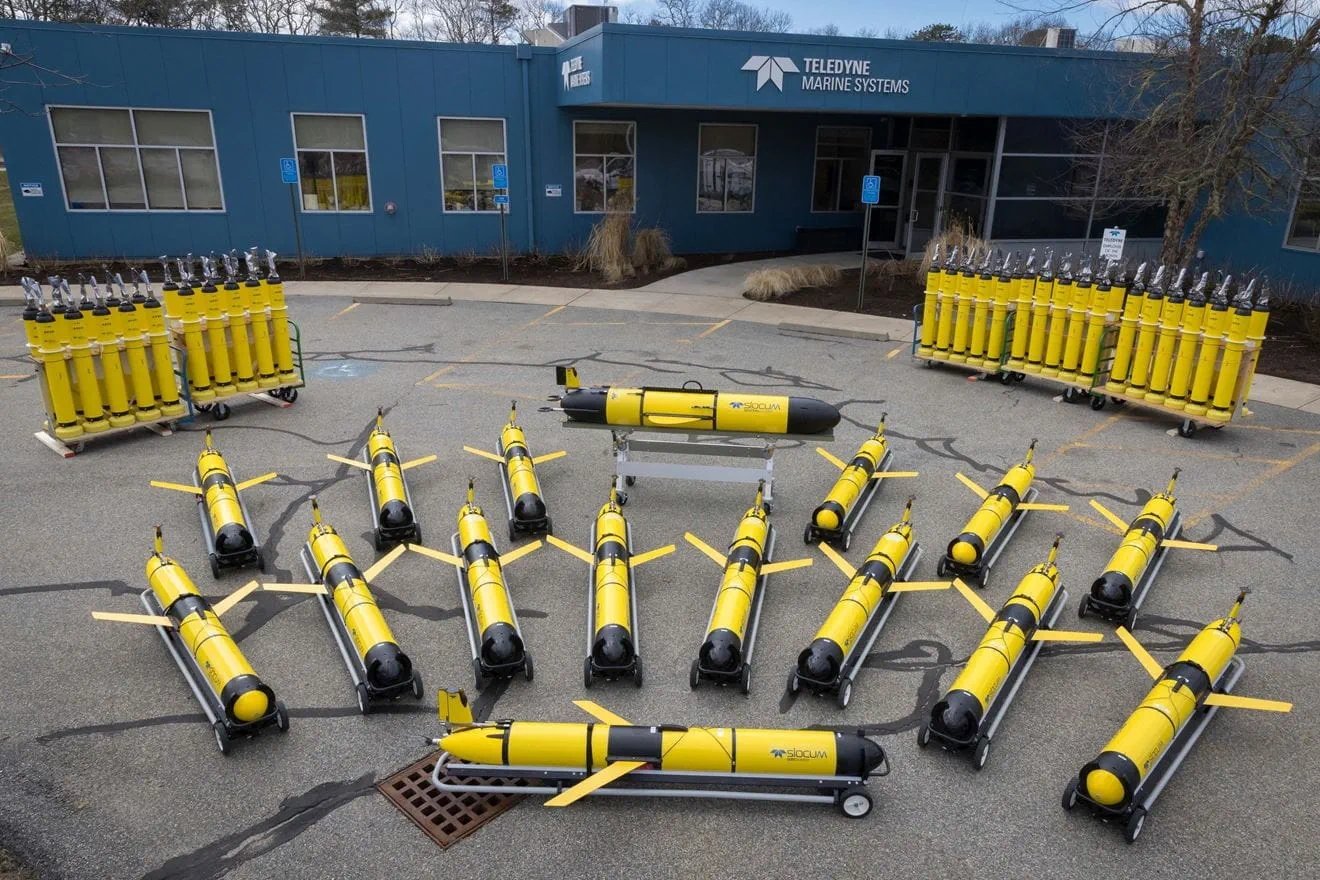

The UK Royal Navy (RN) has contracted Teledyne Marine to supply underwater gliders and other sensing platforms to enhance oceanographic and environmental data collection capabilities, the service reported.
The contract has been awarded as part of the RN’s ‘Future Maritime Data Gathering’ programme, with the new capability designed to generate data that will be delivered directly to frontline operators in the navy’s Information Warfare branch meteorological and oceanographic (IW METOC) teams.
According to a Navy statement, Teledyne Marine will supply autonomous ocean observation systems, including Sentinel and Slocum gliders that carry data-gathering sensors; APEX float devices that take subsurface measurements; and related services.
These new capabilities will allow the RN to enhance its advanced uncrewed technology skills, the navy statement said.
“Persistent data from systems such as these enhances our understanding of the underwater battlespace, enabling tactical exploitation of the environment and delivering the operational and information advantage commanders need,” Commander Mark Butcher, Hydrographic and IW METOC Capability Sponsor within the RN’s Navy Develop branch, said in the statement.
Under the ‘Future Maritime Data Gathering’ programme, Teledyne’s systems will provide long-endurance data collection in complex and remote maritime environments, delivering reliable and actionable environmental intelligence, the RN statement added.
The Navy is moving towards a ‘hybrid’ force structure, integrating crewed and uncrewed systems to deliver enhanced operational mass and output across the maritime domains, including in the underwater battlespace.
In the underwater domain, the RN – and other navies – have long been engaging in crewed and uncrewed ‘teaming’ for mine countermeasures. Now, as the underwater threat grows in anti-submarine warfare (ASW) and critical undersea infrastructure (CUI) protection, the RN aims to improve its uncrewed system capability and capacity for what is now collectively called ‘underwater warfare’.
A central feature of this crewed/uncrewed ‘underwater warfare’ plan is ‘Atlantic Bastion’ – the underwater component of what is known as the ‘Atlantic series’ (the other two elements being ‘Atlantic Shield’ for missile defence at sea, and ‘Atlantic Strike’ for power projection from the sea).
‘Atlantic Bastion’ was formally launched in late 2025. It consists of two components: ‘Atlantic Net’, which – as a focused first phase – involves deploying large numbers of uncrewed underwater vehicles (UUVs) to establish sensing presence around key North Atlantic waters like the Greenland-Iceland-UK (GIUK) Gap; and ‘Atlantic Bastion’, which – as a broader second phase – will see UUV sensing capabilities deployed more widely across the North Atlantic and integrated with larger UUVs, other uncrewed systems, and crewed platforms including Astute-class submarines, Type 26 frigates, and P-8A Poseidon maritime patrol aircraft.
This latest RN contract with Teledyne highlights the increasing importance of uncrewed systems in RN operations and new concepts like ‘Atlantic Bastion’.
The Navy statement emphasised the new capability’s role in fulfilling ‘Atlantic Bastion’ requirements. “This investment in autonomous ocean sensing enhances the RN’s ability to understand and operate in an increasingly contested North Atlantic, supporting ‘Atlantic Bastion’,” Cdr Butcher said.
by Dr. Lee Willett
