

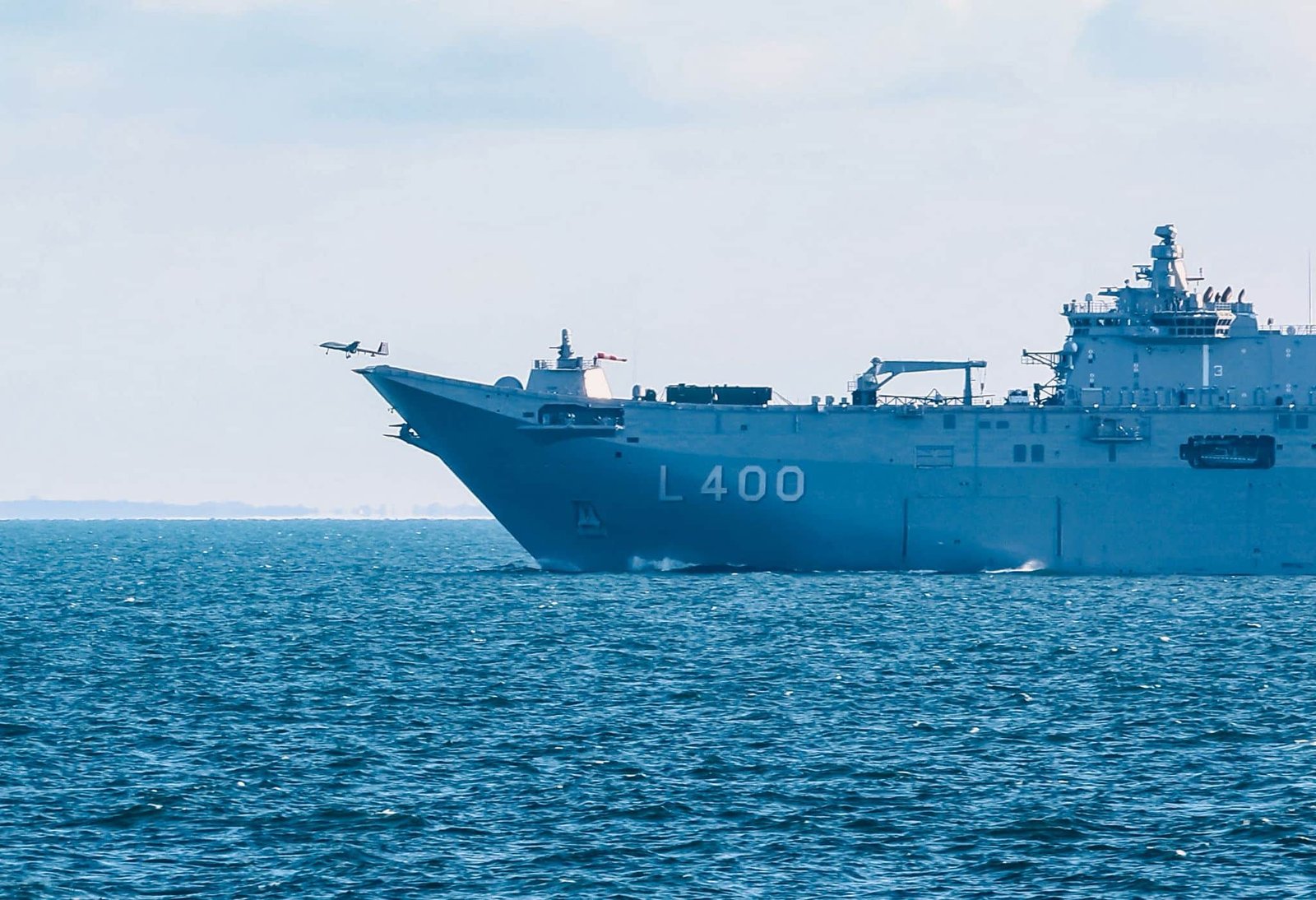
The Turkish Navy deployment to the Baltic Sea marks a significant milestone in both Türkiye’s NATO contributions and the operational employment of Bayraktar TB3 carrier-based combat drones.
The Turkish Navy has deployed one of its most capable task groups to the Baltic Sea for NATO’s Steadfast Dart 2026 exercise, conducting the first operational use of armed drones from a flat-deck ship in Alliance history. The deployment represents Türkiye’s largest naval presence in the Baltic region and demonstrates the fleet’s ability to project power across approximately 8,000 kilometers from its homeland.
Steadfast Dart 2026, running from January 2 to March 18, is NATO’s premier joint deployment exercise for 2026. Hosted by Germany under NATO’s Joint Force Command Brunssum, the exercise involves approximately 10,000 personnel from 11 member states. It is designed to validate the newly established Allied Reaction Force’s (ARF) rapid reinforcement capabilities across land, sea, air, space, and cyber domains. Notably, no U.S. forces participated in this iteration, a development some observers interpret as testing NATO’s operational capacity independent of American conventional support amid shifting transatlantic security dynamics.
The Anadolu Task Group
The Turkish contribution centers on the Anadolu Task Group, comprising four surface combatants representing the breadth of the country’s naval modernization efforts.
TCG Anadolu, the 27,000-ton, 232-meter amphibious assault ship, serves as the formation’s flagship and command-and-control hub. The vessel features a full-length flight deck with a ski-jump ramp, a well deck for landing craft, vehicle storage for armored units, and extensive command facilities supported by the GENESIS-ADVENT combat management system. With is combat drone operation capabilities, it is called the first drone-carrier vessel worldwide.

TCG İstanbul (F-515), commissioned in January 2024, is the lead ship of the I-class frigates—the first indigenous frigate designed and built entirely by Turkish industry under the MILGEM program. The 3,100-ton warship achieved an 80 percent indigenousness rate across its systems, including the ADVENT combat management system, CENK-S AESA radar, Atmaca anti-ship missiles, and the MiDLAS vertical launching system. Over 220 Turkish companies contributed to its construction.
TCG Oruçreis (F-245) completed the world’s most comprehensive MEKO-class frigate mid-life upgrade in April 2025. The modernization replaced 21 systems aboard the Barbaros-class frigate, including installation of a new stealth mast structure, as well as ASELSAN’s FERSAH sonar, AKREP fire control radars, and the GÖKDENIZ close-in weapon system. The upgrade effectively transformed the 1990s-era platform into a contemporary surface combatant with capabilities approaching those of new-build frigates.
TCG Derya, the Turkish Navy’s first fleet oiler with gas turbine propulsion, provides logistics support enabling sustained operations far from home ports. Her high-speed capability allows her to keep pace with the combatants rather than constraining task group mobility.
The embarked force includes an amphibious marine infantry battalion, “ZAHA” amphibious armored assault vehicles, naval special warfare elements (SAT and SAS teams), helicopters, and three “Bayraktar TB3” unmanned combat aerial vehicles.
Combat Drone Operations: A New Chapter for NATO Naval Aviation

The deployment’s most significant aspect is the operational employment of armed drones from TCG Anadolu during a NATO exercise. On February 14, a Bayraktar TB3 launched from the ship’s ski-jump deck, located and engaged a designated surface target with Roketsan MAM-L precision-guided munitions, and recovered aboard—completing the first full ship-to-target combat cycle for a carrier-based drone in NATO history.
The TB3 is purpose-built for operations from short-deck ships. Its folding wings, reinforced landing gear, and low stall speed enable launch and recovery without catapults or arresting wires. Powered by a domestically developed TEI-PD200 turbodiesel engine, the aircraft offers over 24 hours of endurance and can carry up to 280 kilograms of ordnance across six hardpoints. According to Baykar, TB3 drones carried out 232 sorties from TCG Anadolu throughout the exercise, and all takeoffs and landings were conducted autonomously. Baykar also showed its virtual corridor technology in the video below, which allows the drone to land on the deck of the carrier in all weather conditions. The drones conducted operations in -6 celcius degrees temperature weather conditions, which is out of the limitations of numerous air assets.
The TB3 combat drones also carried out live firings with Roketsan-made MAM-L smart munitions and hit the target with pinpoint accuracy. These firings were recorded as a first in NATO history, as a shipborne drone strikes a target within an exercise scenario. Baykar Technologies a
Dr. Lee Willett, naval expert and regular Naval News contributor, noted the broader implications for the Alliance:
“The key capability uncrewed systems bring for NATO at the moment is mass—especially for sensing. Navies across NATO are starting to see all surface ships of any type, and especially new classes, as drone carriers. For NATO, any platform that can bring uncrewed systems to the fight quickly adds operational advantage.”
Three TB3s are embarked on TCG Anadolu for Steadfast Dart, conducting intelligence, surveillance, and reconnaissance missions alongside strike operations. The employment of armed drones in an amphibious landing context—using UCAVs to soften coastal defenses before troop landings—represents a doctrinal first for the Alliance.

Turkish Naval Forces Commander Admiral Ercüment Tatlıoğlu characterized the development as establishing “a new doctrine for amphibious operations within the Alliance.”
“Türkiye is sharing its experience with unmanned systems, including lessons from employing drones for mine detection in the Black Sea, with NATO partners.”
Admiral Ercüment TATLIOGLU, Chief of the Turkish Navy
Power Projection and Strategic Mobility

The deployment demonstrates capabilities that extend beyond the specific systems employed. Transporting a mechanized battalion with its equipment approximately 8,000 kilometers from the Eastern Mediterranean to the Baltic Sea validates Türkiye’s status as a blue water navy capable of sustained expeditionary operations.
This capability gains additional significance given Türkiye’s assumption of NATO’s Commander Amphibious Task Force (CATF) and Commander Landing Force (CLF) responsibilities for the period from July 2025 to June 2026, the first time Ankara has held these positions. TCG Anadolu serves as the command vessel for NATO sea operations during the exercise.
The deployment’s significance extends beyond Turkish national interests. According to Dr. Willett, “The deployment of a Turkish Naval Forces Command task group with a large platform at its core underlines the importance of a broader range of NATO navies demonstrating the capacity to conduct effective command and control of NATO forces in a large-scale alliance exercise in a key part of the Euro-Atlantic theatre.“
He emphasized that with NATO facing threats across its area of responsibility, the Alliance “needs a spread of capacity and capability to conduct task force operations, so it can deploy such groups and effective C2 when and where needed, including at the same time in different places if required.“
Dr. Willett also pointed to the new platforms in the task group as “a visible demonstration to adversaries of the new capability NATO is adding,” while noting that the Turkish Navy’s extensive experience observing events in the Black Sea since Russia’s 2022 invasion of Ukraine makes it “ideally placed to bring to NATO operations an understanding of which lessons from the Black Sea are relevant to risks and responses in the Baltic, and which are not.“
Implications for Allied Amphibious Doctrine
The Turkish Navy’s demonstration of carrier-based drone operations opens questions for other NATO members with amphibious assault ships and aircraft carriers. TCG Anadolu’s transformation from an F-35B-capable platform to a dedicated drone carrier represents an adaptation to strategic circumstances, but also presents a concept potentially applicable to other navies.
Several European nations operate LHD-class vessels theoretically capable of embarking similar systems. The 2025 joint venture between Leonardo and Baykar, LBA Systems, aims to certify the TB3 on Italian flight-deck ships by 2026 and integrate European payloads, potentially offering an affordable carrier-capable drone option for EU navies.
This potential for cross-border defense cooperation carries weight for the Alliance. “A key NATO acquisition focus seems right now to be delivering common, collective capability quickly,” Dr. Willett observed.
“The common, collective capability is a long-standing alliance requirement, but what is new is the need to deliver more quickly. So, a NATO country, its navy, and industry that is building platforms for other NATO members is going to add value for the alliance collectively, in terms of offering a new source of supply.”
Dr. Lee Willett, Naval Analyst & Expert
He added that if such partnerships include developing in-country build capacity in both Türkiye and customer nations, “then if more of the platforms need to be built going forward, there is more collective capacity to do so quickly. Such capacity will be a core capability in the event of conflict.”
Author’s comments
Türkiye contributed approximately 2,000 personnel to Steadfast Dart 2026—roughly one-fifth of the total exercise strength. German Foreign Minister Johann Wadephul, commenting on the exercise, highlighted NATO’s strengthening collective defense capacity and noted Türkiye’s dual contributions to both Alliance military readiness and ongoing diplomatic efforts in Ukraine and Gaza.
The exercise occurred against a backdrop of evolving European security discussions. At the Munich Security Conference, U.S. Secretary of State Marco Rubio spoke of a “new world order,” while French President Emmanuel Macron called for Europe to redesign its security architecture. Steadfast Dart’s execution without U.S. conventional participation tested NATO’s ability to conduct major operations drawing primarily on European and Turkish forces—a scenario gaining relevance as Alliance members reassess burden-sharing arrangements.
For the Turkish Navy, the Baltic deployment extends a pattern of expanding operational reach. Turkish task forces currently maintain presence in the Adriatic Sea, the Indian Ocean, and periodic deployments to the Persian Gulf and off Lebanon. The ability to simultaneously sustain these commitments while deploying a major task group to the Baltic demonstrates force generation capacity that few NATO navies outside the United States can match.
