

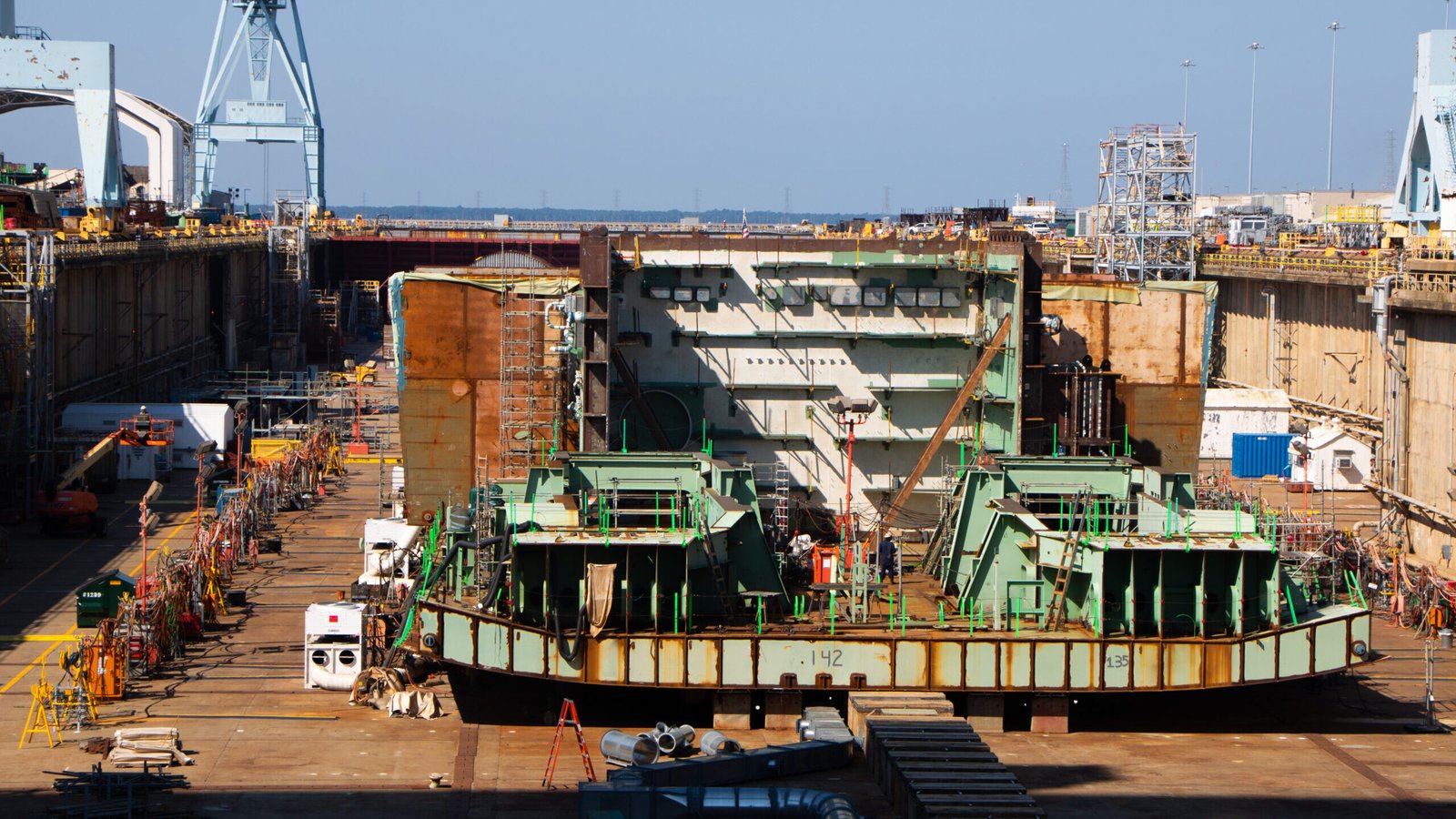
WASHINGTON — The Trump administration’s plans for a “Maritime Golden Age” hinges on bolstering the US shipbuilding industry —which has lagged behind China — and boosting US-built and flagged ships for global commerce, according to its new Maritime Action Plan.
The plan, which comes just after Secretary of Defense Pete Hegseth launched his “Arsenal of Freedom” tour last month calling for a reinvigoration of the US industrial base and shipbuilding, was released Friday and proposes establishing Maritime Prosperity Zones to encourage investment in new waterfront communities separate from the traditional coastal shipyards. Likewise, these zones would receive certain regulatory relief, according to the plan.
The administration and lawmakers have previously suggested regions like the Great Lakes that have a track record of hosting shipbuilders for these communities.
“The Great Lakes are already home to shipbuilders, manufacturers, steel producers, casting and forging, and maritime industry suppliers,” a bipartisan group of lawmakers said in a letter to the White House in December. “Additionally, efforts are underway to connect industry leaders in the Great Lakes and develop a shipbuilding consortium for organized and strategic collaboration. In many ways, the Great Lakes states are well positioned for sustained national investment that would build on the current shipbuilding and manufacturing capacity in the region.”
The Trump administration’s new proposal, which largely focuses on commercial shipbuilding, also seeks to establish incentives to drive a larger US-built and flagged fleet to boost the Merchant Marine fleet, which is utilized to deliver supplies to the military when in conflict.
“The United States can neither afford for its trade to and from foreign markets to be ferried almost entirely on foreign-built, -crewed, and -flagged ships, nor for the MIB [maritime industrial base] to be unable to build and maintain the vessels the United States needs to defend American interests on the high seas,” the White House said in its announcement on Friday.
Meanwhile, the US is significantly behind near-peer competitors when it comes to shipbuilding. For example, China is responsible for more than 50 percent of global shipbuilding, while the US accounts for only 0.01 percent, according to the Center for Strategic and International Studies.
Even so, Trump has turned his attention to US shipbuilding, and told lawmakers last March that he wanted to “resurrect” both commercial and military shipbuilding. In April, he signed an executive order instructing agencies including the Department of Defense, the State Department, the Office of Management and Budget (OMB) and others to craft the Maritime Action Plan.
Sen. Todd Young, R-Ind., endorsed the action plan, claiming that it aligns with the SHIPS for America Act — legislation that seeks to enhance the US shipbuilding industry and support the Merchant Marine fleet.
“This plan is a much-needed, holistic approach to restore American commercial shipping dominance,” Young, who has previously advocated for establishing maritime prosperity zones, said in a statement on Friday about the administration’s new plan.
“There is substantial overlap between the President’s vision and the plan we’ve proposed in the SHIPS for America Act,” Young said. “The announcement today should serve as a wake-up call for Congress to act quickly on this bill in order to provide the legal authorities and resources necessary to make this plan a reality. It’s time to make American ships again.”
Meanwhile, the plan comes as the Trump administration is pushing its Golden Fleet initiative, a plan to drive US Navy maritime superiority. Reviving the industrial base is key to the success of that initiative, Secretary of the Navy John Phelan said at the WEST conference in San Diego on Thursday.
“The logic behind the ‘Golden Fleet’ is about solving the decline in the maritime industrial base by changing the variable of the equation that have been broken for decades,” Phelan said. “Here is the problem: After years of poor management and constrained shipbuilding budgets, particularly under the prior administration, our acquisition system did not provide the speed and flexibility to deliver capability to the fleet.”
As a result, Phelan claimed the administration is “making deliberate choices to implement systemic change.”
Likewise, Hegseth has visited multiple shipyards in support of his “Arsenal of Freedom” tour, including Bath Iron Works in Maine and General Dynamics Electric Boat in Rhode Island.
