

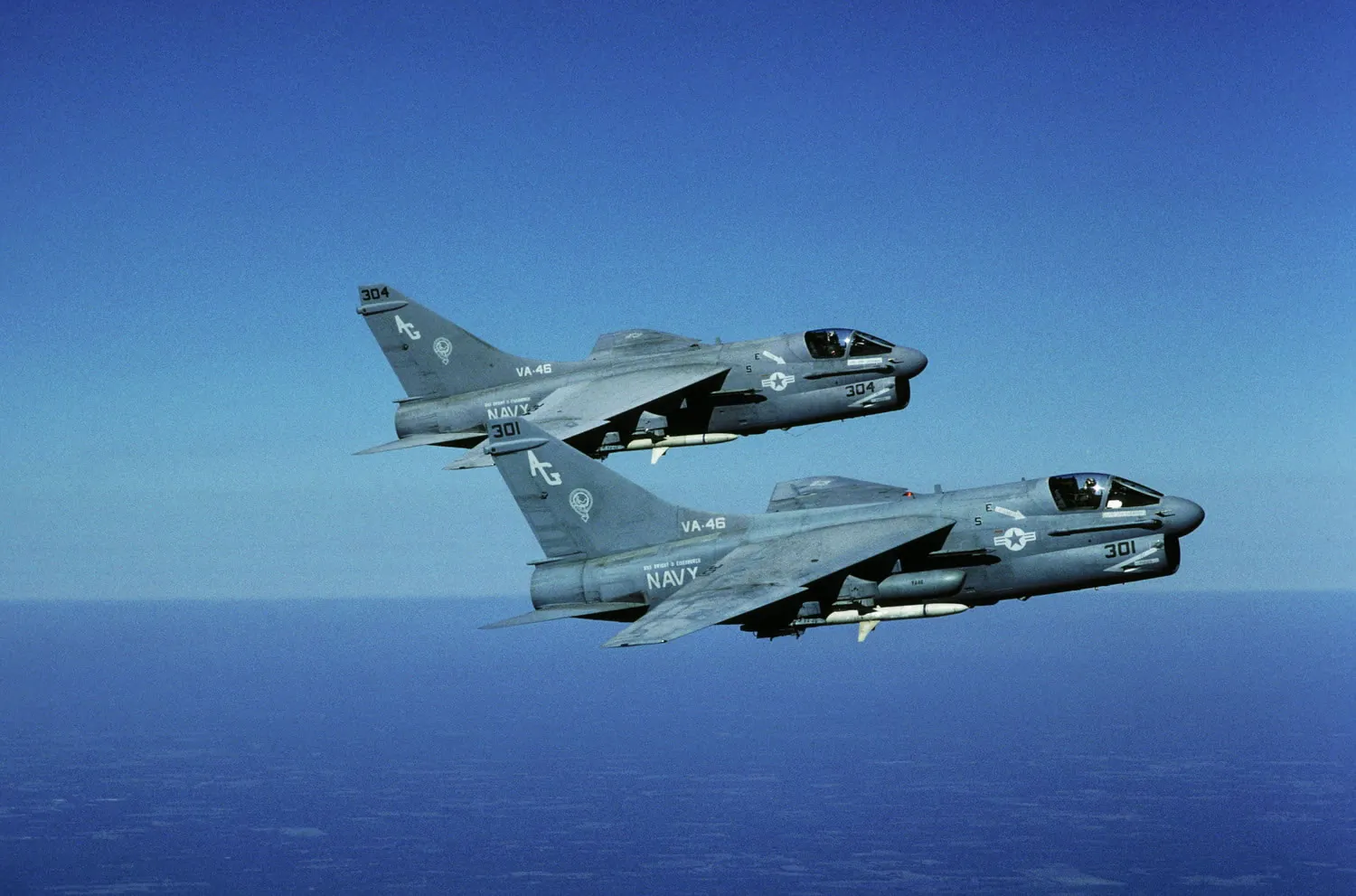
Picture a jet that didn’t care about breaking speed records or looking pretty on recruiting posters, but showed up, every time, with bombs on target and fuel still in the tanks.
That was the A-7 Corsair II. No afterburner bravado. No Mach-2 swagger. Just a blunt-nosed, purpose-built attack aircraft that did the unglamorous work of modern air war astonishingly well.
Developed in the 1960s as a carrier-based light attack aircraft, the A-7 Corsair II became one of the most efficient strike platforms the U.S. Navy, and later the U.S. Air Force, ever fielded.
It was designed to fly low, carry heavy payloads, hit accurately, and bring pilots home. In an era obsessed with speed, the A-7 leaned into something more practical: precision and persistence.
What makes the Corsair II especially interesting isn’t just where it flew, Vietnam, the Cold War Mediterranean, Desert Storm, but how it flew. It introduced advanced avionics years ahead of its time, including one of the first operational head-up displays (HUDs) in a combat aircraft. It could deliver more ordnance than faster jets while burning less fuel, a tradeoff that commanders quietly loved.
Today, the A-7 Corsair II rarely dominates headlines or aviation documentaries. Yet its influence runs deep, threading through modern strike aircraft design philosophies.
This post takes a closer look at that overlooked legacy, starting with how and why this tough, slightly awkward jet came into existence in the first place.
Development & Design History: Built for the Job, Not the Spotlight
The A-7 Corsair II was born out of frustration, and that’s usually a good thing in engineering.
In the early 1960s, the U.S. Navy needed a replacement for the nimble but aging A-4 Skyhawk. The brief sounded simple on paper: longer range, heavier payload, better accuracy, carrier-friendly. No one asked for glamour. They asked for results.

Ling-Temco-Vought answered by doing something quietly clever. Instead of starting from scratch, they borrowed heavily from the F-8 Crusader, same basic fuselage DNA, but widened the wings, shortened the nose, and slowed the jet down. That last part was intentional. Slower approach speeds meant safer carrier landings and more fuel-efficient loiter time over targets. In other words: more bombs, fewer accidents.
The design philosophy was almost stubbornly practical. A single Allison TF41 turbofan powered the aircraft, trading raw thrust for fuel economy.
The cockpit was arranged for workload reduction, not aesthetics. And then there was the avionics leap: the A-7 became the first operational U.S. combat aircraft with an integrated head-up display (HUD) tied directly to its navigation and weapon systems. That was a big deal. Pilots could now attack with precision without burying their heads in instruments.
One test pilot famously described the A-7 as “honest.” It didn’t pretend to be a dogfighter. It didn’t punish sloppy inputs. It just did what you told it, predictably, repeatedly.
By 1965, the Navy was convinced. The first A-7A flew in 1966, and within a few years, the Corsair II was headed straight into combat.
Not flashy. Just ready.
A-7 Corsair II Specifications: Where the Numbers Tell the Real Story
Specs don’t usually get hearts racing, but in the case of the A-7 Corsair II, the numbers explain why this aircraft punched far above its weight. On paper, it looks modest. In practice, it was a workhorse with a spreadsheet full of quiet advantages.
At the core of the Corsair II was the Allison TF41-A-2 turbofan, producing roughly 14,500 pounds of thrust. That doesn’t sound impressive until you factor in efficiency.
The turbofan burned significantly less fuel than the turbojets of its era, giving the A-7 exceptional range for a carrier-based strike aircraft. It could fly farther, stay longer, and still bring back unused fuel, something pilots deeply appreciated during long combat sorties.
Here’s a snapshot of the A-7E (the most advanced U.S. Navy variant):
| Specification | Data |
| Crew | 1 |
| Length | 46 ft 1 in (14.05 m) |
| Wingspan | 38 ft 9 in (11.8 m) |
| Max Takeoff Weight | ~42,000 lb (19,050 kg) |
| Max Speed | ~690 mph (Mach 0.9) |
| Combat Radius | ~600 miles |
| External Payload | Up to 15,000 lb |
That payload figure is the eyebrow-raiser. The A-7 Corsair II could haul more ordnance than many larger, faster jets, everything from iron bombs and cluster munitions to AGM-45 Shrike and AGM-88 HARM missiles in later years.

Accuracy was the real flex. The navigation and attack system, tied into the HUD, allowed for bombing precision that reduced the number of passes required over a target. Fewer passes meant higher survival rates. It wasn’t loud about it, but the A-7 was brutally efficient, and the math always worked in its favor.
Variants & Model Differences: One Airframe, Many Personalities
The A-7 Corsair II may look the same at a glance, but under the skin, its variants tell a story of constant adaptation. Each version was a response to a specific problem, combat lessons learned the hard way, service rivalries, or evolving technology that refused to sit still.
It started with the A-7A, the original Navy model. Reliable, but underpowered. Pilots liked the avionics and payload capacity, yet the early engine struggled during hot, heavy carrier launches. That complaint didn’t linger long.
The A-7B followed with a more capable TF41 engine, improving thrust and overall confidence during takeoff, especially at sea.
Then came the Air Force’s turn. The A-7D wasn’t just a Navy jet in different paint. It received a different gun (the M61 Vulcan instead of dual 20 mm cannons), upgraded avionics, and compatibility with USAF weapons.
Interestingly, Air Force pilots, initially skeptical of a “slow Navy bomber”, ended up praising its accuracy and reliability. The jet won them over by simply delivering.
The most refined naval version, the A-7E, pushed things further. Better radar, improved navigation systems, and broader smart-weapon compatibility made it a precision strike platform before that phrase became fashionable. Late in its life, the Corsair II was dropping laser-guided munitions with surprising finesse.

A quieter footnote, the A-7K, served as a two-seat trainer for the Air National Guard. Not glamorous, but essential for keeping pilots sharp.
Same silhouette. Different strengths. The A-7 evolved without losing its identity, and that consistency mattered more than reinvention ever could.
Operational History: Where the A-7 Corsair II Earned Its Reputation
The A-7 Corsair II didn’t build its legacy in airshows or headlines. It earned it the hard way, low, loud, and often alone over hostile territory. Its first real test came in the Vietnam War, and the timing was brutal. High losses, dense air defenses, and missions that demanded accuracy under pressure. The Corsair II fit that environment better than almost anyone expected.
Navy A-7s flew from carriers in the Gulf of Tonkin, hammering bridges, supply routes, and fortified positions. What stood out wasn’t speed, it was mission success rates.
The aircraft’s advanced navigation and attack system allowed pilots to strike targets in poor weather and low visibility, conditions that grounded other jets. Fewer attack runs meant less exposure to anti-aircraft fire. Survival math, plain and simple.

The U.S. Air Force put the A-7D to work in a different way. Operating from land bases, especially with the Air National Guard, the Corsair II became a precision strike asset during the Cold War.
By the late 1980s, Guard units flying A-7s were regularly outperforming newer aircraft in bombing accuracy during NATO exercises. Awkward moment, for the budget planners.
Then came Operation Desert Storm.
By 1991, the A-7 was no longer the new kid, but it still delivered. Corsair IIs flew suppression of enemy air defenses (SEAD) missions, launching AGM-88 HARM missiles against Iraqi radar sites. It was one of its final combat acts, and a fitting one. Quietly opening the door for faster jets to follow.
From Vietnam to the Persian Gulf, the A-7 Corsair II proved that effectiveness ages better than hype.
Export & International Operators: A Long Second Life Beyond the U.S.
When the A-7 Corsair II began phasing out of U.S. service, it didn’t fade away, it migrated. For several allied nations, the aircraft arrived not as a hand-me-down, but as a serious upgrade.
What made it attractive overseas was the same thing that made it valuable at home: range, payload, and systems that punched above their era.
Greece became the most dedicated foreign operator. The Hellenic Air Force flew A-7H and later A-7E models for decades, using them as primary strike aircraft across the Aegean.
Greek pilots valued the Corsair II’s ability to carry heavy ordnance over long distances while navigating complex maritime terrain. In exercises, the jet earned a reputation for showing up “uninvited” on target, low, precise, and annoyingly hard to intercept.

Portugal operated the A-7P, a locally modified variant tailored for NATO interoperability. These aircraft served well into the 1990s, giving Portugal a credible strike capability without the cost or maintenance burden of newer supersonic jets. For a smaller air force, the math worked beautifully.
Thailand flew ex-U.S. Navy A-7Es, using them primarily for coastal defense and ground attack. Their reliability in hot, humid conditions mattered more than raw performance numbers, and the Corsair II delivered.
What’s striking is how long these operators kept the aircraft flying. Some A-7s remained operational into the early 2010s, nearly 50 years after the type’s first flight. That kind of lifespan isn’t accidental. It’s the result of conservative engineering, adaptable avionics, and an airframe that tolerated upgrades without complaint.
The A-7 Corsair II didn’t just serve globally. It aged globally, and that’s a rarer achievement.
Legacy & Influence: The Jet That Changed How “Attack” Was Defined
The A-7 Corsair II didn’t leave behind a dramatic farewell. No final victory lap. No iconic retirement ceremony. Its legacy is subtler and arguably more important. It changed expectations.
Before the A-7, attack aircraft were often judged by speed or raw performance. After the Corsair II, the conversation shifted toward accuracy, efficiency, and systems integration. The idea that avionics could matter as much as airframe performance?
The A-7 proved it in combat. Its HUD-centric attack philosophy laid conceptual groundwork later seen in aircraft like the F/A-18, A-10, and even modern multirole fighters where sensors do as much work as engines.

One underappreciated influence: pilot workload management. The A-7’s cockpit was designed to reduce mental clutter during low-level attack runs. That thinking, designing around human limits rather than raw machine capability, became standard practice later, but it was unusual in the 1960s. The Corsair II treated pilots less like components and more like decision-makers. That mindset stuck.
There’s also a cultural legacy. Among pilots, the A-7 earned a reputation as a jet that “had your back.” It wasn’t glamorous, but it was predictable. Forgiving. Honest. In aviation, those qualities age exceptionally well.
Today, surviving A-7 Corsair IIs sit in museums, often overlooked beside sleeker fighters. But look closer. Many modern strike doctrines, precision over spectacle, persistence over speed, echo ideas the A-7 quietly normalized decades ago.
It didn’t chase the future.
It defined a practical version of it.
And that, oddly enough, is why the A-7 Corsair II still matters.
