

Dynamic changes in GPR index
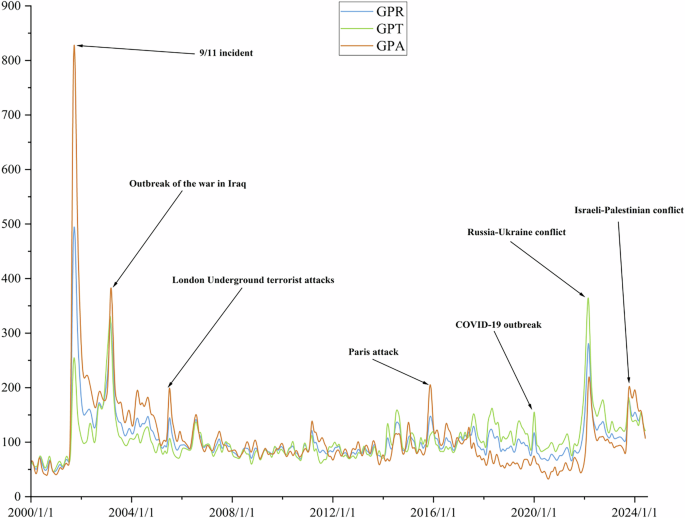
Figure 1 displays the dynamic changes in the monthly geopolitical risk (GPR) index from January 2000 to July 2024. The figure reveals several significant peaks closely associated with major international events during this period. Between 2000 and 2005, the GPR index experienced dramatic fluctuations. The peak around September 2001 corresponds to the terrorist attacks by Al-Qaeda against the United States. The peak around March 2003 relates to the Iraq War. The high point in late 2015 primarily stems from a series of terrorist attacks in France. After 2016, the notable intensification of global geopolitical risk led to further increased volatility, a trend that persisted until 2020 with several smaller peak fluctuations occurring during this time. Starting in 2020, the GPR index reflects another significant surge in geopolitical risk volatility, driven by critical factors including the global COVID-19 pandemic, the Russia-Ukraine War, and the Israeli-Palestinian conflict.
Monthly GPR index for the sample period from January 2000 to July 2024.
Cross-quantilogram analysis
Based on the half-life property of commodity price shocks (Etienne et al., 2014) and the decay pattern of GPR impacts (Andersen et al., 2001), this paper constructs three-order lag windows at k = 1, 5, and 10 days: capturing immediate market sentiment-driven responses through k = 1 (next-day panic trading), diagnosing mid-term logistics and cost-transmission pressures through k = 5 (weekly shipping delay effects), and observing supply-demand rebalancing adjustments caused by trade flow shifts through k = 10 (fortnightly import substitution and inventory release). This framework effectively distinguishes the differential pathways through which lagged effects influence food crops versus economic crops.
Figures 2–9 employ quantile cross-correlation heatmaps to depict the nonlinear dynamic response patterns of geopolitical risk (GPR) shocks on four major food crop futures (corn, wheat, soybeans, rough rice) and four key economic crop futures (sugar, cotton, cocoa, coffee) at lags of 1 day (Lag = 1), 5 days (Lag = 5), and 10 days (Lag = 10). The analysis reveals significant heterogeneity in GPR impact across both the futures price return quantile (τ) dimension and the temporal dimension. These differences stem fundamentally from variations in the inherent financial attributes and supply elasticities of distinct crop types.

Heatmap of the Cross-Correlation Between International Geopolitical Risk and Corn.

Heatmap of the Cross-Correlation Between International Geopolitical Risk and Wheat.

Heatmap of the Cross-Correlation Between International Geopolitical Risk and Soybean.

Heatmap of the Cross-Correlation Between International Geopolitical Risk and Roughrice.

Heatmap of the Cross-Correlation Between International Geopolitical Risk and Cocoa.

Heatmap of the Cross-Correlation Between International Geopolitical Risk and Coffee.

Heatmap of the Cross-Correlation Between International Geopolitical Risk and Sugar.

Heatmap of the Cross-Correlation Between International Geopolitical Risk and Cotton.
Corn exhibits the most rapid response to GPR shocks. During Lag = 1, a significant localized positive correlation (displayed as discrete orange speckles) emerges at the intersection of the GPR upper tail region (τ ≥ 0.60) and the medium-to-low quantile range of corn futures price returns (τ = 0.00–0.20). This indicates that sudden geopolitical crises (e.g., escalation of the Russia–Ukraine conflict) immediately trigger short-term safe-haven capital flows toward low-priced corn futures contracts. By Lag = 5, this positive correlation zone expands significantly, demonstrating reinforced upward pressure on corn futures price returns resulting from heightened risks. However, at Lag = 10, the heatmap transitions predominantly to deep blue, meaning the correlation between GPR shocks and corn futures has largely dissipated, reflecting the market’s attainment of a new equilibrium through self-adjustment.Unlike corn, wheat demonstrates relative sluggishness during initial GPR shocks (Lag = 1), exhibiting interactive signals only within limited quantile ranges. Its price sensitivity peaks on day 5 post-crisis (Lag = 5), when nearly all quantile ranges of wheat futures price returns show significant responses to GPR shocks, with particularly pronounced intensity at both price extremes (low τ and high τ). Nevertheless, by Lag = 10, this influence likewise largely subsides.
Soybeans also show predominantly positive responses at Lag = 1. When GPR is at medium-high quantiles (τ ≥ 0.6) while soybean futures price returns are at medium-low quantiles (τ = 0.05–0.5), a significant positive correlation manifests, reaffirming short-term safe-haven capital’s tendency to flow into low-priced futures. Notably, a significant positive correlation is also observed when soybean futures themselves are at high return quantiles (τ ≥ 0.5) while GPR remains at low levels (τ ≤ 0.4), highlighting soybeans’ stronger financial speculation attributes. This positive correlation substantially contracts during Lag=5 and nearly vanishes by Lag = 10.
As another staple crop, rough rice exhibits similarities to soybeans at Lag = 1: A significant positive correlation emerges in the combined region of medium-high GPR quantiles (τ ≥ 0.4) and medium-low rough rice futures price returns (τ = 0.05–0.65). Moving to Lag = 5, the positive correlation area contracts and becomes more concentrated within high GPR quantiles (τ ≥ 0.85). This may reflect temporary export restrictions by major-producing countries amid heightened geopolitical risks, subsequently driving up international prices. By Lag = 10, responses largely subside, indicating completion of the market rebalancing process. As a regionally dominant staple, the core of rough rice’s long-term pricing reverts to its local supply-demand fundamentals.
The futures price return changes of economic crops exhibit two distinct patterns in response to GPR shocks. Cocoa and coffee exhibit similar performance: the heatmaps appear predominantly blue-white across most regions, overall indicating that GPR shocks exert negligible impacts on their prices, leaving only exceptionally minimal traces of influence on isolated extreme price ranges at Lag = 1.In stark contrast stand sugar and cotton. Sugar displays weak reactivity to GPR during initial shocks (Lag = 1), likely due to its relatively weaker financial attributes failing to attract immediate safe-haven capital. However, by Lag = 5, sugar futures price returns demonstrate exceptionally strong positive responses to GPR shocks across all quantile ranges. We infer that the surge in geopolitical risks elevates energy prices, thereby significantly increasing energy-intensive sugar production costs (e.g., fuel, fertilizers) (Jin et al., 2023). This intense pressure effect persists until Lag = 10 before gradually stabilizing, ultimately converging in two specific zones: sugar futures returns still show significant positive correlations with GPR when GPR is at high quantiles (τ ≥ 0.75) or low quantiles (τ = 0.05), implying persistent transmission of long-term energy cost pressures.Cotton’s performance follows: no significant response at Lag = 1; during Lag = 5, medium-to-low quantile ranges of cotton futures returns (τ = 0.05–0.65) exhibit powerful responsiveness to GPR; by Lag = 10, this responsiveness weakens considerably, leaving only a faint positive correlation at the intersection of medium-high GPR quantiles and medium-low cotton return quantiles.
TVP-VAR-BK results
Average dynamic connectedness
Based on the existing literature (Chatziantoniou et al., 2023) and empirical guidance, this study sets the lag order of the VAR model as 1 and the forecast step size as 100. To deepen the understanding of the relationship between geopolitical risk and international agricultural commodity markets, we analyze their interaction at two time frequencies, short term (no more than 5 days) and long term (more than 5 days). In Tables 2, 3 and 4, the “To” column and “From” row identify the direction and source of the impact, respectively, while the bottom row labeled “NET” indicates the net spillover level, whose value is derived by subtracting “From” from.
First, we present in Tables 2, 3 and 4 the average results for the population and the sub-short and long run, respectively, which cover the entire sample period and do not take into account the specific dynamic effects of events at specific points in time. Table 2 reveals significant spillover effects between geopolitical risks and international agricultural markets. In the whole sample period, 25.05% of the variation in the connectedness of the two systems is caused by the spillover effect within the system. Among them, corn, wheat, and soybeans have high “FROM” values, indicating that these commodities are more vulnerable to external factors, and they also have high “TO” values, indicating that they may act as an important source of risk or information dissemination in the system. Based on the net spillover perspective, the “NET” values of corn and wheat are 6.73% and 3.54%, respectively, which marks them as net exporters to the system; Conversely, the “NET” values of cotton and brown rice as net recipients are −3.16% and −2.96%, respectively.
Tables 3 and 4 further detail the spillover effects between geopolitical risks and international agricultural markets in the short and long run. The short-term total connectedness index reached 23.50%, significantly higher than the long-term 1.55%. Both in the short and long run, corn, wheat, and soybeans exhibit high values of “FROM” and “TO”, again emphasizing their central role in the overall system. Moreover, although corn, wheat and soybeans maintain the role of net exporters, while geopolitical risk, brown rice, cotton and sugar are net importers, the “NET” values of cotton and sugar decrease significantly in the long run. It is worth noting that this phenomenon is particularly prominent in the longer time frame where all values are substantially reduced.
The Total Connectedness
The total connectedness index (TCI) is an important indicator to measure the overall interactivity and interaction degree among variables in a system. Figure 10 presents the overall evolution of the TCI between 2000 and 2024, as well as its dynamics in the short-run (green shaded area) and long-run (orange shaded area) frequencies.

Note: The blue area illustrates the dynamic total connectedness while the short-term and long-term dynamic total connectedness are illustrated in green and orange, respectively.
From the general development trend of TCI: during the period from 2000 to the beginning of 2003, the level of TCI was relatively low, indicating that the correlation between markets was not high at that time. However, with the outbreak of the Iraq war in early 2003, the global geopolitical environment and the stability of agricultural markets were challenged, leading to sharp fluctuations in the prices of major agricultural products, which in turn led to the rise of TCI. Between 2008 and 2009, TCI rose sharply and reached historic highs, mainly as a result of the global economic crisis. The TCI again shows a small peak in 2011 and then experiences a significant decline until 2014. However, from 2014 to 2019, TCI showed a trend of slowly rising amid fluctuations. From 2020 to 2021, TCI increased sharply again and hit a new peak, reflecting the strong risk spillovers and interactions within the system due to the combination of COVID-19, lockdowns and economic stimulus policies. After entering 2022, the TCI gradually fell back from the high level, indicating that the extreme linkage effect was alleviated as the system adapted to the new routine state. At the same time, with the gradual recovery of economy and production, the correlation between different agricultural products and geopolitical risks has returned to a relatively differentiated situation.
From the perspective of frequency analysis, the dynamics of connectedness are mainly driven by short-run rather than long-run factors. Specifically, the long-run total spillover index (TCI) only reaches a significant peak around 2008 and 2022, but even then its contribution to the overall TCI remains relatively small. In contrast, the trends in short-and long-run volatility reveal a high degree of consistency between short-run spillovers and overall spillovers. This shows that the spillover effect between the international agricultural market and international geopolitical risks is mainly affected by short-term shocks. Regarding the integration of international agricultural commodity markets with the international geopolitical risk system, they show a higher degree of integration in the short term; That is, the interaction within the system is closer in the short run. However, in the long run, the degree of integration is low, indicating that the relationship between variables gradually becomes loose over time and the response of the system to external shocks becomes more differentiated.
Net total directed connectedness
In order to deeply explore the dynamic spillover effects between geopolitical risk and agricultural commodity markets and capture the changing roles of these factors in different time and frequency intervals, this study visualized the net spillover trends of each market as well as geopolitical risk. These indicators reflect the difference between the amount of spillovers transmitted by a particular entity to the system as a whole and the amount received from the system.
Figure 11 shows the net spillover effects of each market in terms of time and frequency. The data show that between 2001 and 2003 geopolitical risk (GPR) was a net exporter; Over longer time horizons, however, the GPR exists primarily as a net receiver. In contrast, corn, wheat, and soybeans mostly play the role of net exporters throughout the observation period, with a particularly significant effect for wheat. Brown rice, cotton and sugar are more likely to be net recipients, while cocoa and coffee are more evenly split between the two. It is important to note that significant volatility peaks in net aggregate directional connectedness in agricultural markets tend to occur after major events, such as the period following the 2008 global financial crisis and the period following the onset of the COVID-19 pandemic in 2020. This shows that various agricultural products are highly sensitive to extreme events, showing their vulnerability in this environment.

a GPR, b Corn, c Wheat, d Soybean, e Rough rice, f Cotton, g Sugar, h Cocoa, i Coffee.
