


Article Summary – More than a decade after the USS Ponce first fired the Navy’s Laser Weapons System, directed-energy arms are spreading across the U.S. military.
-The Army is fielding high-energy lasers on Strykers, HEMTT trucks, and now even Infantry Squad Vehicles and JLTVs, while the Navy installs HELIOS on destroyers and the Air Force eyes fighter-mounted systems.
U.S. Army Pvt. 1st Class Ian Wojick, assigned to 552nd Military Police Company, 25th Infantry, aims a DroneBuster, an anti-drone weapon, toward the sky during the Joint Pacific Multinational Readiness Center Exportable (JPMRC-X) exercise at Fort Magsaysay, Philippines, June 1, 2025. This iteration of the JPMRC-X marks the second Combat Training Center (CTC) rotation conducted in the Philippines. As part of the Army’s premier regional CTC, JPMRC-X enables the U.S. Army, joint force, allies, and partners to develop skills in realistic environments and conditions. Through exportable capabilities, JPMRC-X strengthens war-fighting readiness, enhances multilateral relationships, and contributes to regional security and stability in the Indo-Pacific. (U.S. Army photo by Staff Sgt. Keith Thornburgh)
-The appeal is obvious: lasers fire at the speed of light, double as ISR sensors, offer a virtually bottomless magazine, and cost pennies per shot—an answer to cheap drone swarms that would quickly exhaust pricey interceptors. The race now is miniaturizing power for truly mobile laser defenses.
Why Cheap Lasers Could Beat Costly Missiles in the Drone Wars
More than ten years ago, the US Navy armed the USS Ponce with the cutting-edge, promising Laser Weapons System (LAWs), a first-of-its-kind ship-integrated, scalable laser weapon capable of incinerating drones, helicopters, surface ships, and even fixed-wing targets from the deck.
Since this time, the Army, Navy, and Air Force have all pioneered a wide range of laser applications intended to bring Directed Energy laser attack weapons to modern combat.
As low-cost, adjustable weapons able to attack at the speed of light, lasers introduce both new attack possibilities, ISR applications, and new combat Concepts of Operation.
The Army has armed a Stryker with its C-UAS DE Stryker laser weapon and integrated its High Energy Laser onto a Heavy Expanded Mobility Tactical Truck (HEMTT).
The US Navy is now arming its Destroyers with the High Energy Laser and Integrated Optical Dazzler and Surveillance (HELIOS), and the Air Force Research Lab has for many years been testing and experimenting with ground tests for aircraft-mounted laser systems with the intention of arming F-35, F-22s, or even F-47s with laser weapons.

NGAD F-47 Fighter. Image Credit: Creative Commons.
Laser on ISV & JLTV
Now the Army is arming small, on-the-move Infantry Squad Vehicles with mobile lasers to track and destroy drones.
The Army has recently put AV (formerly AeroVironment) on contract to arm ISVs and JLTVs with its Army Multi-Purpose High-Energy Laser.
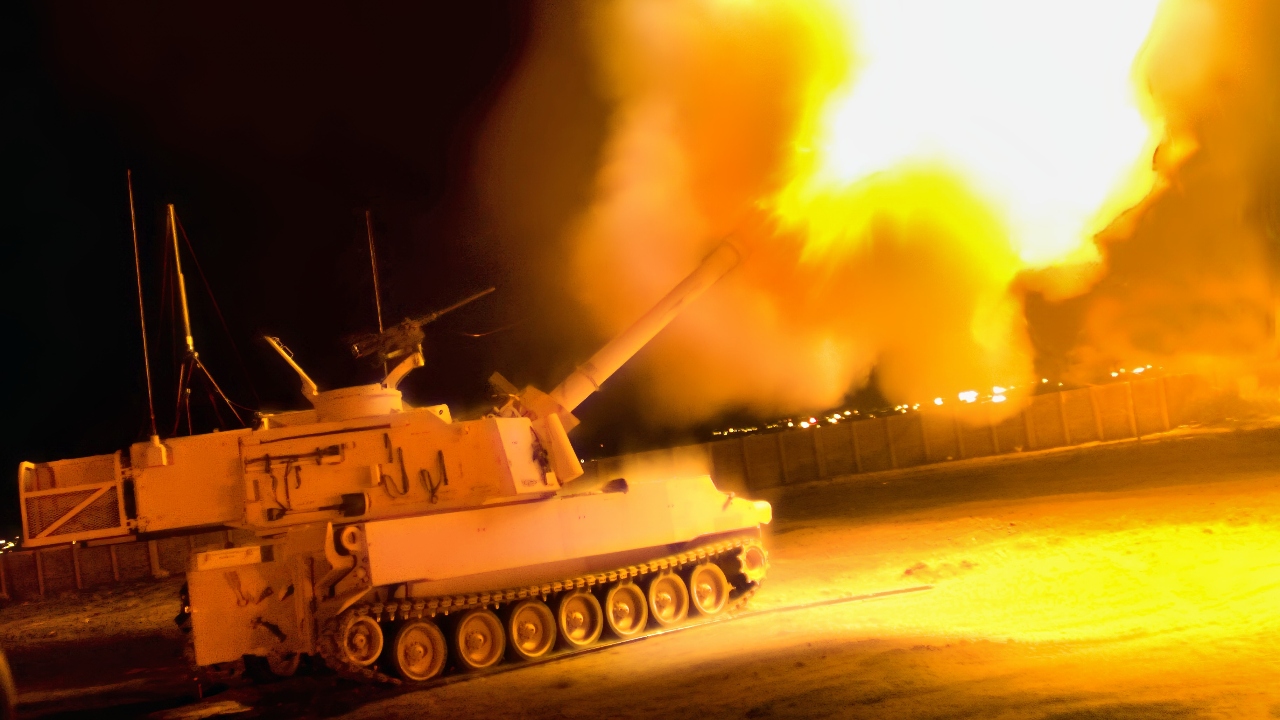
From a gun that shot at trees to an $18 billion boondoggle, these are the 5 worst and most disastrous weapon systems in U.S. Army history. Image Credit: U.S. Army.
The challenge with laser weapons has always been to engineer mobile, expeditionary power sources small enough to integrate onto drones, lightweight vehicles, fighter jets, and other host platforms that are less able to accommodate such large power requirements.
Armed ships and other larger platforms with lasers have naturally proved much easier to integrate, given greater Swap, Size, Weight, and Power capability to support the larger form factors required for laser weapons.
Since then, the military services and their industry partners have been working intensively to miniaturize laser weapons and power support systems sufficient to arm smaller, more mobile, and more expeditionary platforms such as ISVs.
Detecting Swarms
Many are likely to wonder whether vehicle-mounted laser systems, or even soldier-carried lasers someday, will not only be able to destroy point-to-point targets but also counter swarms of small drones.
It could be difficult for a laser system to target and counter hundreds of small drones at once, unless there were a high-volume, precision-guided, pencil-beam laser weapon aligned with the necessary fire-control system to ensure accurate targeting.
Laser Advantages
Lasers have an optical function as well, enabling them to perform ISR and help identify targets.
Lasers also offer the advantage of operating at the speed of light and being scalable, meaning they can be tailored to disable or entirely destroy, depending on the needs of a given combat circumstance.
The other clear advantage of lasers is that they can operate with an immense or seemingly limitless magazine, since they are powered by electrical energy.
There is no need for traditional ammunition, so as long as there is an effective ongoing source of electrical power, a laser weapon can continue to fire. This is of great significance in the realm of countering drone swarms, given that large numbers of drone threats would need to be countered by a high number of interceptors.
US Navy commanders in the Red Sea emphasized the need for a deep and effective magazine in the counter-drone fight, something well-powered laser systems are well-positioned to provide.

The world’s largest aircraft carrier USS Gerald R. Ford (CVN) 78 and the USNS Laramie (T-AO-203) conduct a refueling-at-sea in the Eastern Mediterranean Sea, Oct. 11, 2023. USS Gerald R. Ford is the Navy’s newest and most advanced aircraft carrier, representing a generational leap in the U.S. Navy’s capacity to project power on a global scale. The Gerald R. Ford Carrier Strike Group is currently operating in the Eastern Mediterranean Sea, at direction of the Secretary of Defense. The U.S. maintains forward deployed ready and postured forces to deter aggression and support security and stability around the world.(U.S. Navy photo by Mass Communication Specialist 2nd Class Jackson Adkins)
There is also a clear cost element to this equation, as lasers are extremely inexpensive “per shot,” and many weapons developers address so-called “cost-curve” pressures.
This means it is not cost-effective or feasible to counter inexpensive drones with a high volume of expensive interceptors.
About the Author: Kris Osborn
Kris Osborn is the President of Warrior Maven – Center for Military Modernization. Osborn previously served at the Pentagon as a highly qualified expert in the Office of the Assistant Secretary of the Army—Acquisition, Logistics & Technology. Osborn has also worked as an anchor and on-air military specialist at national TV networks. He has appeared as a guest military expert on Fox News, MSNBC, The Military Channel, and The History Channel.
