

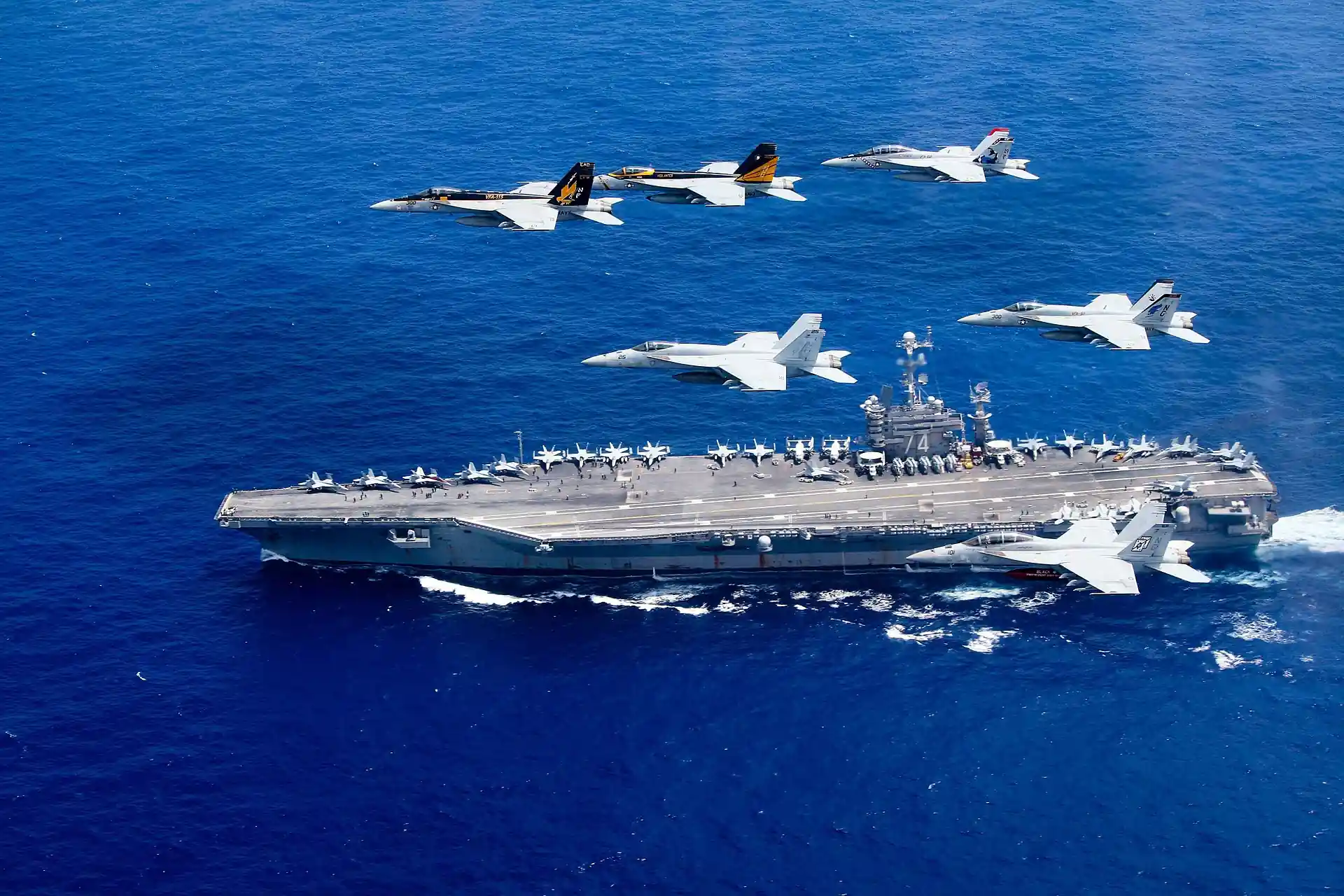
There’s something almost unreal about a city that floats. Not metaphorically, a literal, steel-built, nuclear-powered city slicing through the ocean at over 30 knots. That’s exactly what the USS Jon C. Stennis (CVN-74) is. And once you start digging into it, you realize… this isn’t just a ship. It’s a moving ecosystem, a strategic weapon, and, in many ways, a symbol of modern naval power all rolled into one.
If you’ve ever wondered what gives the United States its ability to project power halfway across the globe without needing permission, or even a nearby base, this aircraft carrier is part of the answer.
Commissioned in 1995, the USS Jon C. Stennis is one of the formidable Nimitz-class aircraft carriers, a class known for size, endurance, and sheer operational muscle.
We’re talking about a vessel that can carry around 90 aircraft, support thousands of personnel, and operate continuously for decades thanks to its nuclear propulsion. No refueling stops. No slowing down.
But here’s where it gets more interesting.
Today, the USS Jon C. Stennis isn’t just cruising the seas, it’s undergoing a massive mid-life transformation. A refueling and complex overhaul (RCOH), the kind that essentially gives the ship a second life. Think of it less like maintenance and more like a full reboot.
In this post, you’ll explore everything, from its origins and missions to the hidden mechanics that keep it running. And along the way, you might start seeing this carrier not just as a machine… but as a living, breathing force on the ocean.
How the USS Jon C. Stennis Was Built And Why That Still Matters
Most people picture a warship fully formed, cutting through waves, jets roaring overhead. But the USS Jon C. Stennis didn’t begin that way. It started as fragments. Steel sections scattered across a shipyard, each one meaningless on its own.

Back in 1991, construction began at Newport News Shipbuilding. Not with a dramatic launch, but with the slow, almost methodical process of assembling massive modules, like industrial-scale LEGO blocks, except each piece weighed hundreds of tons. Workers didn’t “build a ship” in one go; they built pieces of a ship and then fused them together into something coherent.
By 1993, the USS John C. Stennis (CVN-74) touched water for the first time. Launch day always looks cinematic, cheers, flags, that slow slide into the harbor.
But here’s the part people miss: at that stage, the carrier was still incomplete. Systems weren’t fully installed. Electronics needed calibration. The ship could float… but it couldn’t yet function.
That took time. Two more years of fitting out, testing, correcting things that only reveal themselves under pressure. It’s one thing to install a radar system, it’s another to make sure it works flawlessly in the middle of the ocean, under stress, surrounded by interference.
Finally, in December 1995, the USS John C. Stennis aircraft carrier was commissioned. Not just finished, but operational. Staffed. Ready.
And here’s why that origin still matters today: the way it was built, modular, layered, adaptable, makes upgrades possible decades later. The CVN-74 Stennis wasn’t designed as a static machine. It was designed to evolve.
Which is exactly what it’s still doing.
Specifications and Technical Details of USS Jon C. Stennis
If the history of the USS Jon C. Stennis tells you where it’s been, the specs tell you what it’s capable of. And honestly, this is where things get a little wild, because the engineering behind the USS John C. Stennis (CVN-74) feels closer to science fiction than traditional shipbuilding.
Let’s ground that with a clear snapshot:
| Feature | USS John C. Stennis (CVN-74) |
| Ship Class | Nimitz-class aircraft carrier |
| Commissioned | 1995 |
| Length | ~1,092 feet (333 meters) |
| Displacement | 100,000+ tons (full load) |
| Propulsion | 2 nuclear reactors |
| Speed | 30+ knots |
| Range | Essentially unlimited (fuel-wise) |
| Crew | ~5,000–6,000 personnel |
| Aircraft Capacity | ~70–90 aircraft |
| Flight Deck | ~4.5 acres |
Now here’s where it gets interesting.
That “unlimited range” line? It’s not marketing language. The nuclear reactors onboard the USS John C. Stennis aircraft carrier can power the ship for years without refueling.
In practice, deployments are limited by human needs, food, maintenance cycles, crew rotation, not energy. That’s a massive strategic advantage, especially in remote regions where supply lines get complicated.

The flight deck, roughly 4.5 acres, is another detail that sounds abstract until you picture it. That’s enough space to run continuous flight operations: jets launching every few minutes, others landing with split-second timing. Controlled chaos, but never random.
And speed… over 30 knots for something this size feels counterintuitive. Yet the CVN-74 Stennis can reposition faster than many smaller ships, which matters when timing is everything.
Put it all together, and the specs stop feeling like numbers. They start feeling like capability, layered, deliberate, and designed for a very specific purpose: to project power anywhere, without needing permission from geography.
Mission and Role of USS Jon C. Stennis in Modern Naval Power
So what does the USS Jon C. Stennis actually do out there in the open ocean?
It’s tempting to say “it launches fighter jets,” and yes, that’s part of it. But that answer barely scratches the surface. The USS John C. Stennis (CVN-74) is less like a single weapon and more like a floating system of systems, designed to influence events long before conflict even begins.
At its core, the carrier’s mission is power projection. That phrase gets thrown around a lot, but here’s the simple version: it allows a country to bring air power anywhere in the world without relying on foreign bases. No negotiations. No waiting. The ocean becomes the runway.

When the USS John C. Stennis aircraft carrier operates as part of a Carrier Strike Group, things scale up quickly. It’s not alone, it’s surrounded by destroyers, cruisers, submarines, and support ships. Each one plays a role, but the carrier is the centerpiece. The brain and the runway, all in one.
From that position, it can support a range of missions:
- Air superiority (controlling the skies)
- Precision strike operations
- Maritime security and patrol
- Humanitarian assistance when disasters hit coastal regions
And here’s something people often overlook: the psychological effect. When the CVN-74 Stennis arrives in a region, it sends a signal. Not always aggressive, not always hostile, but unmistakable. It says: we’re here, and we can act if needed.
In many cases, that presence alone is enough to stabilize situations. No missiles launched. No headlines. Just quiet deterrence.
It’s a strange kind of power, really. The ability to influence outcomes not by acting, but by being undeniably capable of it.
Air Wing of USS Jon C. Stennis, The Real Power on Deck
If the USS Jon C. Stennis is the stage, the air wing is the performance. The ship itself is impressive, no doubt, but the real punch comes from what it carries and launches into the sky.
Think of the USS John C. Stennis (CVN-74) as a mobile airport, except every aircraft onboard has a mission that can shift in minutes. The mix isn’t random. It’s carefully structured to cover offense, defense, surveillance, and support, all at once.
Here’s a simplified look at a typical air wing composition:
| Aircraft Type | Role |
| F/A-18 Super Hornet | Strike fighter (attack + air combat) |
| EA-18G Growler | Electronic warfare (jamming enemy systems) |
| E-2D Hawkeye | Airborne early warning & command |
| MH-60 Seahawk | Helicopter (search, rescue, anti-submarine) |
| C-2 Greyhound (legacy) / CMV-22 Osprey | Carrier onboard delivery (logistics) |
Now picture this in motion.
On the deck of the USS John C. Stennis aircraft carrier, these aircraft aren’t just parked, they’re constantly cycling. Jets launch every few minutes during peak operations.
Others return low on fuel, catching arresting wires with precision that feels almost mechanical… except it’s human pilots doing it.
The CVN-74 Stennis can carry around 70 to 90 aircraft depending on mission needs. That flexibility is key. Some deployments lean heavier on strike fighters. Others emphasize surveillance or electronic warfare. It’s not a fixed setup, it adapts.

And here’s something people don’t always realize: the air wing isn’t permanently attached to the ship. It rotates. Different squadrons come and go, bringing their own experience, habits, even personalities.
So while the hull of the USS Jon C. Stennis stays the same, the “soul” of its air power shifts over time.
Which keeps it unpredictable. And very, very effective.
You have not enough Humanizer words left. Upgrade your Surfer plan.
Deployments and Operational History of USS Jon C. Stennis
A ship like the USS Jon C. Stennis isn’t defined by where it’s built, it’s defined by where it goes. And over the years, the USS John C. Stennis (CVN-74) has quietly traced a path through some of the most strategically tense regions on the planet.
Its first major deployment in 1998 set the tone early. The carrier moved toward the Persian Gulf, a region that, then as now, sits at the center of global attention.
From that point on, the USS John C. Stennis aircraft carrier became a regular presence in Middle Eastern waters, supporting operations tied to enforcing no-fly zones and maintaining regional stability.
After 2001, things shifted. The tempo increased. The missions became sharper, more urgent.

The CVN-74 Stennis played a role in operations connected to Afghanistan, launching air sorties and supporting long-duration missions where land bases alone weren’t enough. Carriers like this became floating extensions of the battlefield, mobile, flexible, always repositioning.
But it’s not just the Middle East.
The Pacific has been another major theater for the USS Jon C. Stennis. Deployments there often revolve around deterrence, showing presence in areas where geopolitical tensions simmer just below the surface. Exercises with allied nations, large-scale drills, coordinated maneuvers… all part of maintaining balance without tipping into conflict.
And here’s the part that rarely gets emphasized: most deployments don’t make headlines. Months at sea, routine patrols, constant readiness. No dramatic footage. Just persistence.
That’s the rhythm of the USS John C. Stennis aircraft carrier, moving from one hotspot to another, sometimes visible, often not. Not chasing attention, but quietly shaping the environment it operates in.
Which, in many ways, is exactly the point.
Modern Upgrades and the Future of USS Jon C. Stennis
Warships don’t age gracefully, they either evolve, or they become obsolete.
The USS Jon C. Stennis is firmly in the first category, though not without effort, cost, and a bit of downtime that stretches longer than most people expect.
Right now, the USS John C. Stennis (CVN-74) is deep into one of the most critical phases of its life: the Refueling and Complex Overhaul (RCOH). That sounds technical, and it is, but think of it as a midlife rebuild on a massive scale. Not just fixing things. Reimagining them.

The nuclear reactors, for instance, are being refueled to extend the ship’s operational life by another couple of decades. Without this process, the carrier simply couldn’t continue functioning at full capacity. It’s like replacing the heart while also upgrading the nervous system.
But the overhaul goes far beyond propulsion. Systems are being modernized, radar, communication networks, defensive capabilities. There’s ongoing work to integrate next-generation technology, including compatibility with newer aircraft platforms and advanced surveillance systems.
Here’s the quiet shift: the role of carriers like the USS John C. Stennis aircraft carrier is changing. Not disappearing, but adapting.
In an era of hypersonic weapons, cyber warfare, and unmanned systems, even a 100,000-ton carrier has to stay flexible.
That’s why upgrades matter so much. They’re not just maintenance, they’re survival in a rapidly evolving battlefield.
When the CVN-74 Stennis returns to active duty, it won’t be the same ship that entered overhaul. It’ll look similar from a distance, sure. Same silhouette. Same runway at sea.
But under the surface? It’ll be sharper, smarter, and built to operate in a world that didn’t quite exist when it was first commissioned back in 1995.
