

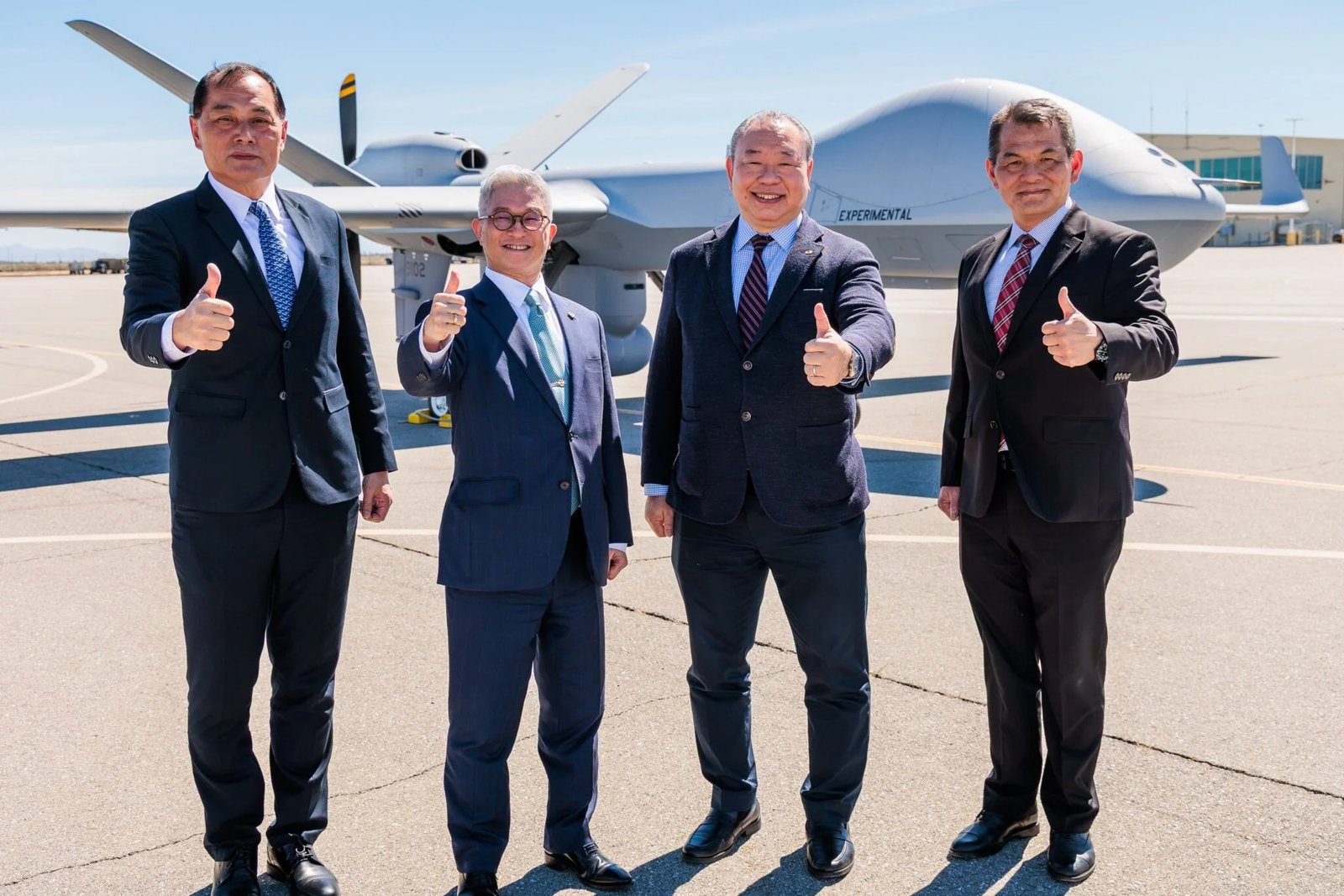
The first pair of MQ-9B SkyGuardian unmanned aerial vehicles (UAV) built by General Atomics Aeronautical Systems (GA-ASI) was handed over to Taiwan’s air force in the USA on 17 March.
The Republic of China Air Force (ROCAF) received the MQ-9B medium-altitude, long-endurance (MALE) UAVs at a ceremony at an unknown location. They will remain in the USA for the next few months for testing.
The country has four SkyGuardians on order; the first pair is due to arrive in Taiwan later this year – in Q3 of 2026, according to ROCAF Chief of Staff Lieutenant General Lee Ching-jan – with the remaining brace due for handover next year.
The National Chung-Shan Institute of Science & Technology (NCSIST) had been developing the Reaper-like Teng Yun MALE UAV since well before 2015. However, it has suffered from a particularly long and painful development period, which is probably why the ROCAF pursued SkyGuardians as well.
In March 2024, the Teng Yun II resumed user trials after a software update was provided following failed tests in 2023. In January 2026, the aircraft completed along-endurance flight test. Four prototypes exist, but the ROCAF is yet to order the aircraft.
It is possible that an electronic warfare variant may be developed, as the Defense Industry Development Act allocated NT$60 million (US$20.1 million) in 2027 and 2028 for two “large composite airframes,” plus NT$55 million for two sets of “electronic signals intelligence receiver module systems”.
On the same trip to the USA, the Taiwanese delegation visited Lockheed Martin’s F-16 facility in Greenville, South Carolina a day earlier on 16 March. There they witnessed completion of flight acceptance tests of the ROCAF’s first F-16V.
Taiwan has 66 F-16Vs on order via a 2019 Foreign Military Sales programme, and the first was originally scheduled for delivery in 2023. Delays have been due to supply chain problems and technical challenges relating to flight control software.
Whilst on the topic of UAVs, Taiwan has now received all 291 Anduril Altius-600M loitering munitions requested in 2024. Within six months of the contract being inked, the first batch reached Taiwan in August 2025. These aircraft possess a 440km range.
Also, on 17 December 2025, the US Defense Security Cooperation Agency approved the sale to Taiwan of 1,554 Altius-700M loitering munitions and 478 Altius-600ISR UAVs. These were to be procured by a special supplemental defence budget, but funding has been held up by the opposition Kuomintang party.

Under the same supplemental budget, the Ministry of National Defense (MND) detailed a proposal to procure 200,000 UAVs, since drones “have become a key part of enhancing the ROC Armed Forces’ asymmetric capabilities in modern combat environments”.
Earlier, in July 2025, the MND announced plans to procure 48,750 drones of five types with a budget of NT$50 billion (US$1.56 billion). Of this total, 11,270 units are to be delivered in 2026 and 37,480 in 2027.
Among domestic UAV designs, the NCSIST’s Cardinal III, a tactical UAV with a vertical-take-off-and-landing (VTOL) capability, is supposed to enter series production this year. Ninety units are to be procured by the ROC Army Special Forces Command and ROC Marine Corps. The ROC Army also plans to evaluate fibre-optic and tethered UAVs this year.
NCSIST has developed a range of Mighty Hornet (Chien Feng) drones that include the Chien Feng I loitering munition, Chien Feng II anti-radiation similar to the Israeli Harpy, Chien Feng III VTOL and Chien Feng IV based on the Kratos MQM-178 target drone.
The NCSIST Albatross II tactical UAV with a 16-hour endurance is understood to be in mass production now. It has been exhibited carrying Chien Feng I loitering munitions and an anti-submarine warfare pod too.
by Gordon Arthur
