


The US Army has decided not to move ahead with the procurement of some elements of the Terrestrial Layer System Brigade Combat Team architecture.
The United States Army’s decision to acquire the Terrestrial Layer System (TLS) cyberwarfare and Electronic Warfare (EW) capability can be traced back to 2019. One year before, the US National Defence Strategy (NDS) had stressed the need for operational- and tactical-level spectrum dominance vis-à-vis near peer adversaries. NDSs detail the strategic priorities of the United States Department of Defence. Published every four years, a non-classified version of the document is made publicly available.
Plans called for the army to acquire five TLS variants: Stryker Brigade Combat Teams (SBCTs) were earmarked to receive one element of the TLS Brigade Combat Team (TLS BCT) platform. This element was to be housed onboard the medical evacuation variant of a General Dynamics M-1126 wheeled armoured fighting vehicle. According to the US Army, the M-1133 variant was chosen due to the abundance of power sockets within the vehicle’s interior. Lockheed Martin was chosen by the US Army to build a prototype TLS-BCT in August 2022. TLS-BCT systems were to have been produced in two sub-variants: One variant was restricted to SIGINT collection and processing, while the other would have also possessed cyber/electronic attack capabilities. The decision to split these configurations was based on feedback from US Army operational prototype TLS-BCT demonstrations in 2023.
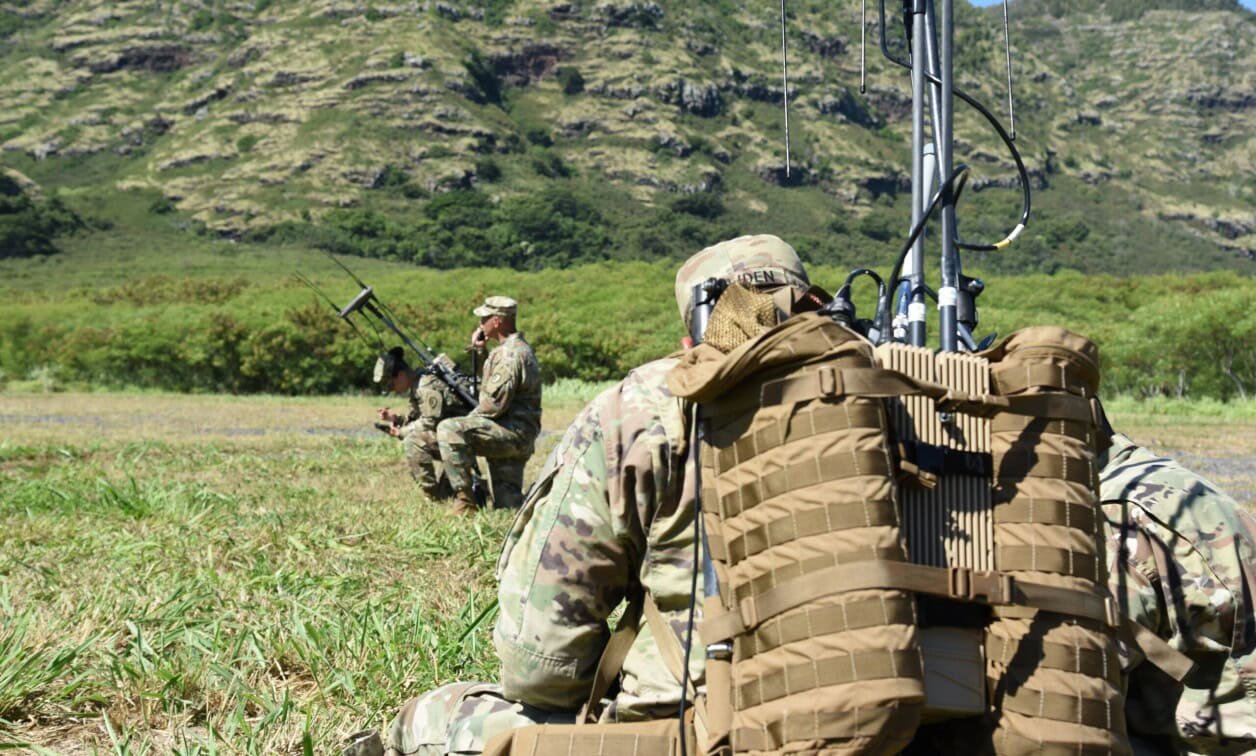
Mastodon Design’s TLS backpack was another part of the overall TLS architecture and formed part of the TLS-BCT ensemble as a tactical system to facilitate cyberwarfare and EW by dismounted troops. The TLS backpack, which commenced delivery in 2024, was earmarked for the army’s Infantry BCTs. Armoured BCTs were to have had their TLS architectures equipping BAE Systems Armoured Multi-Purpose Vehicle (AMPV) variants. Division- and corps-level formations will receive the TLS Echelon Above Brigade (TLS-EAB) system. TLS-EAB provides multi-function EW and cyberwarfare to support land manoeuvre and joint forces at these echelons.
Rebalancing the force
According to the army’s Capability Programme Executive for Intelligence and Spectrum Warfare (CPE ISW) the TLS-BCT Stryker-based acquisition has been cancelled: “The Army has no plans to field or further develop the Terrestrial Layer System Brigade Combat Team variant integrated with the Styker platform”, the CPE ISW told Armada in a written statement. The CPE ISW was formally known as the Programme Executive Office for Intelligence, Electronic Warfare and Sensors. This organisation was responsible for procuring and delivering TLS incarnations into the US Army, The reason for the change appears to be the result of feedback concerning the TLS backpack’s utility: “TLS BCT rapid prototyping programme, experimentation, and operational lessons learned, provided valuable insights into lightweight, modular architectures, informing the transition to the TLS backpack as the primary EW/signals intelligence system for all BCTs”.
That the army reached this conclusion is perhaps not surprising. The ongoing conflict in Ukraine has underscored that large, vehicle-mounted EW systems, particularly when deployed at, or near, the tactical edge can be vulnerable. These targets are relatively distinct if not suitably camouflaged due to their antenna arrays and they can be at risk from artillery and/or attack by suicide uninhabited aerial vehicle. To compound matters, large vehicle-based EW systems tend to not be numerous: The loss of one vehicle in a company or even a brigade could mean a serious degradation of capability.
Instead, it appears the army is keen to embrace Integrated, Tactical EW Systems (ITEWS) that can be deployed across a wide area and networked to provide electronic attack, electronic protection and electronic support. In this case, the ITEWS enablers will be the TLS backpacks which will allow the architecture to move as troops manoeuvre providing coverage across the entire tactical area. Moreover, the loss of one or two of the backpacks allows graceful degradation: Such outages are unlikely to excessively impinge on the ITEWS’ overall performance. Moreover, losses may be easily replaceable by reserve backpacks.
The army is also thinking about using a Modular Adapter Kit (MAK) being developed by Mastodon Design in cooperation with the force. The MAK could equip manoeuvre force vehicles to house the TLS backpack and provide a mounted EW capability when needed. The CPE ISW’s statement continued that MAKs could be deployed from 2028. An article penned by John Haystead in the April 2025 edition of the Journal of Electromagnetic Dominance stated that each IBCT will have six TLS backpacks. Whether this number remains fixed given TLS-BCT Stryker variant cancellation remains unknown.
A similar change may affect the TLS variants intended for the Armoured BCTs. Instead of having Terrestrial Layer System cyberwarfare and EW capabilities permanently mounted on a dedicated AMPV, MAKs could furnish AMPVs deployed across the formation to provide a similar, dismounted/mounted ITEWS. The one part of the wider TLS undertaking that appears unchanged for now is the TLS-EAB.
Outlook
The army has probably taken the correct lessons from Ukraine, but also correctly anticipating what a future conflict with the People’s Republic of China could look like. Knowing the clear advantage of the US military regarding effective manoeuvre in the electromagnetic spectrum to achieve a position of electromagnetic superiority and supremacy, US EW systems would be a top priority for the People’s Liberation Army. Likewise, other potential adversaries like the Islamic Republic of Iran will place a heavy emphasis on destroying US EW assets. Reorienting US Army manoeuvre formations to embrace ITEWS-style architectures thus makes sense not only from a survivability perspective, but also to provide tactical EW coverage over areas large and small.
by Dr. Thomas Withington
