

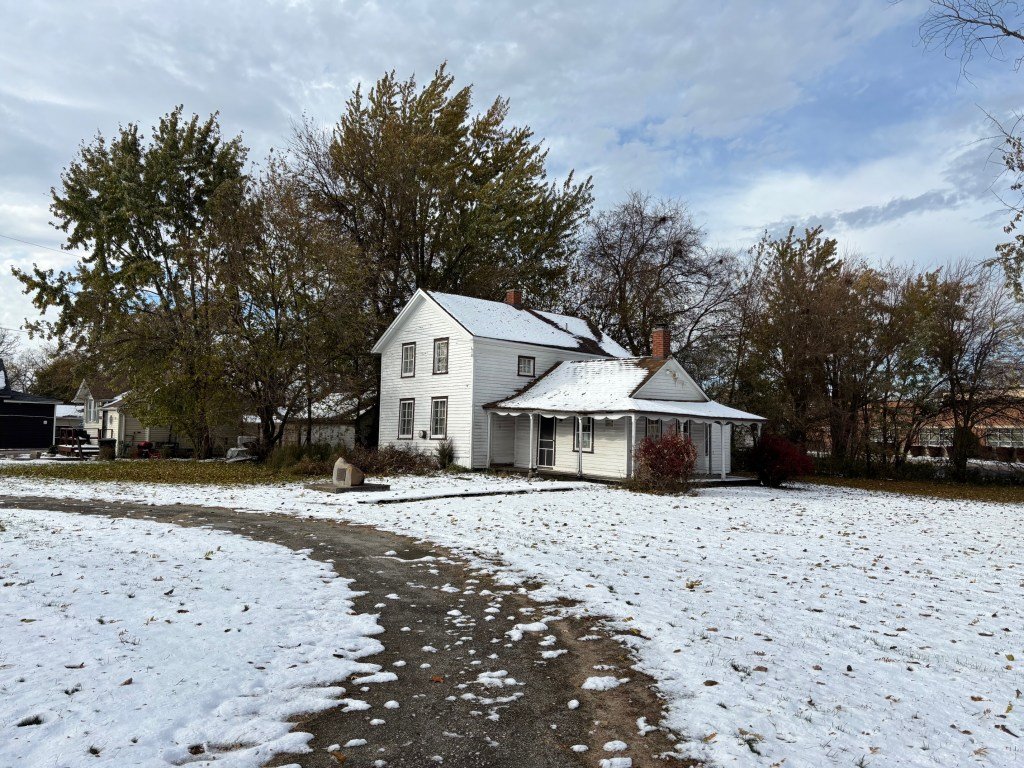
The village of South Holland plans to tear down a historic homestead due to lack of maintenance and use, a choice opposed by the great-great-grandson of a woman who lived there.
“We’ve been thinking about this for some time, because it’s been in disrepair,” said Mayor Don De Graff. “There’s no tours, there’s no events scheduled at it or around it. So we as the village administration met with the historical society leadership and said, ‘hey, what should we do with this, because at this point we’d recommend that it come down.’”
The house in question is the Van Oostenbrugge Homestead, a small white house tucked away on 157th Street, across the street from Van O’ Park, which takes its name from the historic site.
It was once the home of Cornelia Van Oostenbrugge, whose great-great-grandson, Bill Paarlberg, opposes the demolition.
“My great-great-grandmother, Cornelia Oostenbrugge-Paarlberg, as a teenager she even walked to Chicago to see the Lincoln memorial train go through,” said Paarlberg, referring to an 1865 train that carried President Abraham Lincoln’s body to Springfield.
Paarlberg no longer lives in South Holland, but his family is very important to the town’s history. Antje Paarlberg, also known as the Widow Paarlberg, who emigrated from the Netherlands in 1847, is considered the first settler. Her husband died during the voyage, leaving her with their seven children.
Antje Paarlberg’s oldest son, Peter Paarlberg, later married Cornelia Van Oostenbrugge.
“[Cornelia] had two children who were in the First World War, and were in France, and she had a nephew who was in the Second World War, in Corsica, and he lost his life over there,” Bill Paarlberg said. “So she has a lot of history of the past, and I’d like to see it kept, if all possible.”
A plaque outside the Van Oostenbrugge Homestead states the house was built in 1858 by Cornelia Van Oostenbrugge’s father, Jan Van Oostenbrugge.
“It’s the oldest house in South Holland,” Paarlberg said.
Paarlberg said he would like to get the house state landmark status so it could be preserved. Ideally, he said, he just wants the house to stay where it is.
“He’s really interested in wanting to preserve a lot of the history, and so am I, and so are we,” De Graff said. “We’re wanting to do it in accordance with the historical society, we didn’t want to force anything on them, but they too believe that it’s better for us to take it down.”
De Graff said there is not a set timeline for demolition, but that it would likely happen in the next couple of months.
The village intends to remove all historical artifacts from the house before any demolition takes place.

“Nobody goes in it. It just sits there,” De Graff said. “There’s members of the historical society who’ve been members for years, who’ve never been through it. It’s just one of those things that, we want to preserve history for the right reason.”
De Graff emphasized the village still prioritizes preserving its history, and has many other historical sites that are actively used. That includes another connected to the Paarlberg family, the Paarlberg Farm, where the South Holland Historical Society hosts an annual Heritage Fest event.
“On Labor Day we always host a festival there,” Paarlberg said. “We tour through the house and the barn, and then the assistant mayor, Larry DeYoung, gets up in front of the group, and we maybe have at least 800 people show up there.”
Paarlberg said he and his wife had considered attempting to have the house moved to the Paarlberg Farm, but it would have been too difficult and expensive.

Another important historical site in the village is an Underground Railroad stop, located at the First Reformed Church. There is also a museum dedicated to the village’s history at the South Holland Public Library.
“There’s a lot of great history that we preserve,” De Graff said. “There’s no additional benefit to preserving something like that when it’s in disrepair and there’s really no activity surrounding it.”
elewis@chicagotribune.com
