

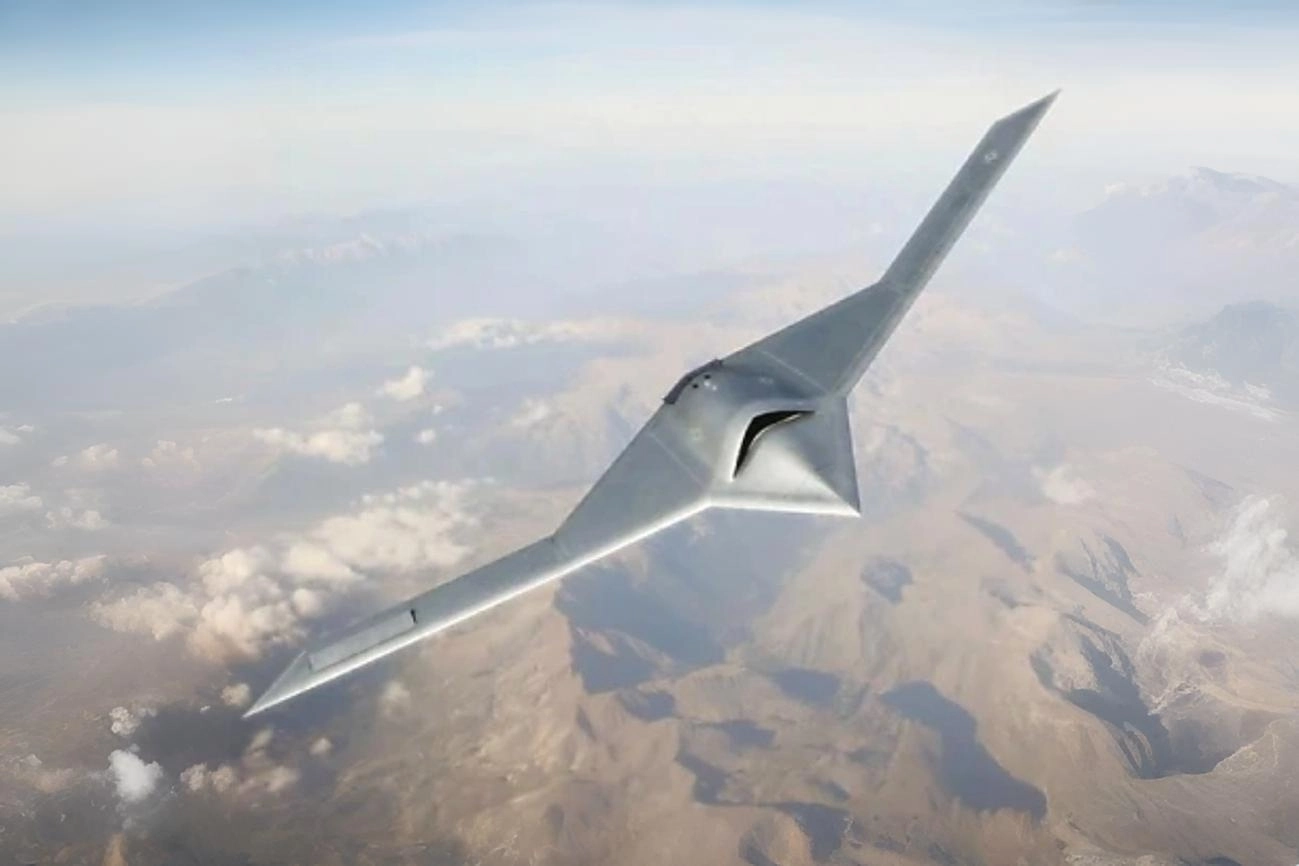
You’re not supposed to see the RQ-180 White Bat drone. That’s the whole point.
Unlike fighter jets that roar overhead and show off at airshows, this aircraft exists in a different world, one defined by silence, altitude, and secrecy. It doesn’t announce its presence. It doesn’t appear in official press photos. And yet, it may be one of the most important aircraft flying today.
A handful of blurry sightings. Strange contrails stretching across empty desert skies. A cryptic squadron patch showing a white bat, almost cartoonish, except it isn’t. These fragments are all the public has to piece together the story of what defense analysts believe is America’s most advanced stealth reconnaissance platform.
The RQ-180 stealth drone, developed by Northrop Grumman, is widely believed to be designed for a single, dangerous purpose: flying deep into heavily defended airspace where satellites struggle and manned aircraft might never return. Its job isn’t combat. It’s knowledge. Intelligence. Awareness.
Think of it as a ghost with sensors.
Modern warfare runs on information, knowing where missile batteries are, tracking mobile radar systems, mapping electronic signals. The side that sees first often wins first. The RQ-180 exists to make sure the United States sees everything, even in places designed to be invisible.
What makes this drone fascinating isn’t just its technology. It’s the mystery. Unlike older aircraft programs, which gradually became public, the RQ-180 lives mostly in shadows. No official spec sheet. No confirmed photos. Just clues, and a growing consensus among military observers that it’s already operational.
What Is the RQ-180 White Bat Drone?
At its core, the RQ-180 White Bat drone is a high-altitude, long-endurance stealth reconnaissance aircraft, but that simple definition barely scratches the surface. This isn’t just another surveillance drone like the ones you’ve seen in news footage. It represents a generational shift in how intelligence is gathered when enemies are actively trying to hide.

To understand why it exists, you have to look at a growing problem. Older surveillance platforms, even advanced ones, became increasingly vulnerable as countries like China and Russia deployed sophisticated radar systems designed specifically to detect and track aircraft.
Traditional drones such as the Global Hawk could still collect intelligence, but only from safer distances. And distance, in intelligence work, is a handicap.
The RQ-180 was built to eliminate that handicap.
Developed by Northrop Grumman, the same company behind the legendary B-2 Spirit stealth bomber, the RQ-180 is engineered to penetrate heavily defended airspace undetected.
Instead of avoiding radar coverage, it moves straight through it, quietly gathering information in places where satellites can’t linger and manned aircraft would be at serious risk.
The “RQ” designation itself tells you something important. In U.S. military naming conventions, R stands for reconnaissance, and Q indicates unmanned. This aircraft was never intended to shoot anything down. Its weapon is awareness.
What makes the RQ-180 especially unusual, though, is its strategic role. It fills a gap left behind when older high-risk reconnaissance platforms, like the famous SR-71 Blackbird, were retired.
Except now, there’s no pilot on board. No human life at risk. Just sensors, algorithms, and stealth doing the dangerous work alone.
In many ways, it’s less like a traditional aircraft, and more like an invisible eye that never blinks.
Design and Stealth Features of the RQ-180 Drone
If you ever saw the RQ-180 white bat drone clearly, which, to be fair, almost nobody outside classified programs has, you might not immediately recognize it as an aircraft. There’s no traditional fuselage. No tail fin. No obvious cockpit, of course. Just a smooth, stretched wing that looks more like a shadow than a machine.
This flying-wing configuration is the foundation of its stealth.
The concept itself isn’t new. Aircraft like the B-2 Spirit proved decades ago that eliminating vertical surfaces dramatically reduces radar visibility. Radar waves hit flat surfaces and scatter away instead of bouncing directly back to the radar receiver.

The RQ-180 takes that idea further, refining the shape into what analysts often call a “cranked-kite” design, essentially a wing with subtle angle changes that scatter radar energy in multiple directions.
But stealth isn’t just about shape. It’s a layered system.
Materials play a major role. The outer skin likely uses radar-absorbent composites that convert radar energy into tiny amounts of heat instead of reflecting it. Engine placement is another critical detail.
Instead of hanging externally, the engine is buried deep inside the airframe, with carefully designed air inlets and exhaust channels that hide the heat signature from infrared sensors.
Here’s a breakdown of its key design elements:
| Feature | Purpose |
| Flying wing structure | Minimizes radar reflection |
| Internal engine placement | Reduces infrared signature |
| Smooth, blended surfaces | Eliminates radar hotspots |
| High aspect ratio wings | Increases endurance |
| Composite stealth materials | Absorbs radar signals |
Altitude is another stealth advantage people rarely think about.
The RQ-180 reportedly operates above 60,000 feet, higher than most commercial aircraft and many air defense systems are optimized to track. At that height, detection windows shrink, and reaction times get painfully short.
Think of stealth like whispering in a noisy room. You’re not invisible, but you’re easy to miss. And by the time someone notices, you’re already gone.
The RQ-180 wasn’t designed to outrun threats. It was designed so threats never knew it was there in the first place.
Technical Specifications of the RQ-180 Drone (Estimated)
Trying to pin down the exact technical specifications of the RQ-180 white bat drone is a bit like measuring a shadow. There’s no official datasheet. No public manual.
What exists instead is a collection of informed estimates based on sightings, engineering logic, satellite imagery, and the known capabilities of similar stealth aircraft developed by Northrop Grumman.
Even these estimates, though, paint a picture of an unusually capable machine.

One of the most striking features is its size. Analysts believe the RQ-180 has a wingspan of roughly 130 feet (40 meters), placing it in the same physical class as large commercial aircraft like the Boeing 737. That’s enormous for a drone.
The large wing area isn’t about speed; it’s about endurance. Bigger wings generate more lift efficiently, allowing the aircraft to remain airborne for extremely long periods.
Altitude is another defining characteristic. The RQ-180 is believed to operate above 60,000 feet, where the air is thin, traffic is minimal, and radar detection becomes more difficult.
Here’s a consolidated table of estimated specifications:
| Specification | Estimated Value |
| Manufacturer | Northrop Grumman |
| Aircraft Type | Stealth ISR UAV |
| Wingspan | ~130 ft (40 m) |
| Length | ~50–60 ft (estimated) |
| Cruise Altitude | 60,000+ ft |
| Endurance | 24+ hours (estimated) |
| Propulsion | Single turbofan engine |
| Stealth Design | Flying wing, radar-absorbent materials |
| Crew | None (unmanned) |
One often-overlooked factor is endurance efficiency. Unlike fighter jets, which burn fuel rapidly, surveillance aircraft prioritize fuel economy.
The RQ-180 likely uses a highly efficient turbofan engine optimized for sustained high-altitude flight rather than speed.
Its sensor payload is equally important. The aircraft probably carries a mix of radar, signals intelligence receivers, and high-resolution optical systems capable of monitoring vast areas simultaneously.
In simple terms, it’s less like a drone and more like a persistent satellite that can move, adapt, and focus on specific targets whenever needed.
And that mobility changes everything.
RQ-180 White Bat Drone Capabilities and Missions
The real power of the RQ-180 drone isn’t speed, or altitude, or even stealth alone. It’s what the aircraft collects. Information. Signals. Patterns. The invisible threads that reveal what an adversary is doing before anything actually happens.
In modern warfare, intelligence isn’t a support function, it’s the foundation. Missiles, aircraft, and troops all depend on accurate, real-time data. Without it, even the most advanced weapons become blunt instruments.
The RQ-180 exists to make sure that never happens.
Its primary mission falls under ISR: Intelligence, Surveillance, and Reconnaissance. That means flying deep into contested airspace and quietly gathering electronic emissions, radar signals, communications activity, and high-resolution imagery.
Unlike satellites, which follow predictable orbits, the RQ-180 can linger over specific areas for extended periods, hours, possibly even more than a day.
This persistence is a huge advantage.
Here’s a simplified view of its mission profile:
| Mission Type | Function |
| Electronic Intelligence (ELINT) | Detects and analyzes radar systems |
| Signals Intelligence (SIGINT) | Intercepts communications signals |
| Imagery Intelligence (IMINT) | Captures high-resolution surveillance imagery |
| Communications Relay | Acts as airborne data transmission node |
| Strategic Reconnaissance | Monitors military infrastructure and movement |
One particularly important capability is its role as a communications bridge. In contested environments, traditional communication links can be jammed or disrupted.
The RQ-180 can operate as a high-altitude relay, connecting assets like fighters, ships, and ground units across long distances.
This transforms it from a passive observer into an active force multiplier.
The United States Air Force increasingly relies on interconnected systems, sometimes called “network-centric warfare.” In this model, whoever controls the information network gains a decisive advantage.
There’s also strong evidence that the RQ-180 helps track mobile missile systems. These targets are notoriously difficult to monitor because they move frequently and hide deliberately. A stealth drone capable of persistent surveillance changes that equation.
In simple terms, the RQ-180 doesn’t destroy targets. It makes sure nothing can hide from the systems that do.
It’s the quiet enabler behind the scenes, the reason other platforms know exactly where to be, and exactly when.
Operational Units and Deployment
One of the most telling clues about the RQ-180 white bat drone isn’t a photograph or leaked document. It’s a patch. A small, embroidered symbol worn on flight suits inside secure facilities. A white bat, wings stretched wide, flying across a dark background. Quiet symbolism, but symbolism with meaning.
This patch is widely associated with the 74th Reconnaissance Squadron, a unit within the United States Air Force believed to operate the RQ-180.
Based at Beale Air Force Base, this squadron has historically flown some of America’s most sensitive intelligence platforms, including the U-2 spy plane and the RQ-4 Global Hawk.
That lineage matters. Units don’t get assigned advanced stealth systems randomly. They’re chosen based on experience, mission profile, and security infrastructure.
Beale Air Force Base itself is uniquely suited for the mission. Located in northern California, it offers access to vast training ranges over the Pacific Ocean and remote inland areas. These wide-open spaces allow stealth aircraft to operate with minimal observation, at least from the public.
But Beale isn’t the only likely operating location.
Highly classified aircraft like the RQ-180 are also believed to operate from remote facilities such as Area 51 and Edwards Air Force Base.
These locations provide controlled airspace, specialized maintenance facilities, and advanced testing infrastructure. Everything needed to support stealth operations without unwanted attention.
What makes the RQ-180 particularly valuable is its flexibility. Unlike satellites, which follow fixed orbits, the drone can deploy wherever intelligence gaps exist. It can reposition. Adapt. Respond quickly to emerging threats.
In essence, it gives commanders something they’ve always wanted, but rarely had: reliable, survivable eyes anywhere in the world, on demand.
RQ-180 White Bat vs Other Stealth Drones
To really appreciate the RQ-180 white bat drone, you have to see it in context. It didn’t replace earlier drones because they failed. It replaced them because the threat environment evolved.
Radar systems became smarter. Air defenses became layered, digital, and adaptive. Suddenly, stealth wasn’t optional, it was survival.
Let’s start with one of its closest relatives: the RQ-170 Sentinel. This drone gained public attention in 2011 after one was captured by Iran.
The Sentinel was stealthy, yes, but optimized for regional surveillance, not deep penetration into heavily defended superpower airspace. Its range and altitude were more limited.
The RQ-180 operates on a different level entirely.
Then there’s the MQ-4C Triton and its cousin, the Global Hawk. These aircraft are excellent for long-endurance missions, capable of flying over 30 hours continuously. But they lack true stealth. They rely on staying far from enemy radar coverage rather than slipping through it.
Here’s a side-by-side comparison that highlights the difference:
| Aircraft | Stealth Level | Primary Mission | Risk Environment |
| RQ-170 Sentinel | Moderate stealth | Tactical surveillance | Medium-threat zones |
| MQ-4C Triton | Minimal stealth | Maritime surveillance | Low-threat zones |
| Global Hawk | Minimal stealth | Strategic surveillance | Low-threat zones |
| RQ-180 drone | Advanced stealth | Penetrating ISR | High-threat, contested airspace |
The RQ-180 fills a role once occupied by manned aircraft like the SR-71 Blackbird, flying directly into dangerous territory to gather intelligence. But unlike the SR-71, which depended on extreme speed, the RQ-180 depends on invisibility.
That shift reflects a deeper change in military thinking.
Speed can be tracked. Heat can be tracked. But true stealth, combined with autonomous operation and long endurance, creates something far harder to counter.
It’s the difference between outrunning a searchlight and never triggering it in the first place.
And in modern airspace filled with networked radar systems, that difference can determine whether a mission succeeds, or never even begins.
