


Schiebel is preparing to establish a dedicated UK legal entity as it looks to consolidate its position in the British defence market and support a growing portfolio of naval, land and joint-domain uncrewed programmes.
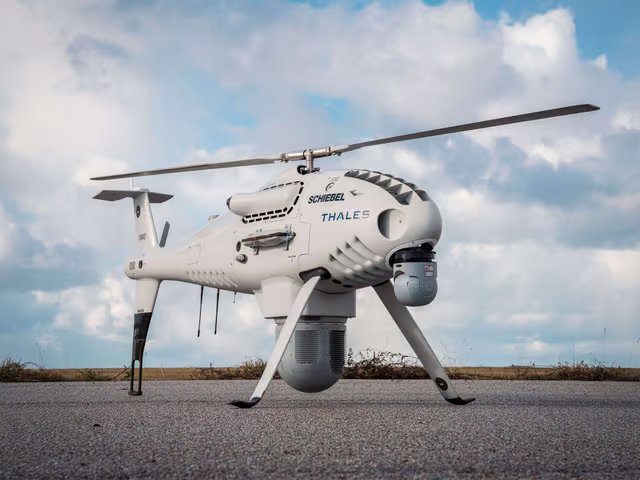
The move follows the operational fielding of the Peregrine Rotary Wing Uncrewed Aerial System with the Royal Navy, delivered in partnership with Thales UK. Based on the CAMCOPTER S-100, Peregrine has now transitioned from programme delivery into routine operational use, providing persistent intelligence, surveillance and reconnaissance (ISR) in demanding maritime environments. Its performance has reinforced confidence in rotary-wing uncrewed systems as an integral component of UK naval capability, with further growth anticipated as requirements evolve.
Beyond the maritime domain, Schiebel is positioning itself for future UK land and multi-domain programmes, including the British Army’s Autonomous Collaborative Platforms (ACP) initiative. Within this context, the company views its partnership model as central to success. Thales brings system integration expertise, advanced sensors and autonomy development, while Schiebel contributes a mature rotary-wing uncrewed air vehicle portfolio with extensive operational experience across naval and land environments. Together, the two companies are targeting scalable, mission-ready solutions aligned with emerging UK concepts for autonomous and collaborative operations.
As part of its UK growth strategy, Schiebel also plans to introduce the larger CAMCOPTER S-300 to the market. Designed as a heavier-lift complement to the S-100, the S-300 offers increased endurance, greater payload capacity and enhanced flexibility for multi-mission profiles. The platform is intended to support extended-range ISR as well as future autonomous and teamed operations across both land and maritime domains.

The planned establishment of Schiebel UK is expected to underpin these ambitions by enabling in-country manufacturing, assembly and capability development. A permanent UK presence would allow closer programme support, faster integration of upgrades and closer alignment with national industrial participation and sovereign capability objectives.
With Peregrine now operational and future land and joint-domain requirements taking shape, Schiebel’s decision reflects a shift from programme delivery to long-term industrial commitment. The UK entity is intended not as a symbolic footprint, but as a practical enabler for sustained engagement with UK Armed Forces and industry partners as uncrewed systems move further into the core of British defence capability.
