

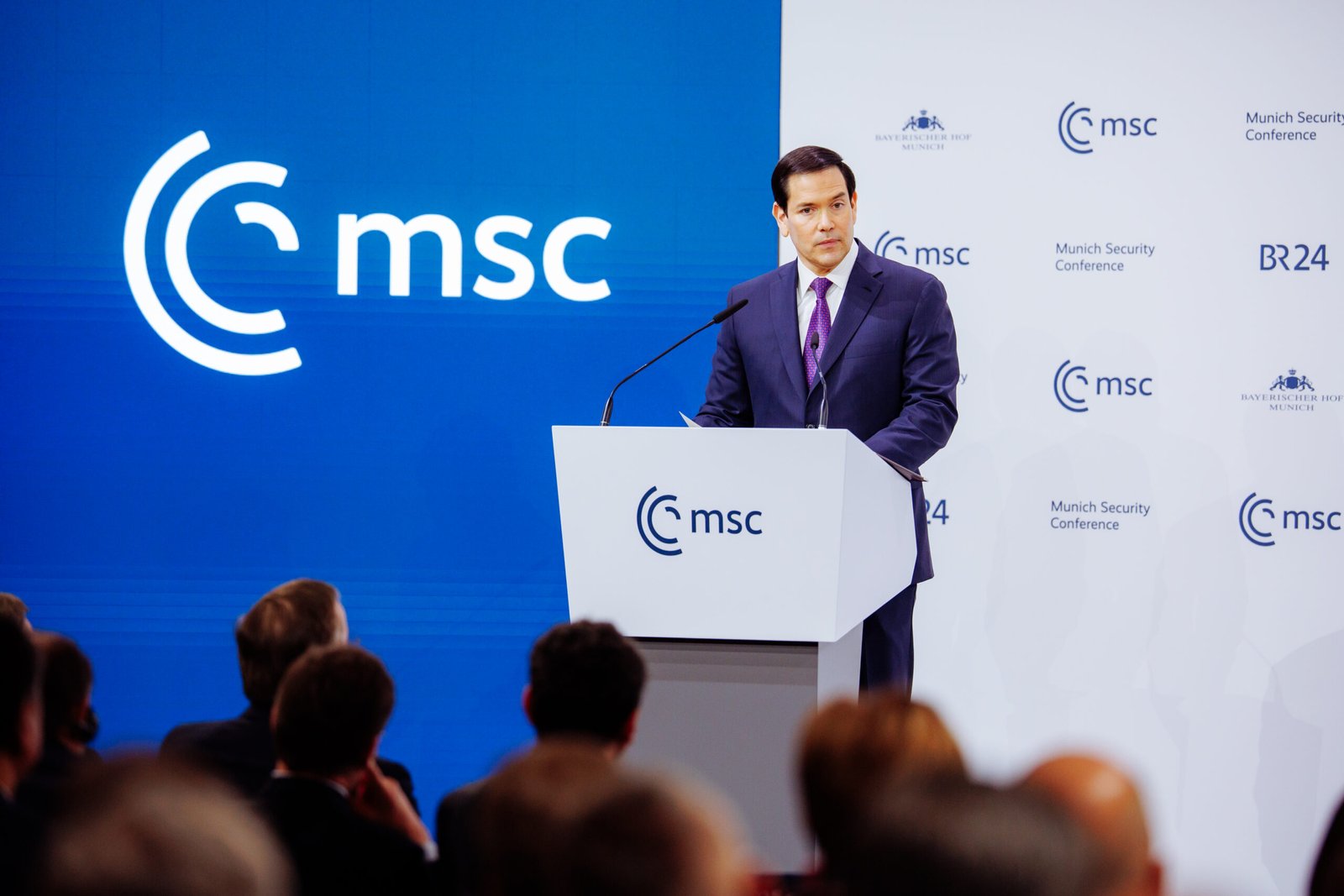
MUNICH — US Secretary of State Marco Rubio attempted to defuse tension with European allies today, telling them that despite headlines saying otherwise, it is not Washington’s “goal, nor our wish,” to end the transatlantic era.
During a hotly anticipated speech here at the Munich Security Conference, Rubio said “the fate of Europe will never be irrelevant to our own national security,” offering reassurance to a region on edge over the Trump administration’s combative approach to issues including Greenland, Arctic security and trade. “For us Americans, our home may be in the Western Hemisphere, but we will always be a child of Europe.”
Rubio largely leaned on a much more sensitive style and oratory compared to Vice President JD Vance’s controversial speech a year ago at this same event. But Rubio also did not come bearing only flowers.
America’s chief diplomat took aim at what he framed postwar “delusion” in the West and a mass migration “crisis” in Europe, echoing terms found in the National Security Strategy released last year. He also called out a lack of industrialization and took shots at the United Nations for offering “no answers” to crises situations around the globe, such as the Gaza war.
“It was American leadership that freed captives from barbarians and brought about a fragile truce,” in the Palestinian territory, he said, while paying tribute to Washington’s push to secure a peace deal in Ukraine, tearing down Iran’s nuclear program through operation Midnight Hammer, and bringing “narco-terrorist dictator,” former Venezuelan President Nicolás Maduro to justice. On Ukraine more broadly, Rubio noted that “issues that need to be confronted to end this war have been narrowed” but “work remains to be done” to resolve them.
In a comment likely appreciated in the room, he did admit that “We don’t know [if] the Russians are serious about ending the war.” Rubio also thanked Europe for taking steps to increase support for Ukraine, outlining that “American weaponry is being sold for the Ukrainian war effort” under NATO’s Prioritised Ukraine Requirements List (PURL) initiative, financed by European allies and Canada.
There is no “buying of time” on a peace deal, Rubio explained, arguing that beyond direct talks, other measures including Washington imposing additional sanctions on Russian oil and a verbal commitment from India to stop buying more of the product from Moscow, have gone ahead in “the interim.”
However, Rubio’s comments seem at least somewhat at odds with President Donald Trump, who told reporters outside the White House on Friday that Ukraine President Volodymr Zelenskyy has “to get moving. Russia wants to make a deal, and Zelensky’s gonna have to get moving — otherwise he’s going to miss a great opportunity.” Rubio also reportedly drew scorn from European leaders for skipping a key meeting with them on Ukraine ahead of MSC at short notice.
“We want Europe to be strong,” Rubio added. “We care deeply about your future and ours, and if at times we disagree, our disagreements come from our profound sense of concern about a Europe with which we are connected, not just economically, not just militarily,” but spiritually and culturally.
The immediate impact on an audience that included the European Union’s Head of Foreign Policy Kaja Kallas, and former NATO Secretary General Jens Stoltenberg was clear, as Rubio received light applause and a standing ovation.
Reacting to the speech on X, former Lithuanian Foreign Minister Gabrielius Landsbergis wrote that “Rubio brought a lot of white paint…to cover the cracks caused by the great rupture.” He also lamented a failure to talk about “democracy or true freedom of speech,” concluding, “This was not a departure from the general position of the US administration. It was simply delivered in more polite terms. I am not sure the white paint will hold.”
