

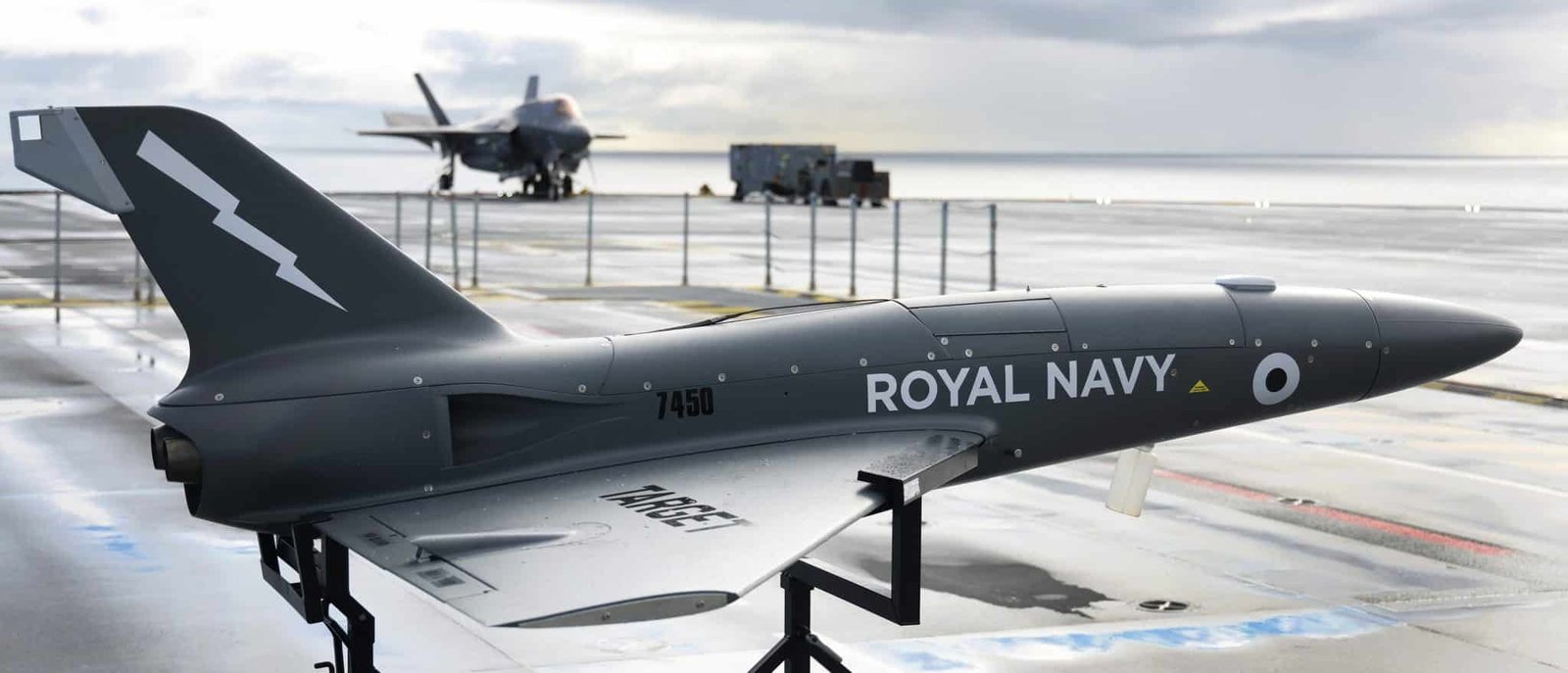
The UK Royal Navy (RN) sees its continuing shift to a ‘hybrid fleet’ as central to prevailing in future conflict, and is focused on accelerating delivery of the maritime uncrewed systems integral to this new ‘hybrid’ force structure, First Sea Lord and Chief of Naval Staff General Sir Gwyn Jenkins has said.
Story by Dr Lee Willett, additional reporting by Richard Scott.
Speaking at the fourth Paris Naval Conference on 3 February, Gen Jenkins said that transition success would hinge on how quickly the navy can harness rapidly emerging and evolving uncrewed technologies to ‘team’ with, and enhance the effects of, crewed platforms. The Paris Naval Conference is an annual event co-hosted by the French Navy and IFRI (France’s international relations institute).
The RN’s ‘hybrid navy’ vision was set out in the UK’s 2025 Strategic Defence Review, which detailed aspirations for a future force mix of crewed and uncrewed platforms. One part of this vision is a hybrid carrier airwing comprising crewed fast jets, autonomous collaborative platforms, single-use drones, and long-range missiles; work is also underway to understand the future force mix in both the surface and underwater domains.
Speaking in Paris on a panel focused on air-sea superiority in contested operational environments, Gen Jenkins said the immediate priority for the ‘hybrid fleet’ was getting human and machine teaming to work. “The challenge is how quickly we can bring these autonomous systems in, to fight alongside the fleet,” he observed. “The tech world has taught us how to do this: it’s through incremental introduction and spiral development; it’s through failure and learning from failure in order to bring capability benefit.”
While naval warfare has been re-shaped by technological revolutions on previous occasions, it is the pace at which uncrewed and autonomous systems are iterating that presents the biggest challenge going forward today. According to Gen Jenkins, evidence from the conflict in Ukraine suggests that navies cannot afford to hold back in embracing this change.
“Our organisations tend to be quite cautious by nature, which I always find ironic because we’re warfighters and risk-takers by nature,” he said. “So, we tend to take an approach which is ‘well, I’m going to sit back and see how the technology is going to develop, and I will transition at the point that the technology is mature’.”
“That’s fine in an approach – as long as you don’t find yourself in a war with somebody who’s already transitioned, because you can’t afford to be in that situation as you will lose at that point,” Gen Jenkins continued. “So, the art in this is understanding where this technology is going and how you can maximize the possibility you don’t lose.”
“I want to be the force that wins. I don’t want to be the force that is sorry it didn’t make the move early enough.”
Gen Jenkins gave examples of how the RN is already integrating crewed/uncrewed capability in conceptual, organisational, and capability contexts. In a conceptual sense, the Royal Marines Commando Force has been transitioning over the last decade to a hybrid-type force with a focus on distributed operations in support of littoral strike. At an organisational level, the RN is trialling its containerised mission PODS (persistent operational deployment system) capability, seeking to generate capacity to embark different capabilities (including uncrewed systems) onboard crewed and uncrewed platforms. In capability terms, work is underway to introduce a hybrid carrier airwing by the end of the 2020s, with the intention to conduct the first launch of a jet-powered autonomous collaborative platform from an RN carrier in late 2026 or early 2027.
These examples, and others, illustrate the nature of and need for the ‘hybrid’ transition.“We are on the trajectory here, because we have to be …. Every ship has [to be] a drone carrier. It’s a question of scale and what you’re trying to run off it,” said Gen Jenkins.
Activity is also underway to accelerate the introduction of uncrewed systems into the surface fleet. Here, the pivot to a hybrid force design is underpinned by a ‘system of systems’ approach that envisions a digitally enabled, resilient fleet fusing crewed ships with uncrewed and autonomous systems.

Speaking at last September’s DSEI 2025 exhibition, Gen Jenkins revealed his aim to have uncrewed escort ships sailing alongside RN warships within two years, and said that future force design would be guided by the principle of “uncrewed wherever possible, crewed only where necessary”.
A future force mix study has already looked at different force structure models, recognising both financial pressures and challenges around RN personnel numbers. This study activity – which has considered the delivery of capability from the perspectives of sense, decide, effect, connect, host, and enable – has pointed towards a future disaggregated fleet, where functions previously consolidated on a single complex platform may now be spread across a range of crewed and uncrewed vessels.
Another tenet of the hybrid navy is the move to increase mass through the procurement of less complex platforms. This is expected to provide opportunities for shipyards across the UK.
