

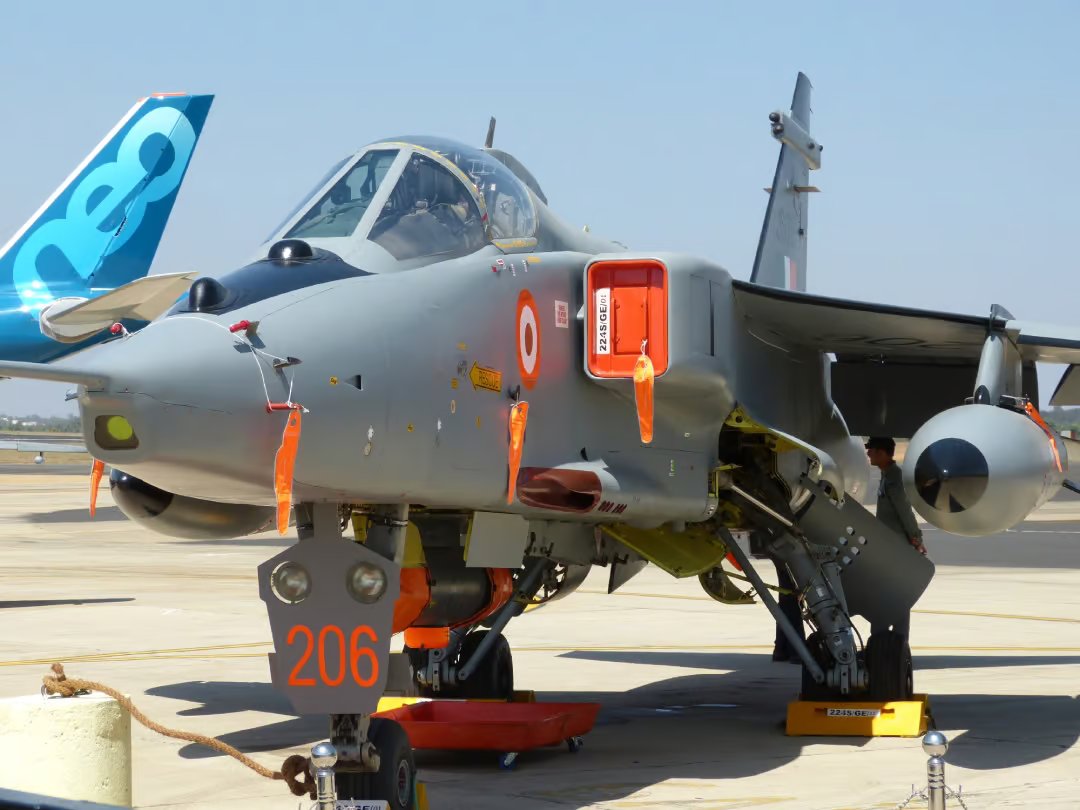

The Indian Air Force (IAF) is the sole operator of the Sepecat Jaguar tactical support fighter. Its current inventory includes 110 Jaguars, known in IAF service as the Shamsher (Assault Sword); 23 two-seat Jaguar IB operational trainers; 77 single-seat Jaguar IS ground-attack aircraft; and ten single-seat Jaguar IM maritime strike aircraft. The first were delivered in March 1981.
The sale included an agreement under which Hindustan Aeronautics Limited (HAL) would assemble the aircraft in India. The first kits were shipped from the United Kingdom in May 1981, and 80 Jaguars were subsequently built by HAL, each powered by two Adour Mk.811 turbofans. HAL-built Jaguars were also equipped with an indigenously developed Display Attack and Ranging Inertial Navigation (DARIN) avionics suite.
In 2018, India cannibalised 31 Jaguar A airframes purchased from France, plus two each from the UK and Oman, for spares. As part of a technology transfer agreement with Israeli Aerospace Industries (IAI), HAL manufactured 54 EL/M-2052 AESA radars for the Jaguar IS aircraft, the first of which was delivered in 2021.

In 2024, the IAF announced plans to retire the oldest batch of 60 aircraft between 2028 and 2031. Some 50 have been lost in accidents, including three in 2025. To keep these aircraft in service until the end of the decade, the IAF has sought more airframes to cannibalise for spares, finding them in Oman and Ecuador. The Royal Air Force of Oman operated 20 single-seat and four two-seat Jaguars between 1977 and 2024. After that, they remained in storage before being donated by Oman to India.
In January 2026, the IAF began negotiations with the Ecuadorian Air Force to acquire its remaining Jaguars. The Ecuadorian Air Force, the only Latin American export customer for the Jaguar, purchased ten single- and two-seat aircraft, the first of which were delivered in 1977. They were used mainly for ground-attack roles and occasionally for air-superiority duties during the Cenepa War with Peru in 1995. The fleet was then held in reserve in case of a wider conflict with Peru until 2002. They were placed in storage until 2006, and four airframes, plus one in a museum, would be available for transfer to the IAF to preserve the operational capacity of its Jaguar fleet.

by David Oliver
