

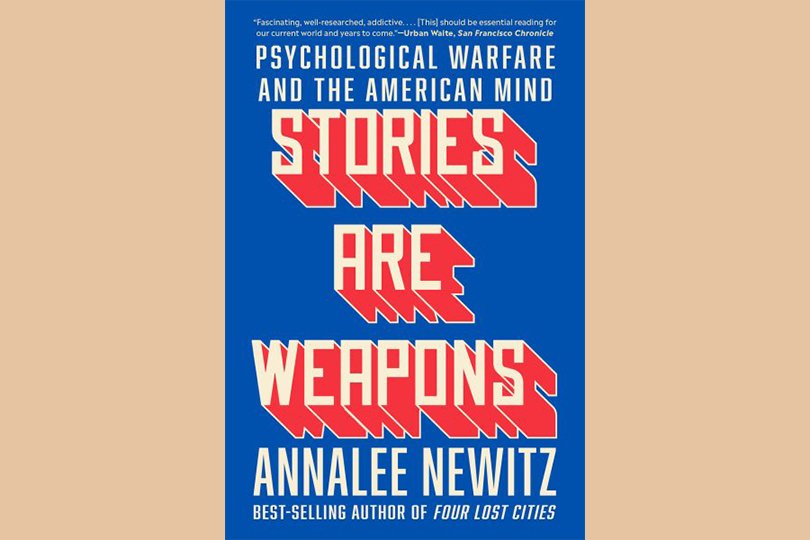
Stories are Weapons: Psychological Warfare and the American Mind
By Annalee Newitz
W.W. Norton and Company, 2024
Stories Are Weapons represents a welcome contribution to the literature on information warfare. It synthesizes reflection on the last decade with contemporary interviews and archival research. Drawing on records from the Propaganda and Psychological Warfare archive at the Hoover Institution at Stanford University, Analee Newitz probes the relationship between psychology, advertising, and the emergence of psychological warfare. They also illuminate the role of 20th century science fiction authors in the solidification of the U.S. military’s psychological warfare doctrine after World War II. However, Newitz’s most controversial contribution is their treatment of the American culture war, which some readers will find biased or polemical. However, no one should skip the book on this count.
Newitz begins with World War I, when the U.S. military’s propaganda and psychological operations (psy-ops)—these concepts were synonymous at the time—were helmed by the influential Walter Lippman. It segues to the emergence of modern psychology under Sigmund Freud, and the appropriation of his ideas by his nephew, Edward Bernays, the father of public relations, who applied Freud’s work in the advertising industry.
Over time, psy-ops became associated with the military, propaganda less so. Today, propaganda is a grey area between information warfare and advertising partly because debates between these titans were never resolved. In Public Opinion, for example, Lippman argues that democratic public life is eroded by propaganda.Freud agrees that propaganda is corrosive to civil society, but his nephew sees it as everyday communication. In Crystalizing Public Opinion, Bernays identifies persuasion as a civil right. Thus, despite Freud’s intent that psychology be used to protect people from manipulation, Bernays turned the former’s ideas to the sale of commercial goods and foreign policy adventurism, using psychology to hook suffragettes on smoking, and help United Fruit overthrow the Guatemalan government to establish a banana republic.
Science fiction also played an important role in the genesis of psychological warfare. Paul Linebarger, a U.S. Army intelligence officer, wrote Psychological Warfare, a 1948 handbook that remains recommended reading, especially among special operators working on influence and deception. A fan of John Carter of Mars, and Amazing Stories magazine, Linebarger was a prolific author whose work appeared under many pseudonyms. He wrote women’s literary fiction as Felix C. Forrest and spy novels as Carmichael Smith. Most importantly, writing under the nom de plume Cordwainer Smith, he became a cult sci-fi author active into the 1960s.
While Linebarger primarily wrote about war in space, he leveraged his PhD in political science to apply his ideas on Earth. As a student of political subterfuge and psychology, Linebarger helped the military understand that propaganda consists of stories aimed at winning allies and frightening adversaries. Words were as powerful as bombs. Stories could foster positive and negative emotions, cause confusion, and most importantly, they could alter political behavior. Thus, from his position at the Johns Hopkins School of Advanced International Studies, Linebarger taught his pupils how to weaponize stories and integrate sci-fi-style worldbuilding into psy-ops.
Newitz’s most provocative thesis concerns the way the U.S. culture war represents a domestic psy-war. The domestic application of psy-ops doctrine is ethically troubling. Political elites break down the walls between civilian non-combatants and legitimate military targets, triggering a process of epistemological breakdown wherein concepts like gossip, opinion, and influence operations become indistinguishable from democratic discourse.
While many will interpret Newitz’s framing of racism as a psy-op as an ideologically-motivated polemic, their argument is less that any particular political group is “bad,” and more that the weapons of psy-ops—scapegoating, deception, and violent threats—should be eschewed by all parties in democratic societies. Many political scientists would agree with this sentiment. Even so, many readers will see Newitz’s concomitant concern for social justice as a priori biased.
Ultimately, anyone interested in narrative, malign influence, psychological operations, or disinformation should read Stories Are Weapons; anyone concerned about bias can simply avoid sections on U.S. politics. The book’s real value lies in Newitz’s discussions of advertising and science fiction, and the roles they played in solidifying psy-ops doctrine in 1940s U.S. military thinking.
However, some of Newitz’s ideas regarding domestic politics still merit consideration. First, the general impact of disinformation within societies is worth understanding as a transnational phenomenon (i.e., simultaneously domestic and international). Second, Newitz’s idea that informational “deterrence” in domestic narrative conflicts is about defusing collective action is also theoretically meaningful. So, too, is their assertion that virality is not evidence of accuracy, but a sign of an active “influence operations kill chain” (p. 185-187).
Internationally, while a country’s psy-ops have the goal of hurting its enemies without kinetic force, they are still carried out to minimize bloodshed. As a result, the emergence of information warfare after the Cold War helps explain large-scale conflict under a nuclear umbrella. Today, as in the Cold War, propaganda allows great powers to compete without having to worry about nuclear escalation.
With this in mind, Newitz’s book represents an important contribution on the subject malign influence operations that should be read alongside The Routledge Handbook of Disinformation and National Security and Nina Jankowicz’s How to Lose the Information War. It has more evidentiary value than John Maxwell Hamiton’s work on the creation of the French 75 cocktail at the end of World War I, which ostensibly illustrates the symbiotic relationship between advertising and propaganda. For anyone seeking ideological balance, Newitz can be read against Lee McIntyre’s Post-Truth, which, following Paul R. Gross and Norman Levitt, identifies the academic left’s fascination with postmodernism as at least partially responsible for sparking the post-truth era. Richard Stengal’s more practical Information Wars also balances Newitz’s theoretical conjecture. Newitz believes the U.S. creates a perception of lying by failing to act in ways consistent with its words. For Stengal, the problem is institutional; ponderous bureaucracies are incapable of competing at speeds consistent with the West’s adversaries. In the end, students and security thinkers interested in narrative warfare will find both perspectives valuable.
