

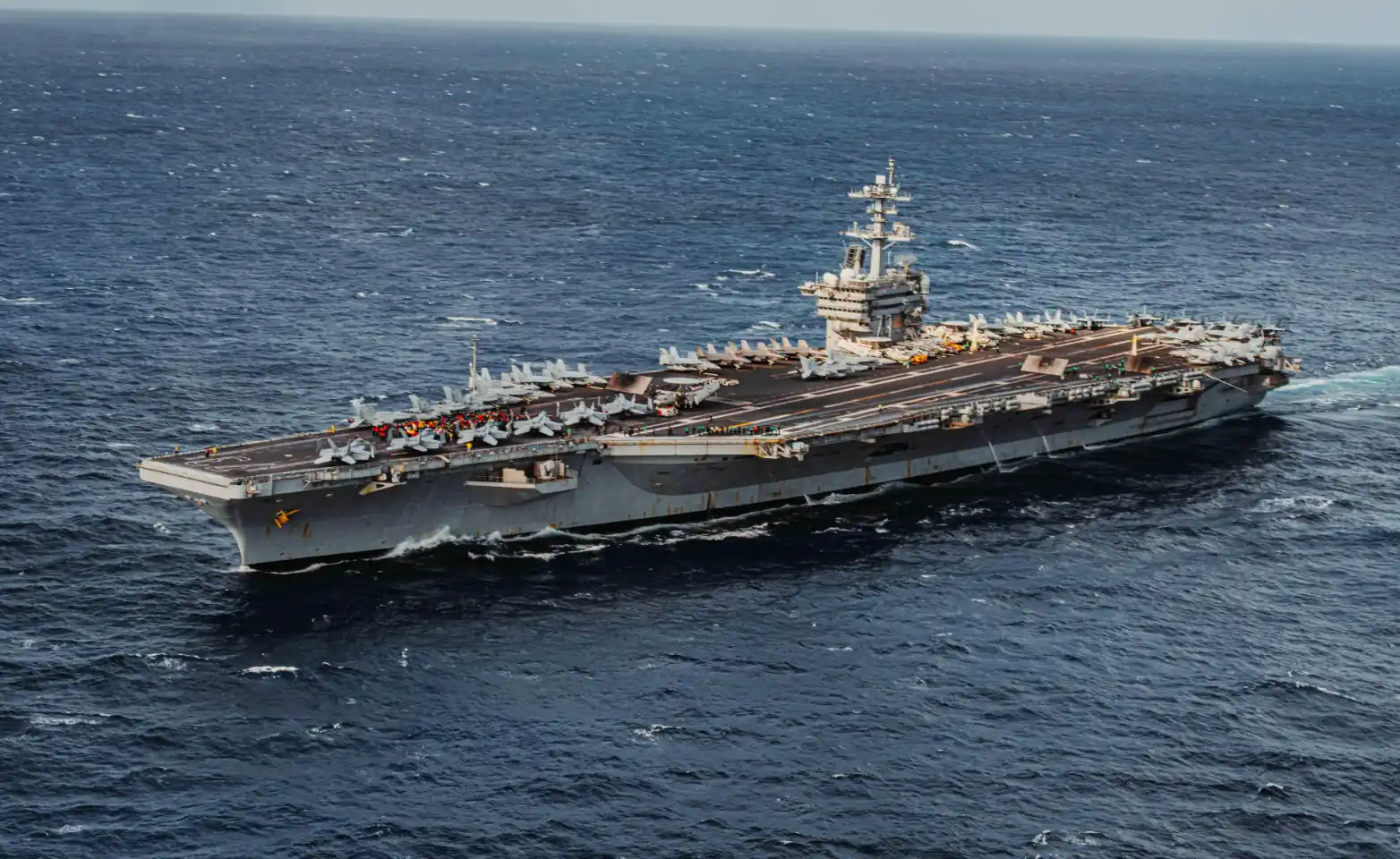
Picture a floating city the length of three football fields, powered not by fuel trucks but by splitting atoms, carrying more aircraft than most countries own outright. That’s USS George Washington, hull number CVN-73, a Nimitz-class aircraft carrier that quietly (and sometimes very loudly) shapes the balance of power across the Pacific.
Commissioned on July 4, 1992, the symbolism wasn’t subtle. Named after President George Washington, the ship represents continuity, from the birth of the United States to modern carrier strike group dominance. Yet this isn’t just a ceremonial namesake.
The USS George Washington is a 100,000-ton instrument of policy, logistics, aviation, diplomacy, and, when necessary, force.
Today, the USS George Washington serves as a forward-deployed aircraft carrier based in Yokosuka, Japan, a strategic move that places American naval airpower within rapid reach of the East China Sea, South China Sea, and beyond. In geopolitical terms, location is leverage.
But here’s the angle most people miss: this ship isn’t just steel and jets. It’s a floating ecosystem of roughly 5,000 sailors and aviators. Think of it as a compact, hyper-efficient metropolis, complete with hospitals, jet workshops, bakeries, chapels, and more caffeine per square foot than Manhattan.
And that’s just the beginning.
Construction & Commissioning of USS George Washington
Before USS George Washington (CVN-73) ever projected power across the Indo-Pacific, it existed as sheets of steel and ambitious blueprints inside Newport News Shipbuilding in Virginia, the only U.S. shipyard capable of building nuclear-powered aircraft carriers. That fact alone says something. You don’t just “assemble” a Nimitz-class aircraft carrier. You orchestrate it.

Construction officially began when the keel was laid on August 25, 1986. Over the next several years, more than 50,000 tons of structural steel were shaped, welded, lifted, and rewelded into what would become a floating airbase.
At peak construction, thousands of shipbuilders worked simultaneously, electricians threading miles of cabling, pipefitters routing complex reactor cooling systems, engineers checking tolerances measured in fractions of inches. Controlled chaos, but purposeful.
Here’s a snapshot timeline:
| Milestone | Date |
| Keel Laid | August 25, 1986 |
| Launched | July 21, 1990 |
| Commissioned | July 4, 1992 |
| Cost (approx.) | $4.1 billion (1990s USD) |
The commissioning date, July 4, 1992, wasn’t accidental. Independence Day. Symbolism layered onto steel. Named after George Washington, the carrier entered service during a post–Cold War transition period when the U.S. Navy was redefining its global posture.
What often goes unmentioned is how commissioning marks a psychological shift as much as a technical one. A ship goes from industrial project to sovereign territory. From workforce to warship.
And once CVN-73 was placed into active service, it didn’t ease into duty. It moved quickly into deployments that would define its role as one of the most strategically important forward-deployed aircraft carriers in modern naval history.
Technical Specifications of USS George Washington (CVN-73)
At first glance, USS George Washington looks like brute force incarnate.
But its real strength lies in precision engineering, millions of parts working in quiet coordination so jets can launch every 20–30 seconds during peak operations. This isn’t just a ship. It’s a self-sustaining aviation platform designed to operate continuously for months, sometimes longer, without touching land.
Let’s break down the core specifications that make CVN-73 such a formidable Nimitz-class aircraft carrier:
| Specification | Detail |
| Ship Class | Nimitz-class nuclear aircraft carrier |
| Commissioned | July 4, 1992 |
| Length | 1,092 feet (333 meters) |
| Beam (Flight Deck Width) | 252 feet (77 meters) |
| Displacement | Approx. 97,000–104,000 tons (fully loaded) |
| Propulsion | 2 nuclear reactors, 4 shafts |
| Maximum Speed | 30+ knots (56+ km/h) |
| Crew | ~3,200 ship crew + ~2,400 air wing |
| Aircraft Capacity | 75–90 aircraft |
| Homeport | Yokosuka, Japan |
The nuclear propulsion system is arguably its most defining feature. Unlike diesel-powered ships that require frequent refueling, USS George Washington’s reactors can operate for about 20–25 years before refueling is needed. That’s not a typo. It allows the carrier to cross entire oceans repeatedly without worrying about fuel logistics.
Read also: USS Ronald Reagan (CVN-76): What Makes This Carrier So Powerful?
Its flight deck spans 4.5 acres, essentially a mobile airport. Aircraft like the F/A-18 Super Hornet, EA-18G Growler, E-2D Hawkeye, and MH-60 helicopters operate from its surface daily. Each launch uses steam catapults capable of accelerating a 30-ton jet from zero to takeoff speed in under three seconds.

And then there’s the human factor. Nearly 5,600 personnel live aboard during full deployment. That’s more people than some small towns, except here, everyone has a job tied directly or indirectly to keeping aircraft flying and the ship alive.
It’s not just big. It’s relentlessly functional.
Life Aboard the USS George Washington
When people picture the USS George Washington, they imagine jets and radar screens.
What they don’t imagine, at least not right away, is laundry lines of uniforms, midnight chow lines, or the oddly comforting smell of industrial coffee drifting through steel corridors at 0200.
The USS George Washington aircraft carrier carries roughly 5,000 personnel when the air wing is embarked. That’s more than the population of many small towns. And just like a town, it runs 24/7.
Here’s how that “city at sea” breaks down:
| Category | Approximate Number |
| Ship’s Crew | ~3,200 |
| Air Wing Personnel | ~2,000 |
| Total Population | ~5,000 |
| Meals Served Daily | 15,000+ |
| Fresh Water Produced | ~400,000 gallons/day |
Yes, 15,000 meals a day. Every day. The galley never truly rests.
Sailors work in rotating shifts called watch rotations. Four hours on duty, eight hours off, if you’re lucky. Some divisions operate on tighter cycles during flight operations. Catapult crews launch aircraft in seconds; reactor technicians monitor nuclear systems with near-ritual precision. A mistake isn’t just paperwork, it’s consequence.
And yet, there’s normal life woven into it all. Gyms below deck. Movie nights projected onto bulkheads. Internet access, limited but cherished. Mail call days that feel like small holidays.

Forward deployment in Yokosuka adds another layer. Families live overseas. Sailors step off a warship and into Japanese city streets on liberty weekends. Cultural blending happens quietly, baseball games, ramen shops, shared festivals.
It’s easy to talk about tonnage and firepower. Harder to grasp that the USS George Washington runs on people more than reactors.
Steel floats. But it’s sailors who make it move.
Deployment History: From Atlantic Patrols to Indo-Pacific Power
If steel had memory, USS George Washington would remember oceans in layers.
After commissioning in 1992, CVN-73 began operations in the Atlantic, Mediterranean, and Persian Gulf. Early deployments supported enforcement missions over Iraq in the 1990s, including Operations Southern Watch and Desert Fox.
In those years, the Nimitz-class aircraft carrier became a symbol of post–Cold War American reach, visible, mobile, and unmistakably present.
Then came 2008. A pivotal shift.
USS George Washington replaced USS Kitty Hawk as the only forward-deployed U.S. aircraft carrier in Japan, homeported in Yokosuka. This wasn’t just a change of address; it was a strategic recalibration.
Stationing a nuclear-powered aircraft carrier permanently in the Western Pacific reduced response times to regional crises from weeks to days.
Here’s a simplified deployment arc:
| Period | Operational Focus |
| 1990s | Mediterranean & Persian Gulf operations |
| Early 2000s | Middle East support & maritime security |
| 2008–2015 | Forward-deployed to Yokosuka, Japan |
| 2017–2023 | Refueling & Complex Overhaul (RCOH) |
| 2024–Present | Returned to Japan, Indo-Pacific missions |
The Refueling and Complex Overhaul (RCOH), completed after nearly six years, was essentially a mid-life rebuild. Nuclear fuel replaced. Combat systems modernized. Radar, electronics, berthing, and flight deck systems upgraded. Think of it as a deep reset designed to extend service life another 25 years.

By 2024, USS George Washington returned to Japan, refreshed, upgraded, and strategically critical in an era of intensified Pacific competition.
What’s remarkable isn’t just where the ship has sailed. It’s how its role has evolved, from post-Cold War stabilizer to a frontline presence in today’s Indo-Pacific security architecture.
And that evolution continues.
Strategic Role of USS George Washington in the Indo-Pacific
Here’s where USS George Washington stops being a ship and starts being a statement.
Forward-deployed in Yokosuka, Japan, CVN-73 sits less than 1,000 nautical miles from flashpoints like the Taiwan Strait and the Korean Peninsula.
In naval terms, that proximity changes everything. A carrier strike group sailing from California might take two to three weeks to reach East Asia. USS George Washington? Days.
That speed matters.

As part of Forward Deployed Naval Forces–Japan (FDNF-J), the Nimitz-class aircraft carrier operates alongside allied forces, particularly the Japan Maritime Self-Defense Force and South Korea’s navy.
Joint drills like large-scale maritime exercises aren’t just choreography; they test interoperability, shared communications systems, coordinated air defense, cross-deck aircraft operations. It’s military teamwork at 30 knots.
A carrier strike group built around CVN-73 typically includes:
- 1 Ticonderoga-class guided missile cruiser
- 2–3 Arleigh Burke-class destroyers
- 1 fast-attack submarine (often operating quietly nearby)
- Carrier Air Wing with 70+ aircraft
That layered defense network creates a mobile air and missile shield spanning hundreds of miles.
But strategy isn’t just about firepower. It’s about reassurance. When USS George Washington conducts port visits in Southeast Asia or sails through contested waters under international law, it sends a subtle message: sea lanes remain open.
Think of it like a lighthouse that can move, visible, stabilizing, and occasionally intimidating.
In today’s Indo-Pacific security landscape, CVN-73 isn’t just reacting to events. It shapes them.
Why the USS George Washington Still Matters in Modern Naval Warfare
You might wonder, why invest billions in a single aircraft carrier in an age of drones, cyberwarfare, and hypersonic missiles? Fair question. But the USS George Washington isn’t a relic. It’s a recalibrated tool for 21st-century competition.
Let’s talk scale first. A Nimitz-class carrier like CVN-73 can launch 120+ sorties per day during sustained operations. Surge conditions? Even higher. That’s airpower without relying on foreign runways. No diplomatic clearance needed. The ship moves; the airfield moves with it.

Today’s USS George Washington aircraft carrier typically embarks variants of the F/A-18 Super Hornet, EA-18G Growler electronic warfare aircraft, E-2D Hawkeye early warning planes, and MH-60 helicopters.
This mix gives the Carrier Strike Group layered reach: strike capability, electronic attack, airborne command and control, anti-submarine warfare. Not flashy buzzwords, integrated systems.
And then there’s deterrence math.
A forward-deployed carrier operating under the United States Seventh Fleet signals commitment in the Indo-Pacific without permanent escalation. It reassures allies while complicating adversary planning. Naval strategists call this “presence with flexibility.” I’d call it chess at 30 knots.
After completing its Refueling and Complex Overhaul, CVN-73 returned with updated combat systems and extended service life into the 2040s. That means the ship is positioned squarely inside the era of unmanned aviation and network-centric warfare.
Carriers are already integrating MQ-25 Stingray refueling drones fleetwide, extending the strike range of manned aircraft.
So no, the USS George Washington CVN-73 isn’t outdated. It’s evolving.
Technology changes. Rivalries shift. Oceans remain.
And somewhere in the Pacific, a 1,092-foot flight deck still turns wind into lift, launch after launch, day after day.
