

Across Southeast Asia, the threat landscape is defined by complexity, dispersion, and persistence. From insurgencies in the southern Philippines and Thailand, to piracy across the Strait of Malacca, and mounting tensions in the South China Sea, regional armed forces must operate across vast geographies while balancing cost, precision, and operational readiness. Against this backdrop, EDGE’s portfolio of smart weapon systems, on display at DSA 2026, offers regional forces highly accurate, modular, and cost-effective solutions tailored to modern asymmetric and conventional warfare.
At the core of this offering is a tightly integrated ecosystem spanning precision-guided munitions (PGMs), glide weapons, and loitering munitions. Systems such as DESERT STING 16 and 25, THUNDER P31 and P32, SHADOW 25 and 50, and AL TARIQ collectively address the region’s operational requirements, from counter-insurgency (COIN) to maritime strike and border security.
Addressing asymmetric and distributed threats
A defining characteristic of Southeast Asia’s security environment is the prevalence of violent non-state actors (VNSAs) operating in difficult terrain, including jungles, archipelagos, and urban environments. Precision and responsiveness are therefore critical.
EDGE’s DESERT STING family exemplifies this approach. These lightweight, air-launched glide weapons utilise GNSS-assisted inertial navigation (GAINS) combined with optional semi-active laser (SAL) guidance to achieve high levels of accuracy, down to three metres circular error probable (CEP) with laser designation.
For forces engaged in COIN operations, such as the Armed Forces of the Philippines or the Royal Thai Armed Forces operating in the south, this level of precision enables the neutralisation of high-value targets while minimising collateral damage, which is an essential requirement when operating near populated or politically sensitive environments.
The scalability of the DESERT STING family further enhances its relevance. DS-16, with its lighter 23 kg-class configuration and 15 km range, is suited to tactical engagements and unmanned aerial vehicle (UAV) integration, while DS-25 extends reach beyond 24 km with a heavier payload. This flexibility allows operators to tailor effects to mission requirements without overcommitting high-cost assets.
Cost-effective modernisation for legacy forces
Many Southeast Asian militaries continue to rely on legacy platforms. Budget constraints and lengthy procurement cycles make wholesale replacement impractical. EDGE addresses this challenge through retrofit and upgrade solutions such as THUNDER P31 and P32.
The THUNDER systems convert standard unguided bombs (MK-81 and MK-82) into precision-guided munitions using modular guidance kits. This approach delivers immediate capability uplift without requiring new aircraft or extensive integration programmes.
With ranges of up to 27 km (P31) and 24 km (P32), and an accuracy of three metres CEP (with laser designation), this combination enables stand-off engagement while maintaining affordability. For air forces seeking to expand precision strike capacity at scale, THUNDER represents a pragmatic pathway to modernisation.
Long-range precision for strategic deterrence
While asymmetric threats dominate headlines, interstate tensions require credible deterrence capabilities. Here, EDGE’s AL TARIQ system provides an affordable and scalable high-end solution.
AL TARIQ is a highly modular family of mission-proven, long-range PGM kits designed for 120 kg to 450 kg class munitions, offering stand-off ranges exceeding 120 km and sub-two metres accuracy with imaging infrared (IIR) seekers. Its multi-mode guidance, combining GNSS/INS, IIR with automatic target recognition, and SAL, ensures precision in all-weather conditions, day or night, against stationary or moving threats. Operational effectiveness is even guaranteed in GPS-denied environments through the system’s built-in GPS anti-jammer.
This capability is particularly relevant in electronic warfare-heavy scenarios, where adversaries may attempt to degrade satellite navigation. AL TARIQ’s resilience to such conditions, combined with its ‘fire-and-forget’ functionality and ability to engage moving or relocatable targets from advantageous distances, enhances survivability for both aircraft and pilots while simplifying mission planning.
Moreover, its variable attack angle, variable attack heading, and modularity allow operators to configure payloads, seekers, and engagement profiles based on mission needs, such as strikes against environmentally protected targets, infrastructure targeting, or battlefield interdiction. This aligns closely with the requirements of countries like Malaysia and Indonesia, which must monitor and defend expansive territories.

Rapid response through loitering munitions
One of the most transformative elements of modern warfare, particularly in counter-insurgency and border security, is the rise of loitering munitions. EDGE brings advanced capabilities in this domain with the SHADOW series.
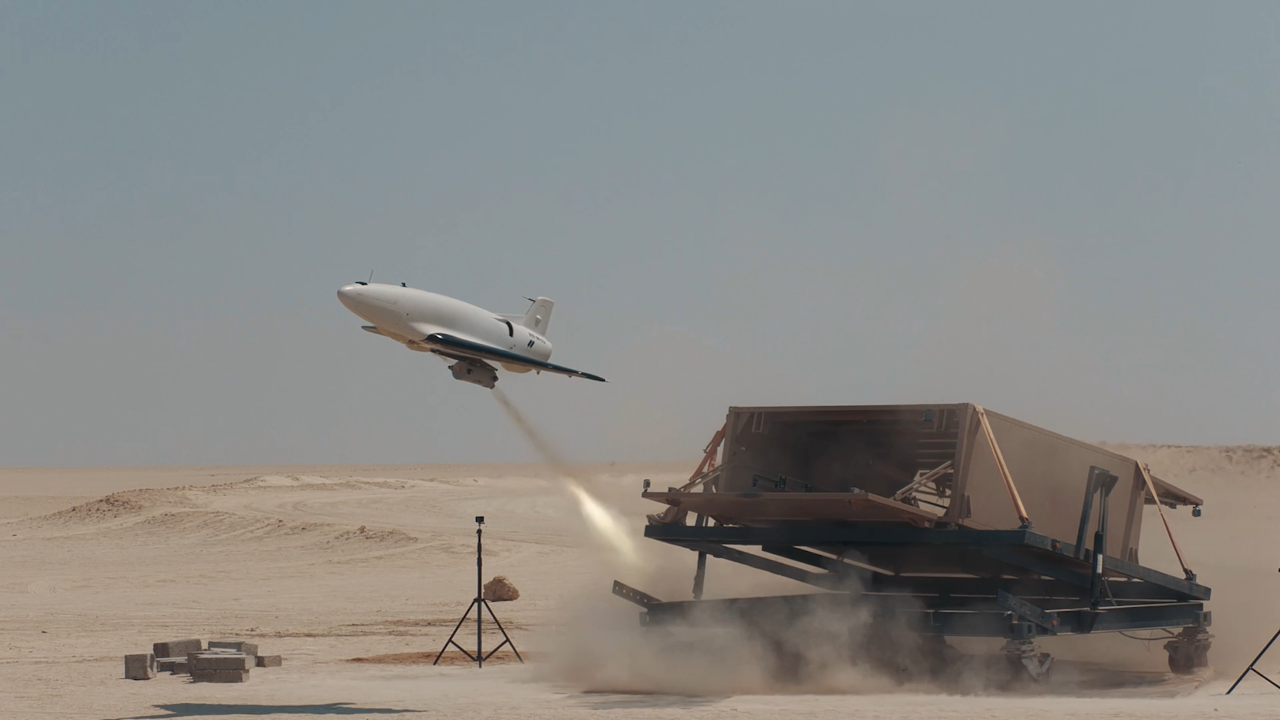
SHADOW 25 provides a jet-powered, rapid-strike loitering munition capable of engaging targets up to 250 km away at speeds of 400 km/h. With onboard video navigation and advanced guidance systems, it enables real-time target identification and engagement, an ideal feature for time-sensitive missions.
For example, in maritime security operations against piracy or smuggling networks, SHADOW 25 can be deployed to monitor and strike fast-moving targets with minimal delay.
Complementing this is SHADOW 50, which prioritises endurance and payload. With up to nine hours of loiter time and a 50 kg payload, it is suited for persistent surveillance and strike missions over large areas. This makes it particularly valuable for archipelagic nations like Indonesia, where maintaining continuous coverage across vast maritime zones is a persistent challenge.
Together, these systems provide a layered capability: rapid-response strike (SHADOW 25) and long-endurance presence (SHADOW 50). This duality is critical for addressing both immediate threats and sustained operations.
Integrated ecosystem and industrial partnerships
What distinguishes EDGE’s offering is not just individual platforms, but integration across its ecosystem. Through its entities, HALCON, AL TARIQ, and ADASI, EDGE collectively delivers a full spectrum of smart weapon capabilities, from guidance kits to autonomous strike systems, supported by in-house design, manufacturing, and testing expertise. This vertical integration directly translates to reduced lifecycle costs, faster delivery timelines, and greater adaptability to customer requirements.
Additionally, EDGE places a robust emphasis on localisation and partnership, exemplified by its USD 7 billion cooperation agreement with Republikorp to establish a localised defence manufacturing ecosystem in Indonesia. This ability to conduct transfers of technology (ToT), localise production, and initiate co-development initiatives resonates strongly in Southeast Asia, where governments increasingly prioritise sovereign defence capabilities and domestic industrial development.
AL TARIQ’s existing collaborations with international partners, including integration efforts with major aerospace firms, further underscore its ability to support localised manufacturing and technology transfer initiatives.
Precision, reliability, and affordability as force multipliers
Ultimately, the value proposition of EDGE’s smart weapon systems lies in their ability to reconcile three often competing priorities: precision, reliability, and cost-effectiveness.
Systems like DESERT STING and THUNDER provide affordable entry points to precision strike, while AL TARIQ and SHADOW deliver advanced capabilities for high-end missions. This tiered approach allows militaries to build balanced, flexible arsenals aligned with their specific threat environments.
As Southeast Asia navigates an increasingly complex security landscape, the demand for adaptable, precise, and cost-efficient weapon systems will only intensify. EDGE’s showcase at DSA 2026 reflects a strategic understanding of these requirements.
By combining advanced guidance technologies, modular architectures, and scalable solutions, EDGE is addressing current operational challenges while also enabling future-ready force structures. Whether countering insurgents in dense terrain, securing maritime routes, or deterring state adversaries, its smart weapon ecosystem offers a comprehensive and credible solution for the region’s evolving defence needs.
