

By Steve Wills
“When leaders design warships the results are often mixed.”
Leaders throughout history, going back at least to the Egyptian pharaoh Hatshepsut, have commissioned the building of great fleets for national security purposes. Henry 8th and Elizabeth 1 created fleets for the defense of England. George Washington authorized the first Continental navy units, and Abraham Lincoln spearheaded the acceptance of armored warships for the United States navy to help defeat Confederate ironclads like CSS Virginia. Teddy Roosevelt was a fan of larger and larger battleships, and he dispatched the Great White Fleet on its global deterrence mission. More recently, President Franklin Roosevelt began the rebuilding of the U.S. navy ahead of World War 2, and President Ronald Reagan’s 600 ship navy in the 1980’s helped to deter conflict with the Soviet Union and bring the Cold War to a close. On the other hand, rulers personally designing their nation’s warships have seen mixed outcomes. Swedish King Gustavus Adophus’ decision to add additional armament to the ship of the line Vasa arguably contributed to that ship’s accidental sinking on its maiden voyage in 1628. The German Kaiser Wilhelm II was an enthusiastic navalist, but his individual ship designs, often at odds with the laws of physics, were the bane of his naval chief Admiral Alfred von Tirpitz. Joseph Stalin was very much a landsman but delighted in suggesting design elements for the Soviet navy’s Stalingrad class battlecruisers that were hated by Soviet naval leadership. Even Great Britain’s Lord Louis Mountbatten’s attempts to design a warship, in his case a gigantic aircraft carrier made of ice, met with less than ideal results. History suggests that leaders should direct the missions and construction program for fleets but save the concepts and designs of individual warships to their navies.
“Next to God the navy is the most important for the success of the country.”
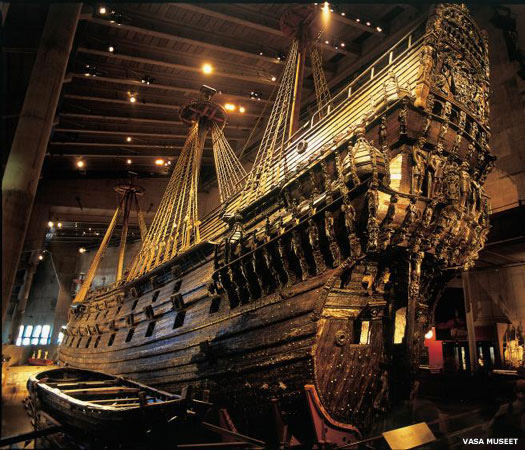
Swedish King Gustavus Aldophus was a revolutionary monarch who greatly expanded the scope and power of the Swedish kingdom over his twenty-plus year reign. He greatly improved his nation’s military and political organization and was one of the military leaders most admired by Napoleon for his campaigns in the bloodbath of the European Thirty Years War, a conflict that ultimately took his life in 1632.
Among his many skills, Gustavus Adolphus was a believer in the power of mobile, effective artillery as a battle-winning tool. The Swedish Navy he inherited featured mostly medium-sized and smaller warships that often relied on the boarding and capture of opponent naval vessels with guns being secondary to combat efforts. The Swedish King however needed to keep open supply lines across the Baltic Sea in order to preserve communication throughout his kingdom and demanded a larger and more capable class of warships to support that mission. That meant a modern warship with standardized cannon mounted on at least two gundecks in order to deliver reliable firepower. The King personally chose the twenty-four pound Swedish army demi-gun developed as a lightweight, mobile weapon for sieges as Vasa’s primary armament.
Vasa had begun construction in 1626, but there had been delays in fitting her armament of over fifty and ultimately sixty four guns, of which the bulk were the 24 pound weapons. Gustavus Adolphus was angry at the delays in the outfitting of his new vessel to the point where he sent one of his personal artillery masters Erik Jonnson back from the battlefields of Poland to get the Vasa’s armament fitting back on schedule. The King reportedly visited the ship in January 1628, but most of his exhortations in a steady stream of letters to the builder came from abroad, but all of them demanded that Vasa needed to go to sea immediately in support of protecting sea lines of communication in the Baltic.
When Vasa was ready to embark on her first voyage in the spring of 1628, she was a dangerously unstable vessel, despite compromises in her armament. Gustavus Adolphus ordered seventy two of the 24 pound guns for the ship, and it was decided the ship would carry fifty six such weapons, but ultimately only forty eight of the weapons were mounted, but on the two full gun decks the King desired. Dutch naval architects that designed the ship had already opted for a relatively shallow hold for the ship that did not adequately support the weight of two gun decks above. The addition of the twenty-four pound weapons may have made the ship’s capsizing on her first voyage on 10 August 1628 inevitable. Gustavus Adolphus was furious at the loss of his prized ship, and immediately made plans to salvage her expensive, standardized artillery. He ordered a court to investigate the ship’s loss demanded, “In no uncertain terms that the guilty parties be punished.” The Captain of Vasa Söfring Hansson, who survived the disaster, assured investigators that all was in order and that the crew was not intoxicated at the time of Vasa’s departure from Stockholm. Much of the blame was ultimately assigned to the Dutch naval architects who designed the hull. Gustavus Adophus once said, “Next to God the navy is the most important for the success of the country,” but he had signed off on all of the ship’s specifications. One of the builders suggested that only God knew the reason for the loss of the ship, but the King had hurried construction and demanded the heavier armament, and as one of the builders Hein Jacoksson stated before the inquiry court, “His Majesty had approved these measurements. The number of guns on board was also as specified in the contract.”
“Stag and Homunculus Dead”
German Admiral Alfred von Tirpitz’s attempts to build a powerful German fleet in the first decade of the 20th century were both aided and hobbled by the enthusiasm of Germany’s ruler Kaiser Wilhelm II. The Kaiser was an enthusiastic navalist and often appeared in the uniforms of not only his own navy, but also those for which he was but an “honorary” flag officer. Unfortunately for Tirpitz, the Kaiser not only advocated for his navy, but also wanted a hand in the design of individual ships. Responding to a report that stated that longer-range naval gunnery was making the mission of torpedo boats more challenging, the Kaiser designed his own high speed, heavily armored “torpedo battleship.” Such suggestions were common from the ruler and Tirpitz noted in his memoirs that his team set to work to assess “the impossible,” noting that the Kaiser’s design was unworkable as the ship’s vast torpedo armament (all tubes were underwater,) combined with heavy armor left no space for required engineering space. Tirpitz’s team nicknamed the unfortunate creation “the Homunculus.” The admiral journeyed to the Kaiser’s hunting lodge where the ruler was on yet another vacation and presented the facts to his leader. Wilhelm gracefully decamped from his naval designer role for the moment, and Tirpitz breathed a sigh of relief. Afterward he was invited to join the Kaiser’s hunting expedition. He later reported to his staff, “stag and Homunculus dead.” So ended that particular imperial effort at warship design.
“You possibly do not know what you need,” which means battleships!
Joseph Stalin was not much of a “navalist” until later in his rule of the Soviet Union, but when he did so, it was with the same, single-minded, ruthless determination with which he pursued other endeavors. Stalin ordered a large, ocean-going fleet in the late 1930’s that was in general a balanced fleet of battleships, cruisers, and destroyers. Salin’s reasoning for building this first ocean-going fleet remain obscure, but “Under Stalin’s direct inspiration and involvement, plans for creating a huge ocean-going navy—bolshoi okeanskii flot—took shape,” and continued even into the beginning of World War 2. The dire necessity to repel invading German forces from the Motherland commanded that Soviet resources be used elsewhere rather than in an ocean-going battleship navy. Once the war ended, however, Stalin resumed his push for a large, ocean-going battleship fleet, even when he senior naval leaders preferred to build aircraft carriers as the new 20th century capital ship. Stalin became personally involved in the primary, postwar capital ship design, labeled the Stalingrad class battlecruiser. Stalin specifically demanded high speed for the class, and an armament of nine twelve inch guns to ensure the Stalingrad’s could outrange any British or American cruiser guns. Soviet admirals who got in his way suffered his wrath and the Soviet leader dismissed Fleet Admiral Kuznetsov in early January 1947 for such opposition. Upon Stalin’s death in 1953 the Stalingrad’s were almost immediately cancelled by his successor Nikita Krushchev. The incomplete hull of Stalingrad was launched; used as a floating target for anti-ship missiles, it was scrapped around 1962. Stalin’s naval leaders had pleaded with the dictator even before World War 2 for more submarines and smaller warships, especially in the confined waters of the Black Sea. Stalin was a man of few words and famously replied to his admirals in 1936, “you possibly do not know what you need,” which for many historians suggests Stalin was fully in support of big-gunned warships above all others.
“To hell with Habakkuk!”
Finally, there was the case of Lord Louis Mountbatten’s Habakkuk pykrete aircraft carrier. Mountbatten had been a Royal Navy signals expert before World War 2 and liked to tinker with naval technology. He persuaded British wartime Prime Minister Winston Churchill to take an interest in a giant, 2000 foot long super carrier made of an ice and wood pulp combination known as pykrete. Mountbatten dramatically presented the power of pykrete to Churchill and other senior leaders at the 1943 Quebec Conference. Two blocks of material, one of normal ice and one of the pykrete mixture were wheeled into the conference room. Mountbatten dramatically removed a pistol from his jacket and proposed to demonstrate the armor like properties of pykrete. He first fired a shot into the ice block which immediately shattered. His second shot at the pykrete bounced off the target, and ricocheted around the room, almost hitting U.S. Admiral Ernie King or British Field Marshal Alan Brooke (the accounts of the incident vary.) It was not an auspicious start to the project, and it was later cancelled as the introduction of much smaller and numerous escort carriers solved the problem of lack of airpower in Arctic seas. A small test ship 1/50 the size of the giant carrier was built and operated on a lake in Canada with some success over the winter but melted and sank with the spring thaw. Field Marshall Lord Alan Brooke perhaps best summed up the challenges of Mountbatten’s ice carrier when he told the admiral at the Quebec conference, “To Hell with Habakkuk! We are about to have the most difficult time with our American friends and shall not have time for your ice carriers.” As it turned out, there was thankfully no time or funding for this particular fantasy fleet.
“I’m Not Into this Detail Stuff, I’m More Concepty”
Defense Secretary Donald Rumsfeld is perhaps best known for his attempts to “transform” the military to meet new and unconventional threats such as seen on 9/11 and other cases in the last twenty five years. These extended to the Navy as well and have sadly come to be represented by the very truncated DDG-1000 (now Zumwalt class destroyer, and the littoral combat ship LCS.) Rumsfeld had been a naval reservist aviator, and had as he said in his memoir, “a healthy respect for the men and women in unform,” but that, “my role as Secretary of Defense was different.” This involved high level leadership and not a focus on details unless immediately the task at hand. Rumsfeld could be very detail-oriented, as he proved when ordering the cancellation of the troubled Army 155mm mobile artillery Crusader vehicle in May 2002.
This detail focus did not extend to the Navy’s DDG-1000 and Littoral Combat Ship programs that evoked well Rumsfeld’s desire to transform the military into a lighter and more agile institution. Both vessels packed excessive amounts of “transformational” equipment, and organizational change into just one generational change in warship. Both types had many new, and as it turned out immature equipment, that began to fail operational testing and other measures of effectiveness. These repeated test failures in propulsion and combat systems, as well as within the vital LCS mission packages excessively delayed both programs which in turn dramatically raised their costs. In effect, each of these programs overloaded the already byzantine defense acquisition and test and evaluation system, but repeated systemic delays that made both ship types, especially the DDG-1000, unaffordable as designed.
Mr Rumsfeld had left office when these problems became more glaringly apparent, and while he was not directly responsible, and was buys engaged in the “War on Terror,” and later invasion of Afghanistan, but he or his immediate subordinates should have perhaps checked back more on the progress of these transformational efforts. In a 2002 Washington Post on operations in Afghanistan in the wake of the 9/11 attacks that included his recollections of detailed plans for attacks on terrorists there, Rumsfeld stated, “I’m not into this detail stuff. I’m more Concepty.” Perhaps in the case of LCS and DDG-1000’s immature Rumsfeld should have been more engaged in the details.
“All I can say is what the girl said when she put her foot in the stocking. It strikes me there’s something in it”
One of the few political leaders who were perhaps responsible for a questionable, and certainly “transformative” but later successful warship design was Abraham Lincoln. The President had heard of the construction of a rebel “monster ship” from the burned remains of the scuttled frigate USS Merrimac in Norfolk, Va, and authorized an immediate response, stating, “”one or more ironclad steamers or floating batteries, and to select a proper and competent board to inquire into and report in regard to a measure so important.” Swedish-born designer John Ericsson planned to submit the revolutionary Monitor design to this U.S. Navy board Lincoln authorized, but the Navy was not fan of the hot-headed Swedish innovator, who had designed a revolutionary screw propellor for the USS Princeton, but was blamed for the disastrous explosions of one of the ship’s guns on trials. Despite his unpopularity, Ericsson persisted in sending his design to the Ironclad board. While Navy officers were dismissive, President Lincoln was intrigued by the design and Monitor was included in the trio of ironclad warships authorized by Congress from a field of seventeen overall entries. Monitor was essentially built by a startup company with dozens of new patents, but was completed before the others and enroute to Hampton Rhodes when CSS Virginia’s 8 March 1862 massacre of Union wooden ships Cumberland and Congress.
Fearing the ex-Merrimac/CSS Virginia might attack Washington DC from the Potomac River, in the wake of the Hampton Roads disaster, some of Lincoln’s cabinet feared the worst, but of course Monitor arrived on time and in an indecisive battle on 9 March 1862 prevented the Confederate ironclad from damaging or destroying other wooden ships. Lincoln toured the Hampton Roads area after the battle, and even inspected Monitor in person, and received briefings from her officers on the battle with the Virginia. While Lincoln played a key role in getting the revolutionary USS Monitor constructed and was a fan of the turreted vessels throughout the war, he was not deep in the details of its construction. When seeing the ship’s design, however he did remark, “All I can say is what the girl said when she put her foot in the stocking. It strikes me there’s something in it” Like Rumsfeld, Lincoln was later too busy fighting a war to really get into the design of successor monitors, notably the failed Casco class shallow draft monitors, that like LCS 140 years later tried to accomplish too many transformational changes (shallow draft, armored turret, better speed,) in a limited hull form.
In retrospect, even the most resolute navalist leader should be advised from advocating for specific types of ships and should never descend into the details of their construction unless perhaps scholastically trained to do so, and in the part of being a good manager. Gustavus Adolphus was a land forces commander who got carried away with loading artillery onto Vasa’s already unstable hull. Kaiser Wilhem fancied himself an expert in everything but was at least willing to give way on some of his more outrageous naval designs. Joseph Stalin’s naval motives remain unclear, but he was always in favor of bigger as better, regardless of cost. Admiral Mountbatten was a visionary in many fields, but his Habakkuk giant carrier was probably an expensive bridge too far, and it was logically discarded. Donald Rumsfeld had a clear concept of transforming the military for new threats but never transformed the acquisition and test and evaluation system to support his vision or checked back enough to evaluate the initial fruits of his call to action. Abraham Lincoln perhaps best represents how senior leaders can enable dramatic naval advances without getting too deep in the details. Lincoln also followed through in checking up on the first of the class in monitor vessels, something that modern presidents and Navy Secretaries might do as well. President Trump’s Great Golden Fleet of guided missile battleships and other ships may yet sail but his administration should likely leave the details to the Navy to work through, in spite of the service’s mixed record of warship design over the past two decades. History suggests leaders should save their exhortations for missions and not design minutia. These leaders should however check back frequently on the progress of their visions as they take form in steel, weapons and the people that crew them.
This maxim would certainly apply to the navy’s new frigate. In the years after his retirement, World War 2 admiral Raymond Spruance was having a routine checkup in a California-area medical center when he encountered an infirm woman in the waiting room with him. Spruance, who never minced words looked the woman over critically and said, “You’ve had a stroke, haven’t you?” The woman angrily replied, “I’ve had two strokes.” Spruance, who was not know for humor replied, “Three strokes and you’re out.” Like the woman in Spruance’s waiting room, the United States has now has two strikes/strokes on building a small surface combatant (LCS and the cancelled Constellation class frigate program.) Each might have been saved had leaders better monitored their progress. Exhortations for new ship concepts can pay dividends, but deep dives into details perhaps limits the leader’s ability to step back and logically evaluate the ship’s potential for success or failure. As President Ronald Reagan famously stated, “Trust but verify,” a maxim for checking shipbuilding as well as Soviets.
Dr. Steven Wills currently serves as a Navalist for the Center for Maritime Strategy at the Navy League of the United States. He is an expert in U.S. Navy strategy and policy and U.S. Navy surface warfare programs and platforms. After retiring from the Navy in 2010, he completed a master’s and a Ph.D. in History with a concentration on Military History at Ohio University, graduating in 2017. He is the author of Strategy Shelved: The Collapse of Cold War Naval Strategic Planning, published by Naval Institute Press in July 2021 and, with former Navy Secretary John Lehman, Where are the Carriers? U.S. National Strategy and the Choices Ahead, published by Foreign Policy Research Institute in August 2021. Wills also holds a master’s in National Security Studies from the U.S. Naval War College and a bachelor’s in History from Miami University in Oxford, Ohio.
Featured Image: Retired Captain Dudley W. Knox presents President Franklin D. Roosevelt with the final volume of an edited collection official naval records relating to U.S. Navy strategy and operations during the undeclared War with France between 1798 and 1801. Cimsec.org
Discover more from Center for International Maritime Security
Subscribe to get the latest posts sent to your email.
