

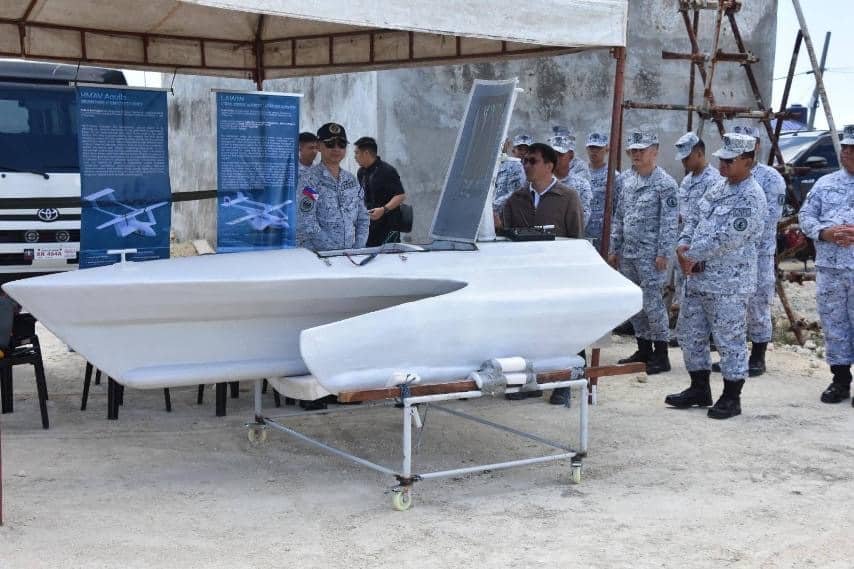
The Philippine Navy is partnering with a local university to develop autonomous drone prototypes, supporting the country’s goal of building a more self-reliant defense posture (SRDP) amid rising security challenges.
The Navy’s Naval Sea Systems Command (NSSC) and the Naval Research and Technology Development Center formalized an agreement with Cebu Technological University (CTU) for the development of an aerial Hybrid Marine-Air Vehicle (HMAV) and the sea-based Maritime Autonomous Surface Ship (MASS). The memorandum of agreement was signed during a ceremony held on March 26 at the CTU main campus in Cebu City, led by NSSC commander Rear Admiral Juario Marayag and Dr. Jonathan Maglasang, project leader for the HMAV and MASS.
The NSSC said:
“These platforms are expected to support rapid and efficient inter-island transport, logistics and disaster preparedness operations of the Navy. Both projects are targeted for completion this year,”

The HMAV is designed to accommodate at least 12 passengers and cover distances of up to 600 nautical miles, providing a faster and more efficient means of transport across the country’s islands, especially in times of emergencies and disaster response operations. The MASS, meanwhile, is an environmentally sustainable autonomous vessel that promotes green maritime technology.
CTU started work on the prototypes in 2023 through its Center for Advanced Vehicles and Energy Systems, leading the research, development, and testing of the vehicles with funding from the Department of Science and Technology (DOST)–Philippine Council for Industry, Energy and Emerging Technology Research and Development.
The university will also handle system integration, performance evaluation and provide technical training for Philippine Navy personnel.
“These initiatives are designed to address the nation’s mobility challenges through cutting-edge, environmentally responsible technologies that will serve both national security and civilian needs,” Dr. Romeo Montecillo, CTU Vice President for Student Affairs, was quoted as saying.
The use of unmanned systems is among the government’s top priorities under the SRDP program, alongside other initiatives such as powder production and the maintenance, repair and overhaul of existing defense assets. Funding, however, continues to be a challenge. The SRDP Revitalization Act, signed into law in October 2024, seeks to bolster the country’s defense industry through research and development of weapon systems.
Currently, the Philippine Navy operates a limited number of unmanned surface vessels and drones acquired from the United States for territorial defense missions.
Previous efforts to build indigenous capabilities include the development of a remote-controlled weapon system (RCWS), or automated gun mount for a 0.50-caliber machine gun, unveiled in 2022. The Buhawi (Building a Universal Mount for Heavy-Barrel Automated Weapon Integration) was developed by the Navy in partnership with the DOST Metals Industry Research and Development Center and Mechatronics and Robotics Society of the Philippines. Last year, the Navy ordered an initial batch of 10 Buhawi RCWS that would be mounted on some of its small boats. The other RCWS currently in service with the Navy is the 12.7mm Rafael Mini Typhoon system from Israel. Meanwhile, the Philippine Air Force and Army are pursuing the development of their own autonomous vehicle capabilities.
