

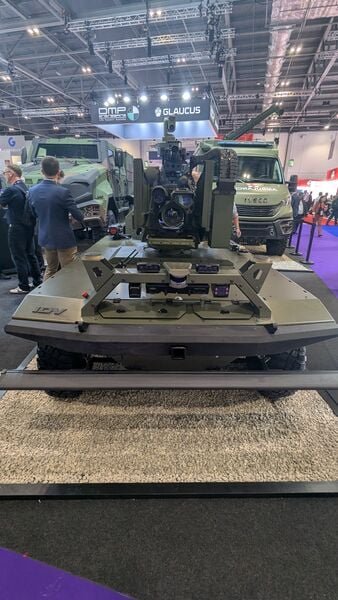

Front view of the Viking, a UGV manufactured by IDV and showcased at the Defence and Security Equipment International (DSEI) 2025 exhibition. IDV is one of the manufacturers participating in the COMMANDS project. (Janes/Tamiris Santos)
The Future Armoured Vehicles Survivability (FAVS) 2025 conference, organised by SAE Media Group and held in London, gathered military officers, civil servants, and members of the defence industry engaged in current and prospective solutions to increase the survivability of platforms and personnel on the battlefield. From 17 to 19 November, the panels and discussions underscored the need for an integrated, modular, and multilayered response to threats, highlighting the asymmetries of ongoing conflicts and the gaps between currently available solutions and the emergence of unmanned platforms and systems as additional means of attrition.
Survivability via integration
Ranging from platform-centric solutions to systems integration, three core requirements emerged as fundamental to enhance survivability, from an equipment point of view: platform-agnosticism, modular designs, and scalability.
Current active platform systems, such as the Trophy active protection system (APS), manufactured by EuroTrophy, are based on the core requirements mentioned earlier. Meanwhile, ongoing projects such as the Modular Integrated Protection System (MIPS) are shaping future expectations by combining situational awareness, combat power, and platform protection into a unified system. The details of the specific systems and platforms set to operate MIPS, with expected trials in the United Kingdom in 2026, were not provided. Despite being considered and mentioned during the presentations, counter-unmanned aircraft system (C-UAS) capabilities, either as part of the forthcoming MIPS or as an evolution of the Trophy APS, were not addressed in detail.
Go beyond the headlines — with direct links to interconnected entities
Get full access to validated equipment, military capabilities, and market insights.
