

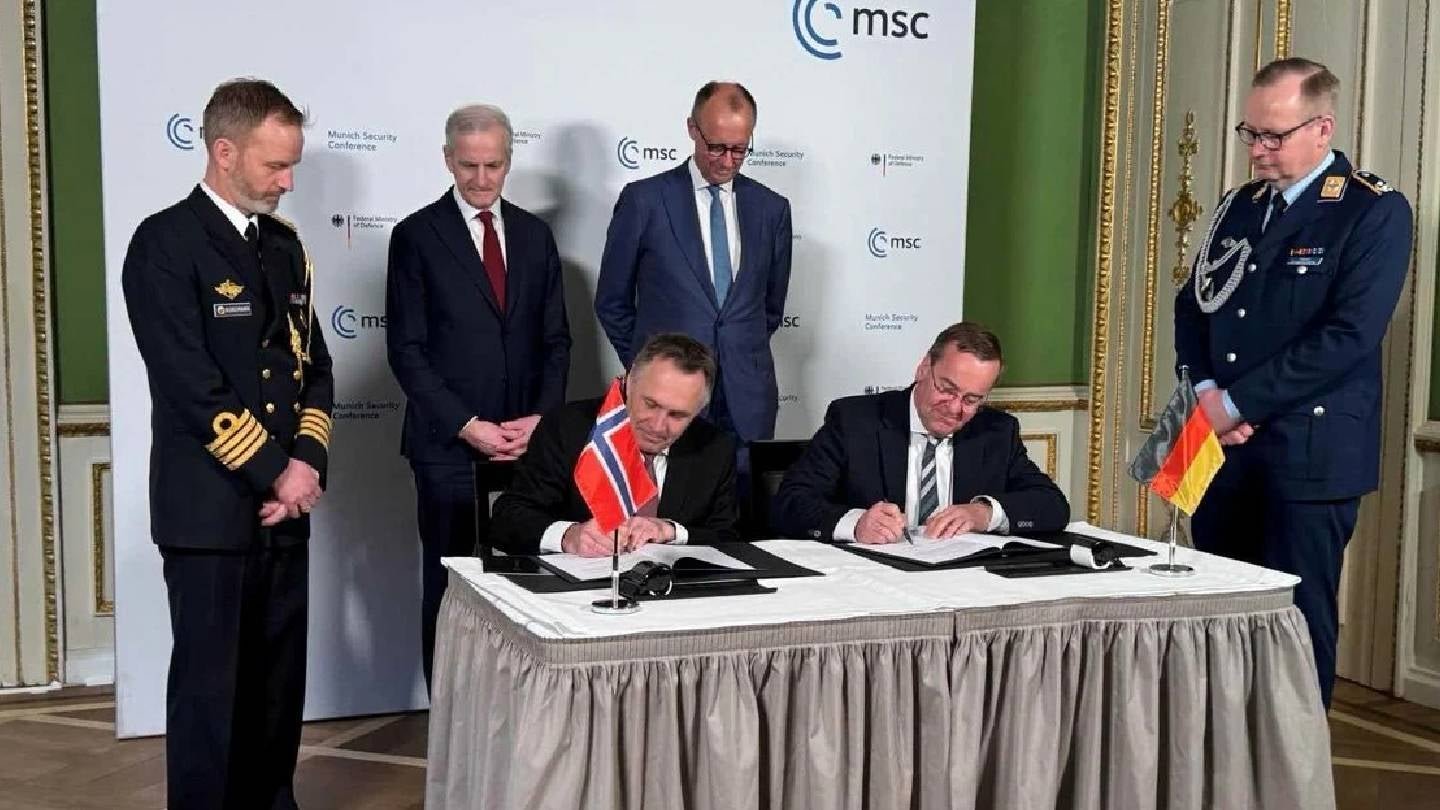
Norway and Germany have formalised a new bilateral defence arrangement, named the ‘Hansa Arrangement’, during the Munich Security Conference held from 13 to 15 February 2026.
Germany Defence Minister Boris Pistorius, and his Norwegian counterpart, Tore O. Sandvik, signed the agreement, which aims to strengthen joint efforts in several military domains.

Discover B2B Marketing That Performs
Combine business intelligence and editorial excellence to reach engaged professionals across 36 leading media platforms.
Find out more
The Hansa Arrangement identifies five main areas of cooperation. These include maritime security and joint maritime operations in the North Atlantic and North Sea, space-based surveillance, combined arms land warfare, rapid reinforcement, and collaboration in the defence industry.
This arrangement follows an earlier announcement by Norwegian Prime Minister Jonas Gahr Støre and German Chancellor Friedrich Merz last summer regarding plans for enhanced bilateral defence ties.
Tore O. Sandvik said: “This is a natural development in an evolving security landscape. We aim to establish a framework that encompasses the full scope of bilateral defence cooperation between Norway and Germany.
“Our countries stand united in a time of heightened uncertainty in Europe, sharing security interests, a solid industrial partnership, and a joint responsibility to strengthen Nato and European security.”
Norway and Germany already cooperate on several defence initiatives. These include Norway’s recent approval of two additional submarines, bringing its fleet to six to match Germany’s total.
The two countries are also jointly developing next-generation long-range maritime missiles (3SM) and constructing new maintenance facilities at Haakonsvern in Bergen.
“Submarines are critical to the defence of allied territory. They are vital to Nato’s ability to maintain control and defence in the North Atlantic and the High North. We have established comprehensive cooperation on personnel training, and both nations are building new maintenance facilities at Haakonsvern in Bergen—a state-of-the-art capability for our submarine fleets,” Sandvik noted.
Both countries intend to deploy expanded and enhanced naval forces, with Germany set to assume a greater role in the North Atlantic.
“This is a positive development for Norwegian and allied security,” Sandvik added.
Additionally, Norway will continue to develop its infrastructure to facilitate allied reinforcements, while discussions are ongoing regarding possible pre-positioning of German equipment on Norwegian territory.
German military units frequently train alongside Norwegian forces, including participation in exercises such as Cold Response 26 scheduled for this winter.
The acquisition of German Leopard A28 main battle tanks by Norway is intended to further enhance collaboration between the two countries’ land forces.
Norwegian units also work closely with German counterparts within Nato structures such as the German-led Multinational Brigade in Lithuania.
In 2025, Norway ranked as the second-largest importer of defence materiel after Ukraine, with procurement reaching €1.4bn.
This volume includes industrial partnerships that support employment, such as RITEK in Trøndelag assembling 37 out of 54 Leopard 2 main battle tanks ordered from German manufacturer Krauss-Maffei Wegmann.

