

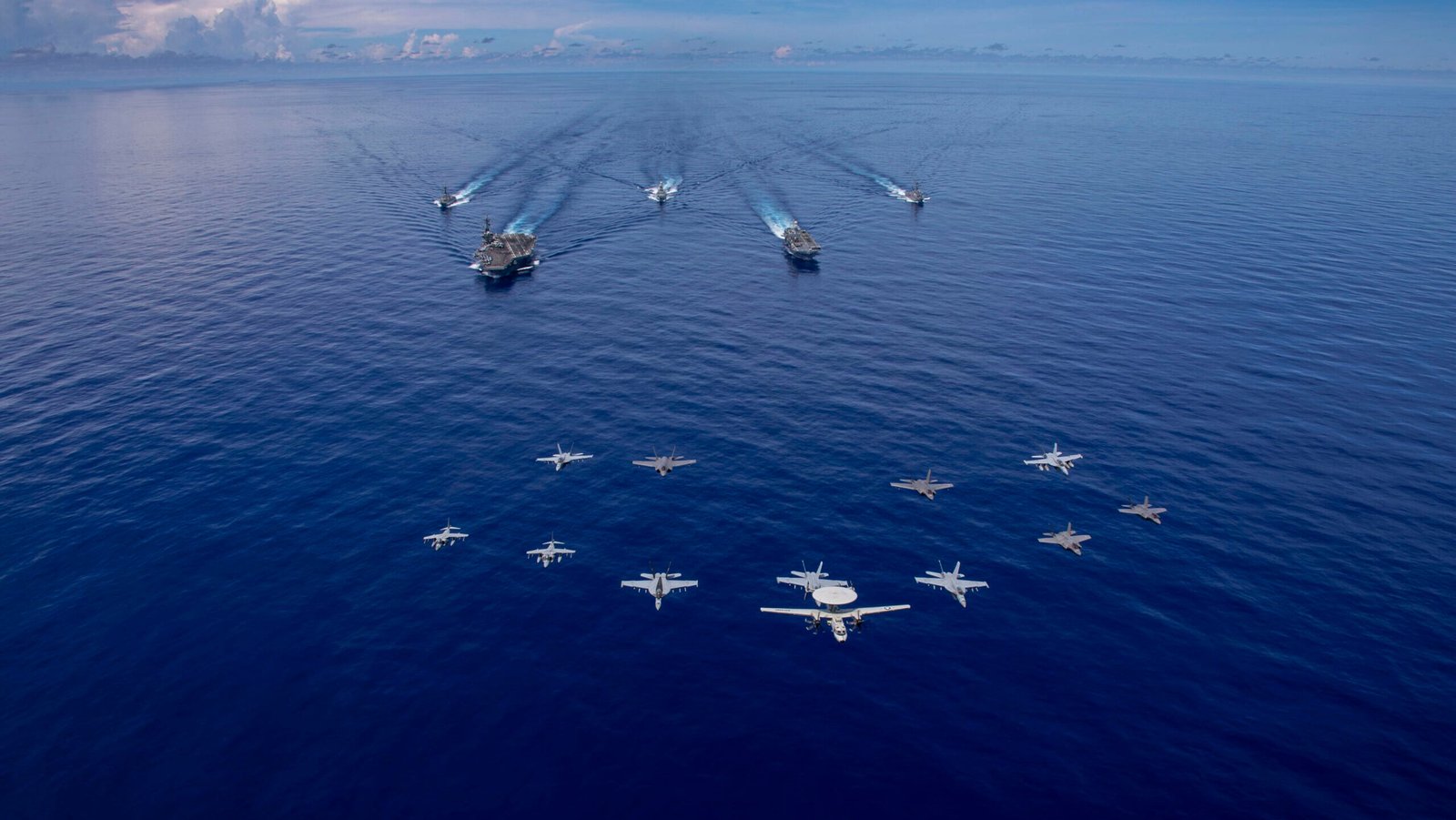
WEST 2026 — A new pilot for information warfare squadrons within carrier strike groups will better operationalize information warfare in the fleet and improve IW lethality at sea, according to a top official.
“One of the asks that I got when I came into the job was, Mike, I really want to operationalize IW more in the fleet,” Vice Adm. Michael Vernazza, commander of Naval Information Forces, told reporters at the annual WEST conference in San Diego this week. “We want to improve the lethality of IW at sea, so to me, this was the first place to start with that.”
The Navy announced in early December that it was establishing Information Warfare Squadron (IWRON) Two, described as a first-of-its-kind unit to operationalize IW capabilities within the strike group in a 48-month pilot. Vernazza told WEST attendees this week that in addition to the East Coast-based IWRON Two, there are also plans to create a West Coast-based IWRON Nine.
“For too long, IW capabilities — intelligence, cyber, oceanography and electronic warfare — were brought into a strike group as separate supporting elements. We have changed that,” Vernazza told attendees. “This isn’t about bureaucracy or streamlining administration. It’s about speed. It allows us to provide the strike group with IW forces early in the training cycle, ensuring that when our forces arrive on the scene, the battlespace is already tilted decisively in our favor.”
Capt. Ed McLellan, who will command IWRON-9, noted that he will still be the information warfare commander for the strike group, but as squadron commander he will also be in charge of the humans that will maintain persistent presence with the carrier strike group, performing information warfare activities throughout the optimized fleet response plan (OFRP). In the past, he said, some of those personnel were added and it was a “pick-up basketball game” of sorts where folks would disperse at the end of the deployment.
As such, part of why the Navy created the new squadrons is to improve readiness early in the deployment cycles, McLellan said at the conference. It will also solve the challenge of keeping the same people together as opposed to training in a disaggregated model prior to deploying — all of which means the Navy won’t have to reinvent the wheel and build things from scratch.
“You’ll also have a persistent body of personnel who can do a new thing when called upon. Imagine a case in which we need an information warfare combined watch, say, as we had to stand up for Ukraine. You already have an organization that can deploy and do that work instead of creating it out of scratch,” he said. “What changes is those personnel, the relationship to me and the relationship to one another, because it will work and fight and train as a team.”
Vernazza will also be measuring how the new squadrons increase lethality.
“I want to see it improve lethality. There’s a big umbrella called improved lethality and what does that mean? I think I want to see improved conditions on how they go after C5ISR-T … improved terminal defense, improved logistics, improved long range fires,” he told reporters.
The squadrons are the latest evolution in the Navy’s information warfare journey following an increased demand for capabilities. It follows the creation of information warfare commanders on carrier strike groups, the creation of Fleet Information Warfare Command Pacific and a series of pilots to place information warfare personnel on subs.
Vernazza said part of what enabled this effort was the Navy’s decision to move IW from restricted to what they dub the “IW line,” meaning they can now command at sea.
While the IW commander was, in theory, a peer with the destroyer squadron commander and carrier air wing commander, in practice that broke down, Vernazza said, in large part because the IW commander couldn’t command at sea.
In addition to the IW squadrons, Vernazza announced plans to pilot sending more senior IW officers aboard destroyers, with the hope of driving expertise down to the tactical edge.
“Historically, IW officer assignments on DDGs were filled by junior officers who are often in their first afloat tour. But the complexity of the threat demands experience. We’re now investing O-4 level IW expertise onto one of our most powerful warfighting and information platforms,” Vernazza told the conference. “We are pairing this human capital with advanced equipment to ensure our destroyers have the decisive decision advantage they need in a contested environment.”
He later told reporters the plan is to pick two destroyers from afloat training group Pacific Northwest this summer, but they are still working on which ones they’ll be.
“I’d like to see this play out across the OFRP, from maintenance phase to basic phase to advanced phase to integrated phase and track and see how this individual improved readiness relative to DDGs that did not have this individual,” Vernazza said.
