

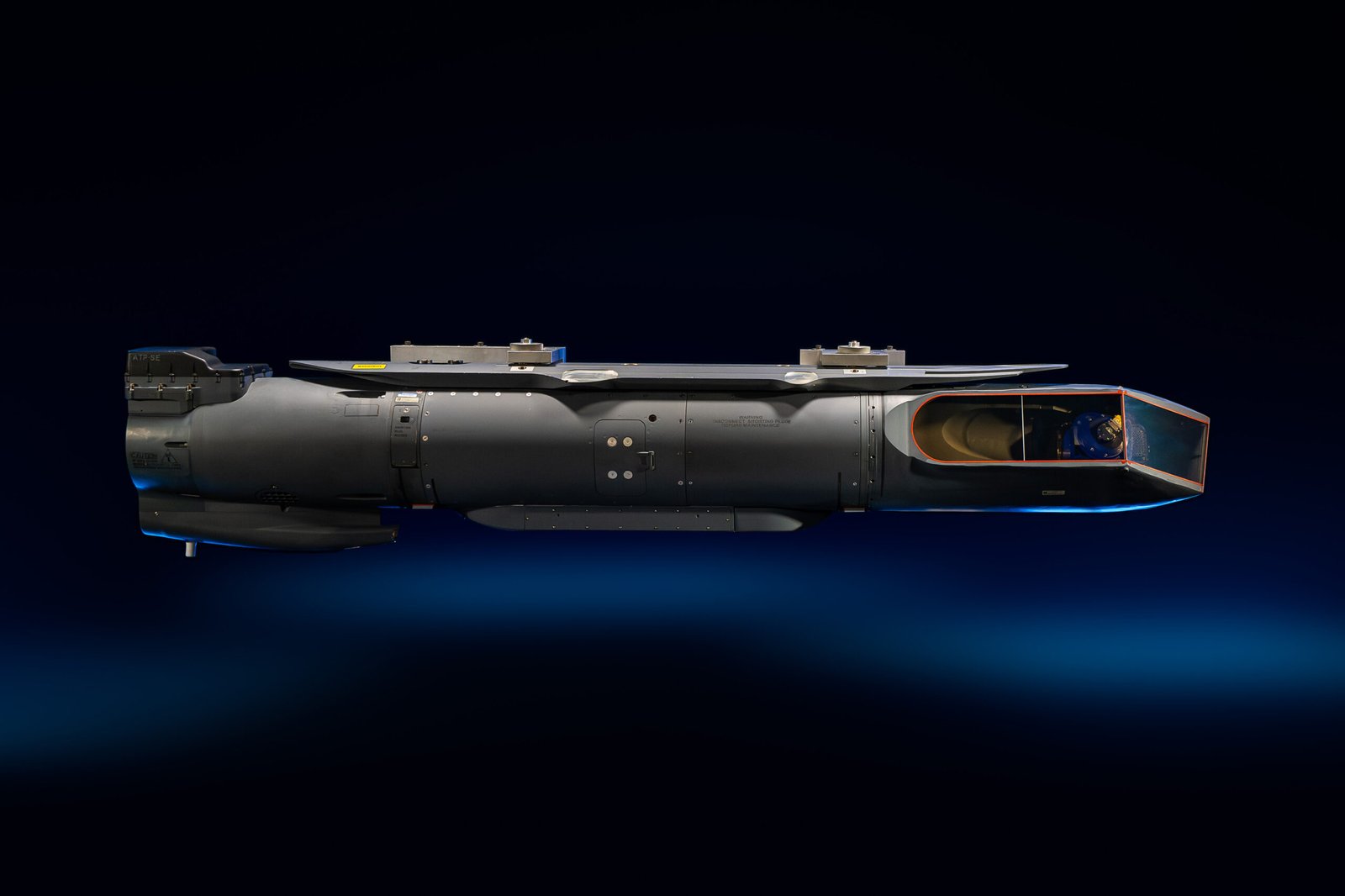
Lockheed Martin said its Sniper Networked Targeting Pod (NTP) could appeal to air forces operating mixed fleets of fourth- and fifth-generation fighter aircraft, as well as countries aiming to enhance interoperability with international partners.
This potential appeal includes numerous countries in the Asia-Pacific region that operate Lockheed Martin’s F-35 alongside legacy fighters.
With the new pod first unveiled in July 2024, Lockheed Martin announced last month that it has completed a demonstration of the Sniper NTP. This validated the exchange of targeting data in real time between two F-16 fighters and a ground station.
The Sniper NTP integrates a hybrid base station (HBS) with the existing Sniper Advanced Targeting Pod (ATP), turning it into an airborne communications node.
The HBS utilises flexible architecture to support various data links, including the Multifunction Advanced Datalink (MADL) for F-35 interoperability, and a mobile ad hoc network capability for mesh networking across air, ground and maritime assets.
While fourth-generation fighters have the ability to communicate with F-35s via existing Link 16 tactical data links, this connectivity comes with some latency and it may also increase the risk of adversaries detecting the low-observable fifth-generation aircraft.
Responding to an Asian Military Review enquiry at a media briefing during Singapore Airshow 2026 earlier this month, Lockheed Martin’s International Business Development Director Paul Schulze said: “We can use MADL to move more data in a less-detectable way, and to do so faster. Link 16 is a great system, but there’s a lot of lag.”
F-35s operating forward deep inside enemy territory could relay sensor data from one F-35 to another, effectively daisy-chaining information out of a high-threat area to a fourth-generation fighter equipped with the Sniper NTP. That aircraft could then use the data for a stand-off attack, or pass it on to other assets or a command post for further exploitation.
Steve Sheehy, Lockheed’s Vice President of Aeronautics International Business Development, said the company has identified that many countries plan to retain a mix of fourth- and fifth-generation fighters for the foreseeable future. He believes the Sniper NTP could enable them to operate together more effectively, as well as in coalition settings.
In Asia-Pacific, Japan and South Korea, for example, fly the F-35 Lightning II alongside legacy fighters. Both countries operate variants of the F-15 Eagle, while South Korea also flies the F-16 Fighting Falcon. Japan, meanwhile, operates the Mitsubishi F-2 that derives from the F-16.
Singapore, which is due to take delivery of its first F-35 later this year, has also indicated that its future fighter fleet will consist of the F-35 alongside the F-15.
All three countries utilise the Sniper ATP on their older fighters.
Lockheed Martin said existing Sniper ATP pods can be upgraded to the NTP version through a return-to-factory overhaul process. With 29 countries operating the Sniper ATP, and more than 1,600 units delivered to date, Lockheed Martin views the conversion market to the NTP version as very promising.
Schulze stated: “The real value proposition of the Sniper NTP is for countries – especially those introducing the F-35 into their fleets – who need a way to keep their fourth-generation fighters relevant, while operating in a connected manner with coalition partners.”
He added: “There’s a variety of platforms that can benefit from this system. We’ve already integrated the Sniper ATP into the Eurofighter Typhoon, Dassault Rafale and Mirage 2000, as well as the KAI FA-50, and these platforms can benefit from the NTP connectivity.”
by Roy Choo
