

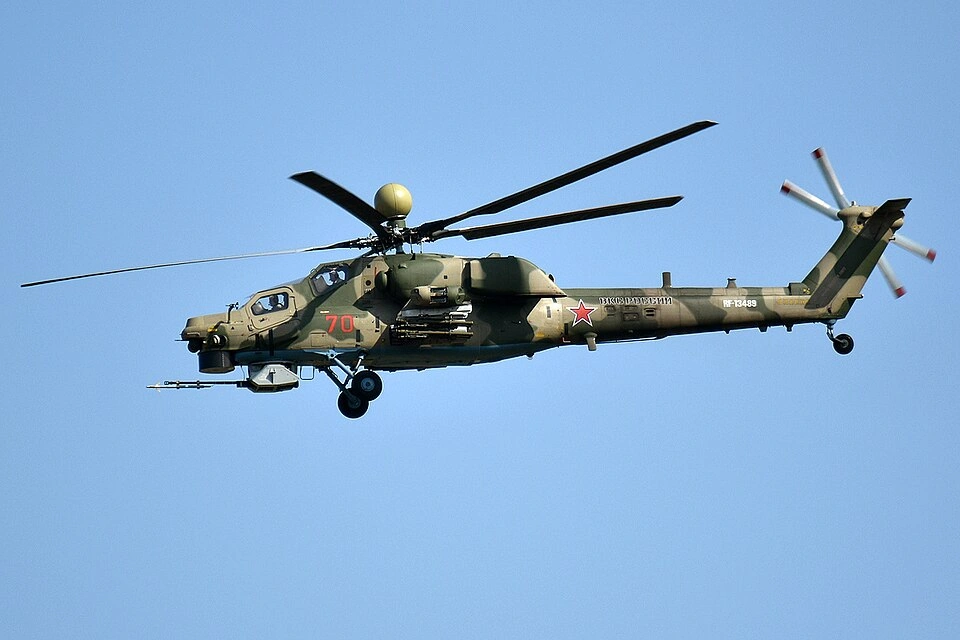
If helicopters had personalities, the Mi-28 Hovoc would be the kind that doesn’t bother knocking. It shows up loud, armored, and unapologetically built for trouble.
Known officially as the Mil Mi-28 “Havoc”, this Russian attack helicopter wasn’t designed to impress airshow crowds or win beauty contests. It was built to survive, hunt tanks, and keep flying when logic says it shouldn’t.
That mindset matters. The Mi-28 didn’t emerge from a clean-sheet, post–Cold War fantasy. It was born out of hard lessons from Afghanistan, where helicopters learned, sometimes the painful way, that speed means nothing without protection.
As a result, the Mi-28 Hovoc leans heavily into brute resilience: thick armor plates, redundant systems, and a crew cocooned like they’re inside a flying bunker.
What makes this aircraft especially interesting isn’t just what it can shoot, though it carries plenty, but how it’s meant to be used.
The Mi-28 is less “sniper rifle” and more “sledgehammer.” It’s designed to operate low, absorb punishment, and keep pressure on ground targets long after lighter platforms would’ve backed off.
In recent conflicts, especially in contested airspace, the Mi-28 has become a case study in modern helicopter warfare. Not perfect. Not subtle. But persistent. And persistence, in combat aviation, counts for a lot.
This post takes a fresh look at the Mi-28 Hovoc from that angle, not just specs and weapons, but intent. Why it exists, what problems it was meant to solve, and why it continues to shape how Russia thinks about attack helicopters today.
The History and Development of the Mi-28 Hovoc
The Mi-28 Hovoc didn’t arrive in a hurry. In fact, its long, sometimes awkward development tells you a lot about how military hardware is really born, slowly, politically, and often in competition with its own siblings.
The story starts in the late 1970s, when the Soviet military realized the Mi-24 Hind, iconic as it was, tried to do too many jobs at once. It carried troops and fought tanks, which sounded efficient on paper but proved limiting in combat. The solution? A purpose-built attack helicopter. No compromises. No passengers. Just teeth.

Mil Design Bureau answered with what would become the Mi-28.
The first prototype flew in 1982, looking almost brutal even by Soviet standards. Tandem cockpit. Narrow fuselage. Short wings built purely for weapons. Early testing showed promise, but timing was terrible.
The Soviet Union was nearing collapse, budgets were shrinking, and a rival design, the Ka-50, was stealing attention with its single-seat, coaxial-rotor weirdness.
For years, the Mi-28 lingered in development limbo. Refined. Redesigned. Shelved. Then revived. It wasn’t until the early 2000s that the helicopter finally found its footing, especially with the Mi-28N “Night Havoc”, which added all-weather, night-fighting capability, something the original version sorely lacked.

By the time it officially entered Russian service in 2009, the Mi-28 Hovoc was no longer a Cold War relic. It had evolved into a modern attack platform shaped by decades of missed deadlines, battlefield lessons, and institutional stubbornness. Oddly enough, that long struggle may be why it’s so tough today.
Design Philosophy and Core Features of the Mi-28 Hovoc
One look at the Mi-28 Hovoc and you can tell it wasn’t designed by people worried about elegance. This helicopter is shaped by a single, stubborn idea: survive the hit, finish the mission, come home anyway.
Start with the cockpit. The two crew members, pilot in the rear, weapons officer up front, sit in a narrow, armored tub, separated by blast-resistant panels.
The windshields aren’t just thick glass; they’re rated to withstand 12.7 mm rounds. That’s heavy machine-gun fire. Not theoretical. Tested. Around them, critical systems are spaced apart on purpose, so one lucky hit doesn’t knock everything offline at once.
The airframe leans into redundancy like it’s a religion. Dual hydraulics. Backup flight controls. Fuel tanks designed to self-seal after being punctured. Even the landing gear is built to absorb hard impacts, letting the crew walk away from crashes that would total other aircraft. There’s a reason Russian pilots sometimes describe the Mi-28 as “forgiving”, it gives you second chances.
Avionics were the weak spot early on, and Russia knew it. The breakthrough came with the Mi-28N, which introduced a mast-mounted radar, thermal imaging, and night-vision compatibility.
Suddenly, the Hovoc could hunt after dark, through dust, fog, and battlefield smoke, conditions where attack helicopters earn their keep.
Here’s a quick snapshot of the Mi-28’s design priorities:
| Feature Area | Design Focus |
| Crew Safety | Heavy armor, shock-absorbing seats |
| Survivability | Redundant systems, spaced components |
| Visibility | FLIR, night optics, helmet-mounted sights |
| Mission Profile | Low-altitude, high-threat environments |
The result isn’t subtle. But it’s deliberate. The Mi-28 Hovoc isn’t built to avoid danger, it’s built to outlast it.
Mi-28 Hovoc Technical Specifications Without the Fluff
Specs can be boring. Rows of numbers, units nobody visualizes. But with the Mi-28 Hovoc, the data actually tells a story, one about weight, power, and tradeoffs made on purpose.
This helicopter is heavy. Fully loaded, it pushes past 11,500 kg, which already hints at its priorities. Armor adds mass. Redundant systems add more.
Yet the Mi-28 still manages respectable speed and agility, thanks largely to its twin Klimov TV3-117VMA turboshaft engines. Each produces around 2,200 horsepower, giving the aircraft enough muscle to stay aggressive even when fully armed.

Speed? About 300 km/h (186 mph) at maximum. Not record-breaking, but fast enough at nap-of-the-earth altitudes, where attack helicopters actually live. Range sits near 435 km without external tanks, again, not flashy, but practical for close-support missions rather than long patrols.
Altitude performance is often overlooked, but the Mi-28 Hovoc can operate up to 5,700 meters, which matters in mountainous regions where thinner air punishes weaker designs.
Here’s a clean snapshot of the core specifications:
| Specification | Mi-28 Hovoc Data |
| Crew | 2 (pilot + weapons officer) |
| Length | ~17.9 m |
| Rotor Diameter | 17.2 m |
| Max Takeoff Weight | ~11,500 kg |
| Engines | 2 × TV3-117VMA |
| Max Speed | ~300 km/h |
| Combat Radius | ~200–250 km |
| Service Ceiling | ~5,700 m |
What stands out isn’t any single number, it’s the balance. The Mi-28 Hovoc sacrifices range and elegance for survivability and sustained firepower. In other words, it’s built for the ugly middle of a fight, not the brochure cover.
Armament and Combat Systems of the Mi-28 Hovoc
If the Mi-28 Hovoc has a personality, its weapons are how it speaks, and it speaks loudly. This helicopter wasn’t armed as an afterthought. Everything about its layout assumes weapons will be used, often, and at close range.
Front and center is the 30 mm 2A42 autocannon, mounted in a chin turret with a wide firing arc. This isn’t a delicate precision gun. It fires high-explosive and armor-piercing rounds capable of shredding light vehicles, infantry positions, and even low-flying aircraft. Pilots often compare it to a flying infantry fighting vehicle, short bursts, brutal effect.

On the stub wings, the Mi-28 carries the real tank-killers. The most common are Ataka-V anti-tank guided missiles, with a range of up to 6 km and the ability to defeat reactive armor. Earlier systems like Shturm are still compatible, which says a lot about the platform’s flexible, some might say stubborn, design philosophy.
Unguided rocket pods add another layer of chaos. The Mi-28 can carry S-8 or S-13 rockets, saturating wide areas during close air support missions. It’s not subtle, but in urban or defensive fighting, saturation matters.

Sensors tie it all together. Helmet-mounted sights let the gunner aim weapons simply by looking. Thermal imaging and radar (on later variants) help detect targets through smoke, dust, or darkness, conditions where ground forces are usually most desperate for help.
A quick look at typical armament options:
| Weapon Type | Example | Purpose |
| Cannon | 30 mm 2A42 | Close combat, suppression |
| ATGMs | Ataka-V | Anti-armor |
| Rockets | S-8 / S-13 | Area saturation |
| Missiles | Igla (optional) | Air defense |
The Mi-28 Hovoc isn’t a sniper, it’s a shock weapon. And it’s built to stay in the fight long enough to matter.
Mi-28 Hovoc Variants and What Actually Changed
On paper, the Mi-28 Hovoc has a neat family tree. In reality, each variant exists because something didn’t work the first time. That trial-and-error evolution is what makes the platform interesting.
The original Mi-28 prototype was daylight-only and frankly limited. No serious night-fighting capability, basic sensors, and an avionics package that already felt dated by the time it flew. It proved the airframe concept, but not much else.
Next came the Mi-28A, a slightly refined version aimed at export markets. Improved engines, better reliability, but still missing one critical thing: the ability to fight at night. For an attack helicopter expected to survive modern battlefields, that was a glaring flaw. Few buyers bit.
Everything changed with the Mi-28N, nicknamed Night Havoc. This wasn’t a cosmetic upgrade, it was a philosophical reset. A mast-mounted radar appeared above the rotor, allowing target detection without exposing the helicopter’s body. Thermal sights, digital navigation, and night-vision compatibility turned the Mi-28 into a true 24/7 hunter. This is the version that finally convinced the Russian Air Force.

Then there’s the Mi-28NE, the export cousin. Functionally similar to the N-model, but tuned for foreign operators like Iraq and Algeria. Some systems were simplified, others adapted to desert conditions, heat, sand, and long loiter times.
The most advanced version so far is the Mi-28NM. Think of it as the Hovoc growing up. Improved sensors, updated avionics, new weapons integration, and better crew coordination systems. It also reflects hard lessons learned from real combat, not test ranges.
Here’s a simplified comparison:
| Variant | Key Upgrade | Primary Role |
| Mi-28 | Baseline prototype | Concept validation |
| Mi-28A | Improved engines | Limited export |
| Mi-28N | Night/all-weather combat | Russian frontline |
| Mi-28NE | Export-optimized | Foreign operators |
| Mi-28NM | Modernized systems | High-threat warfare |
Each version exists because the battlefield demanded it.
Operational Use and Real-World Deployments of the Mi-28 Hovoc
The Mi-28 Hovoc only really makes sense once it leaves the factory and starts flying over ugly terrain. On the battlefield, theory collapses fast, and this helicopter has had plenty of chances to prove what it’s worth when plans fall apart.
The Russian Aerospace Forces are the primary operator, using the Mi-28 as a frontline attack platform rather than a niche asset. It’s typically deployed alongside ground units, flying low and slow, hunting armor, supply columns, and fortified positions. This is not standoff warfare. The Hovoc lives in the danger zone, often within range of small arms and MANPADS.
Combat deployments in Syria offered the first sustained test. There, Mi-28N helicopters flew night missions supporting urban assaults and desert operations. Crews relied heavily on thermal imaging to identify targets hidden among buildings or terrain folds.
The environment was brutal, heat, dust, and unpredictable threats, but it validated the aircraft’s night-fighting concept. Not flawless, but workable.
Later conflicts pushed the platform harder. In high-intensity warfare, the Mi-28’s strengths and weaknesses became more visible.
Heavy armor saved crews in multiple documented incidents, yet losses also highlighted vulnerabilities to modern air defenses. This led directly to upgrades seen in the Mi-28NM, including improved situational awareness and coordination with drones.

Export operators tell a quieter story. Countries like Iraq use the Mi-28NE primarily for counterinsurgency, where endurance and intimidation matter as much as precision. The psychological effect alone, rotor noise, cannon fire, often clears areas before contact even happens.
Operationally, the Mi-28 Hovoc isn’t elegant. It’s persistent. And in modern warfare, persistence can be decisive.
How the Mi-28 Hovoc Stacks Up Against Its Rivals
The Mi-28 Hovoc doesn’t exist in a vacuum. Every attack helicopter is a response to someone else’s idea of airpower, and the Hovoc is no exception. Comparisons are inevitable, especially with the AH-64 Apache and Russia’s own Ka-52 Alligator.
Against the Apache, the contrast feels almost philosophical. The Apache leans on sensor fusion, long-range engagement, and networked warfare. The Mi-28? It prioritizes armor, redundancy, and physical toughness.
Apache crews talk about seeing first. Mi-28 crews talk about surviving first. Neither approach is wrong, they’re shaped by different doctrines, budgets, and combat histories.
The Ka-52 comparison is more awkward. Both are Russian. Both fill similar roles. But they couldn’t be more different. The Ka-52’s coaxial rotors give it agility and stability, especially at low speed. It also boasts advanced avionics and better crew visibility.
he Mi-28 counters with heavier armor and a more traditional, easier-to-maintain layout. In practice, Russia operates both, using them where their strengths matter most.
Here’s a simplified comparison to ground things:
| Feature | Mi-28 Hovoc | AH-64 Apache | Ka-52 |
| Design Focus | Survivability | Sensor dominance | Maneuverability |
| Crew Layout | Tandem | Tandem | Side-by-side |
| Armor Level | Very high | High | Moderate |
| Doctrine | Close, persistent attack | Standoff precision | Flexible strike |
What makes the Mi-28 Hovoc distinctive isn’t that it’s “better.” It’s that it’s honest about its role. It’s built for messy, high-risk environments where clean wins are rare, and where staying airborne might matter more than firing first.
