

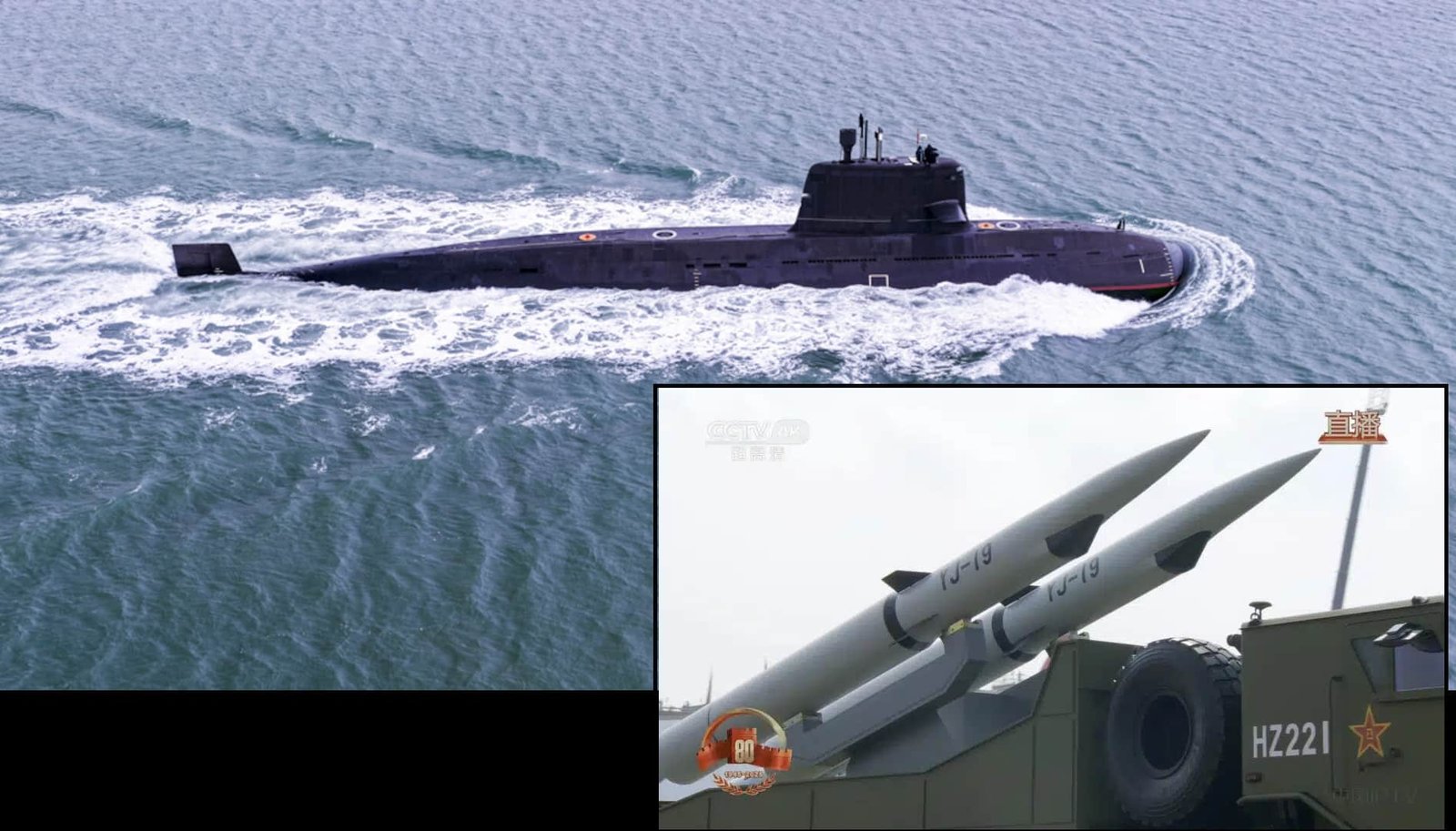
China’s large fleet of air-independent propulsion (AIP) submarines is set to become significantly more lethal. The introduction of the next-generation YJ-19 hypersonic missile dramatically elevates their already serious anti-ship punch. China is currently the only nation known to have armed non-nuclear submarines with hypersonic strike weapons.
Chinese state media has shared a report from the Chinese Navy (PLAN) that the YJ-19 hypersonic missile has been accepted for service aboard the country’s Type-039B Yuan-class diesel-electric submarines. The low-key announcement is a sign of China’s unrelenting rapid growth in naval power.
This gives the submarines new capabilities, making the Yuan-class the only non-nuclear submarines in the world with such a weapon. Hypersonic anti-ship missiles are designed specifically to stretch and overcome even the most capable current defences aboard warships. They will elevate China’s Yuan-class to being the most formidably armed non-nuclear submarines afloat.
YJ-19 Scramjet Missile
The YJ-19 missile was first revealed in public during the September 2025 military parade in Beijing. An air-breathing missile, it has the hallmarks of a hypersonic weapon. It likely employs a scramjet motor for sustained hypersonic flight. Some estimates suggest that it is near-hypersonic, while the main (and Chinese) label is hypersonic, suggesting speeds of Mach 5 or more.
The Type-039B Yuan-class is the mainstay of the Chinese conventional submarine fleet with 13 believed to be in service. It has air independent power (AIP) meaning that it can cruise for days or weeks at low speeds without coming to the surface, a significant aid to remaining undetected. They are complemented by the older Type-039A version, and the newer stealthily shaped Type-039C which is still in production. It seems likely that eventually all Type-039Bs and Type-039Cs will be equipped with the new hypersonic missile.
In Chinese submarine service the YJ-19 missile can be seen as a replacement for the already formidable YJ-18 missile. That weapon is a Chinese copy of the Russian SS-N-27 Sizzler and features a supersonic final attack stage. In essence it is a Kalibr cruise missile carrying a smaller supersonic final stage which approaches its target at 2.5 – 3 times the speed of sound (Mach 2.5 – 3.0). The YJ-18 is considered a serious stretch of warship air defences, but the hypersonic (Mach 5+) YJ-19 will take this to another level.
YJ-19: Advantage Over The Russian Zircon Missile
The YJ-19 missile is analogous with Russia’s 3M22 Zircon (NATO reporting designation SS-N-33). Compared to the Zircon it appears, based on the Chinese ‘YJ’ designation (‘Yingji’ meaning ‘Eagle Strike’), to dedicated to the anti-ship role. Although also considered an anti-ship missile, Zircon has been used in Russia’s war against Ukraine to strike land targets. A Chinese land-attack missile would ordinarily have a CJ (‘Cháng Jiàn’ for ‘Long Sword’) designation. This does not rule out its use against land targets however but does show the doctrinal emphasis.
The major advantage of the YJ-19 over the Zircon is that it can be launched from horizontal torpedo tubes. This means that older boats can be upgraded to carry them. The Zircon is also being carried aboard Russian submarines, but only those equipped with appropriate vertical launch tubes. This rules out its carriage on Russia’s ubiquitous Kilo-class diesel-electric submarines.
China’s Growing Arsenal Of Hypersonic Missiles
The YJ-19 is joined by another new hypersonic anti-ship missile, the slightly larger YJ-17. There are clear indications that the former is for launch out of standard 533mm (21 inch) torpedo tubes, and the latter from vertical launch tubes. Another difference is that while the YJ-19 uses an air-breathing scramjet, the YJ-19 is a glide-vehicle type, suggesting only diving attacks. We can infer that the YJ-19 will have a shorter operational range than its VLS launched brother. However, it remains a serious threat to even the most modern warships.
Just last week China launched the first of its next-generation nuclear-powered submarines, the Type-095 (more properly the Type-09V with a Roman numeral for ‘5’). It is possible that that too could carry the YJ-19 missile, but it seems more likely that it instead has vertical launch types for either the YJ-17, or yet another hypersonic anti-ship missile, the YJ-20. The latter, often referred to as the YJ-21, is a manoeuvring ballistic missile type which is already in service aboard the Type-055 Renhai-class cruisers. The country’s next-generation Type-041 Zhou-class ‘nuclear-AIP’ submarine is however a stronger candidate for the YJ-19 missile.
Outlook
China now fields at least three ship or submarine launched hypersonic anti-ship missiles, the YJ-17, YJ-19 and YJ-20. So many new weapons that the list of designations quickly become confusing even to naval observers.
Their ability to retrofit its large fleet of conventional submarines with the YJ-19 type will greatly increase both the individual submarine’s potency, but also the fleet at large. China’s fleet of conventional submarines won’t only be the most powerfully armed in the anti-ship role, they will also be the most numerous.
