

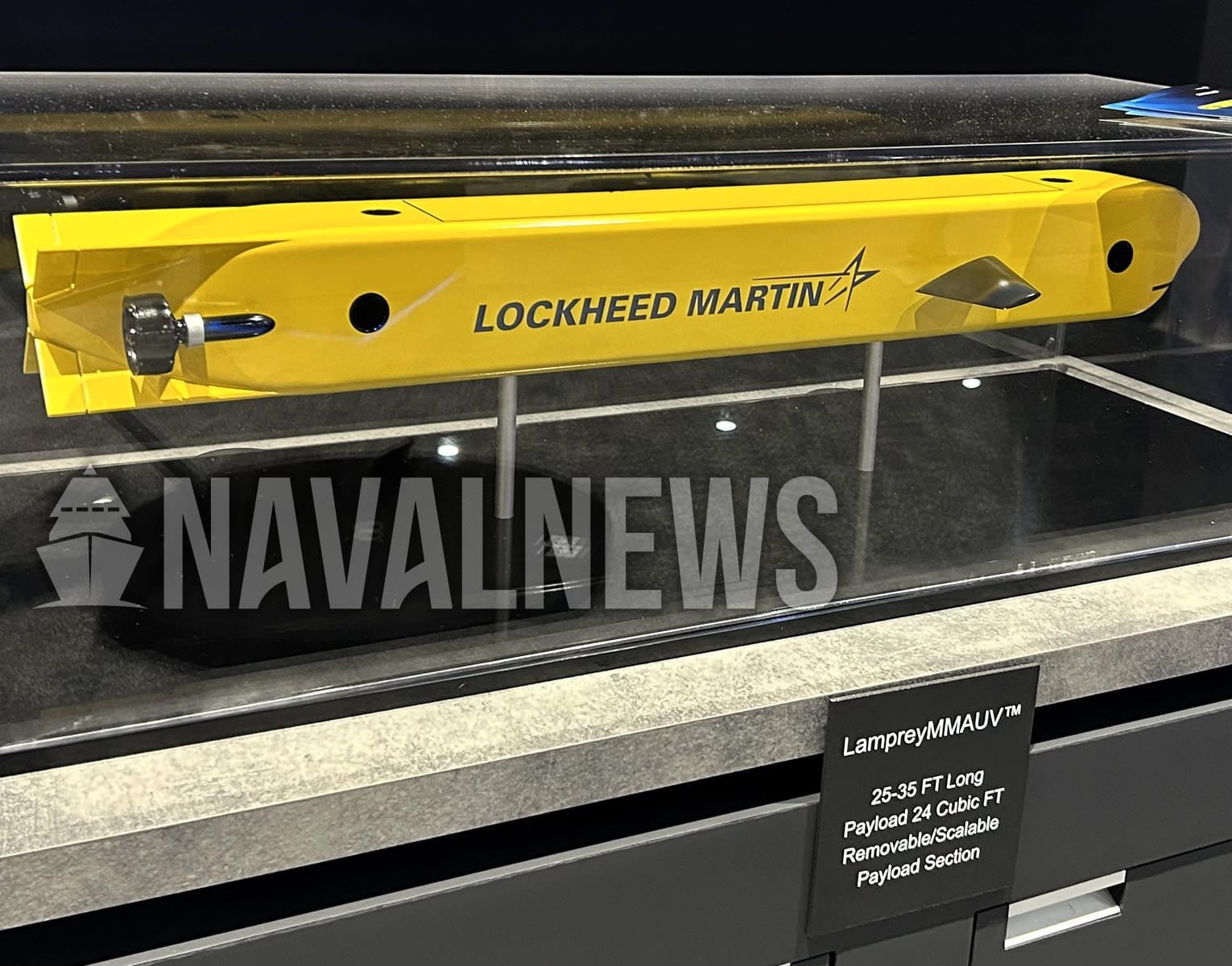
SAN DIEGO — Lockheed Martin rapidly developed its new Lamprey multi-mission autonomous undersea vehicle: The company took just 14 months to develop Lamprey, with future plans to field larger variants and another drone by the end of the year.
Lockheed Martin showcased a model of Lamprey for the first time at WEST 2026. Mark Johnson, program director for unmanned maritime solutions division, discussed the highlights and future iterations of the multi-mission system with Naval News.
Named after the Lamprey, a fish that latches onto others with its sucking mouth, the drone combines numerous features that the company claims could achieve various tailored missions in support of covert surveillance and sea denial.
Given the drone’s namesake, Johnson explained Lamprey comes with this unique ability to latch onto submarines, warships and the seabed. This brings many key implications for operational use.

“This thing has suction cups on the top that basically can autonomously navigate to a sub, a ship, and it swims up and suctions on to the bottom of that vehicle,” said Johnson. “So it can hitch your ride into whatever theater it’s going to, because if you think about one of the restrictions or constraints of UUVs, it’s battery power. You need to get to where you got to get to. This can hitch a ride and not use power while it’s doing it.”
One suctioned onto a vessel, the drone can deploy hydrogenerators to charge itself on the way to its mission area. Johnson further stated that these onboard power sources can also support mission equipment carried aboard the Lamprey.
Lamprey concept graphics depict these capabilities being used for area denial and surveillance missions, including strikes on fast attack craft and warships with the drone’s small torpedoes and loitering munitions.
“We actually have a very large payload cavity that we can use to deploy things or to use for [Intelligence, surveillance and reconnaissance] or sensing missions,” Johnson said. “And so that’s a 24 cubic foot bay that we can put effectors in. We can put sensors in, we can launch torpedoes out of. We can launch [Unmanned aerial vehicles] out of. It’s very versatile from that perspective.”
A Lockheed Martin statement claimed that the system was “built with the U.S. Navy’s need for covert, assured access and sea denial operations.” According to Johnson, Lamprey was rapidly developed within 14 months utilizing technologies internally funded by the American defense contractor over the last two decades.
The system’s reveal comes amid an increased focus on unmanned systems to counter U.S. adversaries. Unmanned surface, underwater and aerial systems have been elevated under Indo-Pacific Command’s Hellscape concept, which aims to deter and defeat a Chinese invasion of Taiwan by swarming the strait with numerous systems capable of enhancing U.S. surveillance and strike capabilities.
Future plans for Lamprey include the development of variants between 20 to 35-feet in length and the construction of a second vessel that will further iterate from the existing testing drone. Johnson stated that the loitering and range time would heavily depend on the size and payload of the variant.


