


Resupply by helicopter has been a routine practice for militaries for over 60 years, providing tactical advantages by delivering essential supplies directly to the end user.
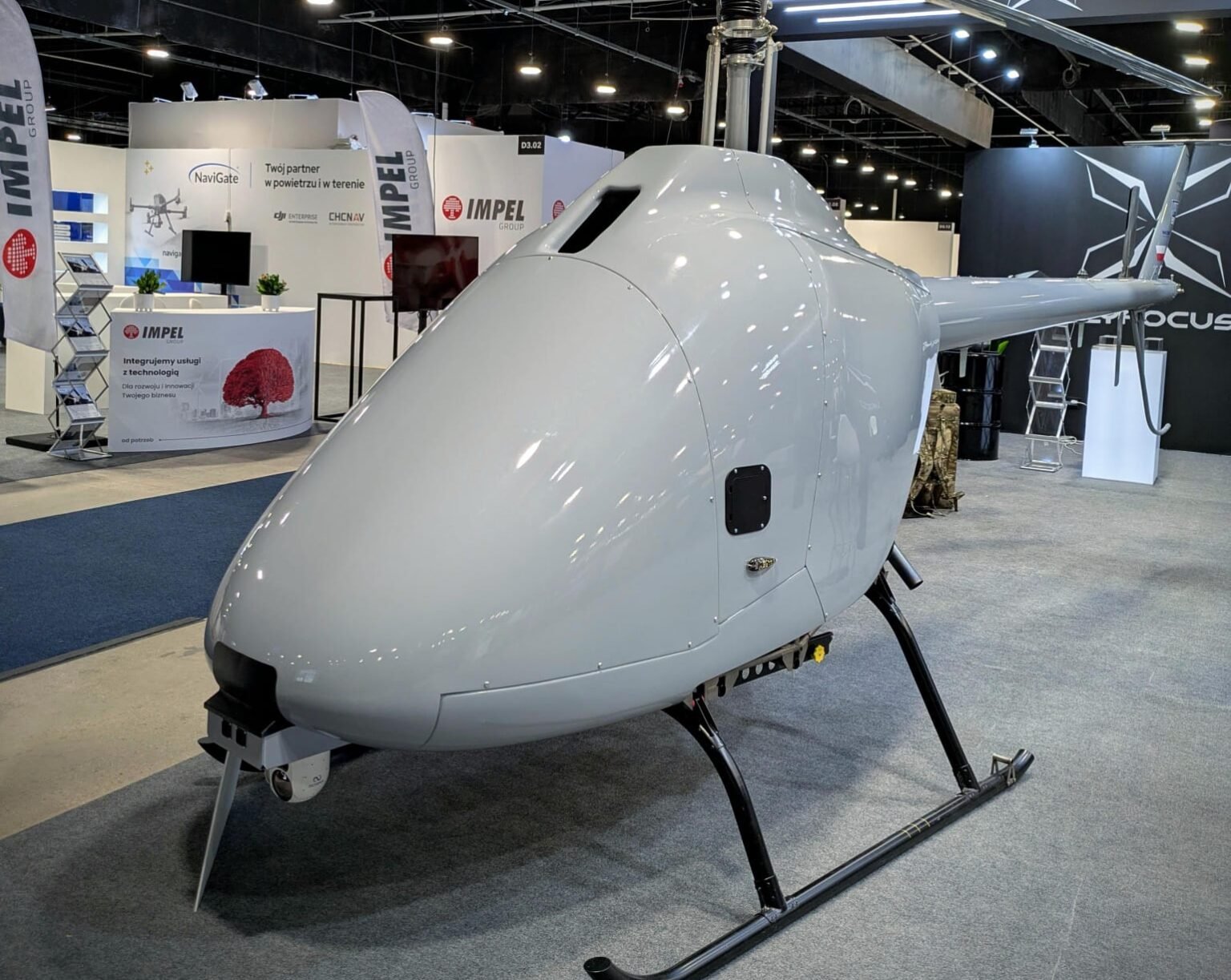
However, increased battlefield surveillance and improved air defences have made conducting resupply missions with manned aircraft increasingly dangerous. It risks not only failing to complete a mission but also losing the aircraft and its crew. The potential use of autonomous control technologies to enable unmanned platforms to carry out these resupply missions is actively being explored by several companies. One such initiative in the industry is the KURIER, an autonomously controlled helicopter designed and manufactured by Poland’s FlyFocus.
Displayed at the World Drone Expo in Warsaw in March 2026, the helicopter results from a collaboration between FlyFocus, FusionCopter, and the Institute of Fundamental Technological Research of the Polish Academy of Sciences (IPPT PAN). Its development is supported by the Polish Ministry of Defence through the National Centre for Research and Development (NCBR). The project received an investment of €5 million (PLN 20.8 million). Launched in February 2024, the team has completed component development and is reportedly approaching Technical Readiness Level (TRL) 6 with the prototype aircraft prepared. Field tests simulating real-world conditions are currently underway at Polish military sites.
The aircraft design is based on the Lamanna Escape Ultralight helicopter, which maximises the use of readily available commercial components. This approach allows for accelerated system development, helps achieve an economical unit price, and facilitates field support. It is designed to provide reliable unmanned flight, delivering up to 200kg (440lb) of cargo to precise sites even in GPS-denied environments. The platform has an empty weight of 350 kilograms (772lb) and a maximum take-off weight of 600kg (1,322lb). It can reach a maximum airspeed of 180 kilometres per hour (112mph) and operate at a maximum altitude of 4,000 metres (13,123ft). It is powered by a 105kW Rotax 915 iS piston engine.
Operational flight endurance for KURIER ranges between 3 and 10 hours, depending on payload size, altitude, and environmental conditions. In addition to its military resupply applications, KURIER could serve as an ideal platform for reconnaissance, border surveillance, and environmental monitoring. Its compact size, minimal take-off and landing requirements, and use of commercial components could appeal to its intended NATO country end-users.
by Stephen W. Miller
