

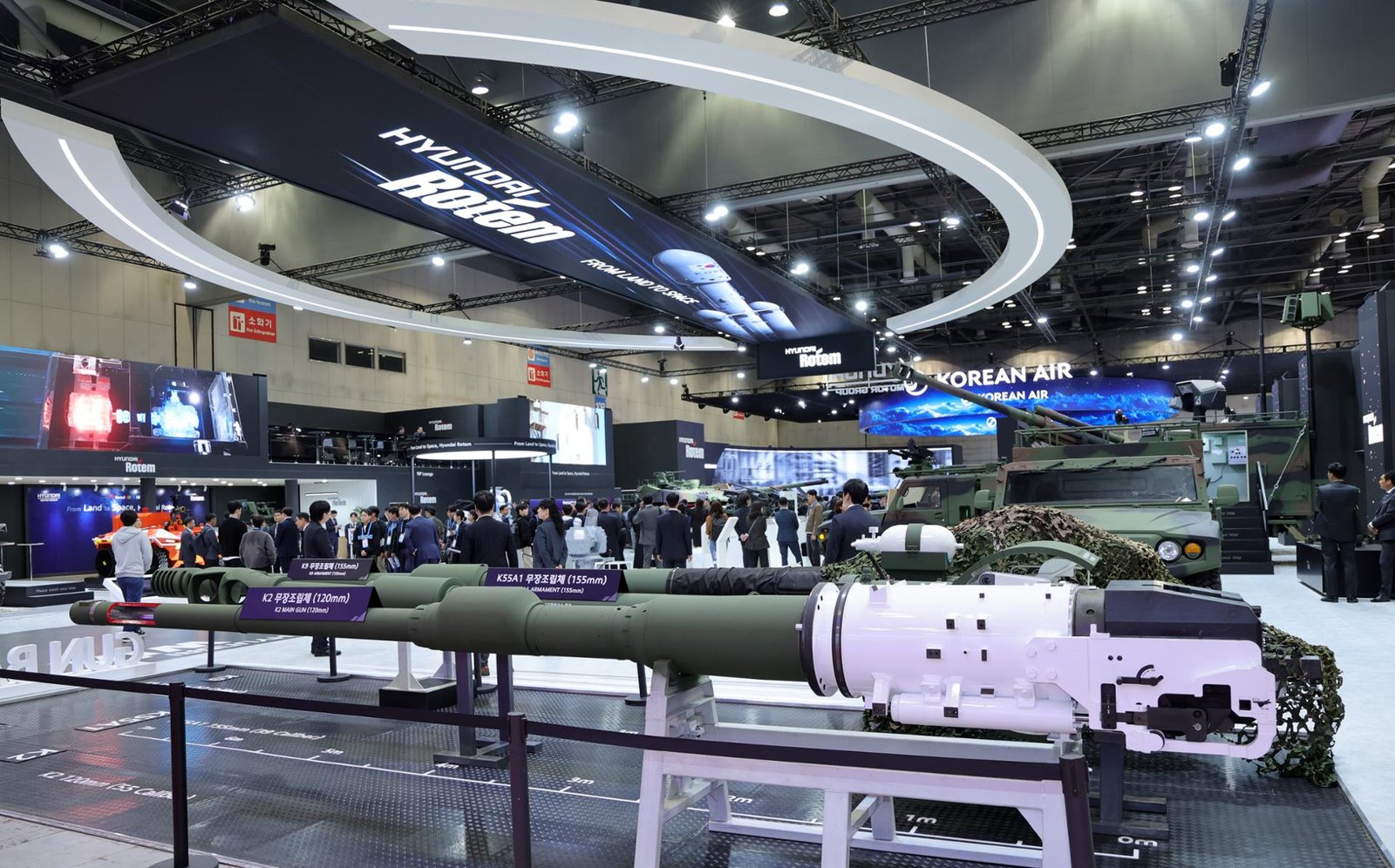
Seoul’s biennial Aerospace & Defense Exhibition (ADEX 2025) offered an extensive overview of the evolution of Korea’s defense sector as it enters a new era of warfare.
Key defense contractors including Hanwha, Korea Aerospace Industries (KAI), LIG Nex1 and Hyundai Rotem showcased an expanded range of systems powered by artificial intelligence (AI), along with unmanned operations and space technologies.
With 600 companies from 35 countries, this year’s exhibition was the largest since its launch in 1996, filling every hall at KINTEX in Goyang, Gyeonggi Province, and attracting a record number of foreign delegations. The event emphasized the momentum behind what officials now call “K-defense 2.0.”
AI redefines warfare
Hanwha Aerospace drew attention with its demonstration of “manned-unmanned teaming” platforms designed for networked combat. Its exhibits included the THeMis-K robotic combat vehicle, Arion-SMET and Grunt unmanned ground vehicles, and a mock-up of the Gray Eagle-STOL, jointly developed with General Atomics of the United States.
Executives said these systems would enable Korean forces to carry out modular operations with minimal risk to human soldiers.
LIG Nex1 unveiled a range of precision weapons under development for the KF-21 fighter, including short- and long-range air-to-air and air-to-ground missiles, as well as its G-Sword autonomous vehicle. The company also introduced a multilayer air-defense network that connects interceptors and radar systems into a single command web in a concept it calls “integrated layered protection.”
KAI demonstrated an AI-driven combat simulation tool that uses machine learning to visualize fast-changing battlefield conditions, while Hanwha Systems showcased four AESA radar models and an automated air-defense network capable of prioritizing multiple targets for simultaneous engagement.
This year’s ADEX event highlighted the growing dominance of AI in global defense technology. Exhibitors said modern warfare is increasingly being driven by AI-based systems that integrate land, sea and air operations under a unified command framework, minimizing human losses through automation.
A view of LIG Nex1’s exhibition booth at ADEX 2025, featuring the company’s Medium Unmanned Common Platform (MUCP) at KINTEX in Goyang, Gyeonggi Province. Courtesy of LIG Nex1
From ground to orbit
Hyundai Rotem, long known for its land systems, made its first foray into aerospace by unveiling reusable 10- and 3.5-ton methane engines, along with dual ramjet engines for hypersonic missiles.
Hanwha Systems introduced its Very Low Earth Orbit (VLEO) Ultra High Resolution (UHR) Synthetic Aperture Radar (SAR) satellite, capable of capturing images with a resolution high enough to detect objects as small as 15 centimeters in size, sufficient to detect something as small as a plastic bottle from an altitude of 400 kilometers above the Earth’s surface.
The company said the satellite boasts the highest imaging resolution in its class and can be used for both military and civilian surveillance purposes.
At the Hanwha pavilion, which brought together Hanwha Aerospace, Hanwha Systems and Hanwha Ocean, the conglomerate showcased a mock-up of an advanced jet engine in development for the KF-21 Block III fighter for the first time. Currently, only five countries — the U.S., the U.K., France, Russia and China — possess the capability to independently design and manufacture such engines.
The Korean government plans to invest approximately 3.35 trillion won ($2.36 billion) over 14 years, beginning in 2027, to domestically develop a 16,000-pound-thrust engine.
ADEX 2025 also reflected the government’s growing interest in AI and space technologies as a foundation for defense exports.
Attending the opening ceremony, President Lee Jae Myung said the government would support research and innovation so that “Korea can become a leading partner in technology cooperation, not a follower.”
Delegations from 35 countries, including the Philippines, the United Arab Emirates, Saudi Arabia, Poland and members of North Atlantic Treaty Organization (NATO), held on-site negotiations with Korean firms.
Hanwha, LIG Nex1, Hyundai Motor Group and KAI operated large pavilions, hosting live demonstrations and export consultations throughout the week.
According to the organizers, the number of foreign buyers increased almost 30 percent compared to the previous event, signaling growing confidence in systems made in Korea.
Hanwha Group said it will continue developing its expertise in AI, satellite and propulsion technologies in order to meet rising global security demand. Industry observers noted that ADEX has evolved from a weapons fair into a comprehensive platform for future warfare, where unmanned systems, hypersonic engines and orbiting satellites will operate under a unified digital command network.
