

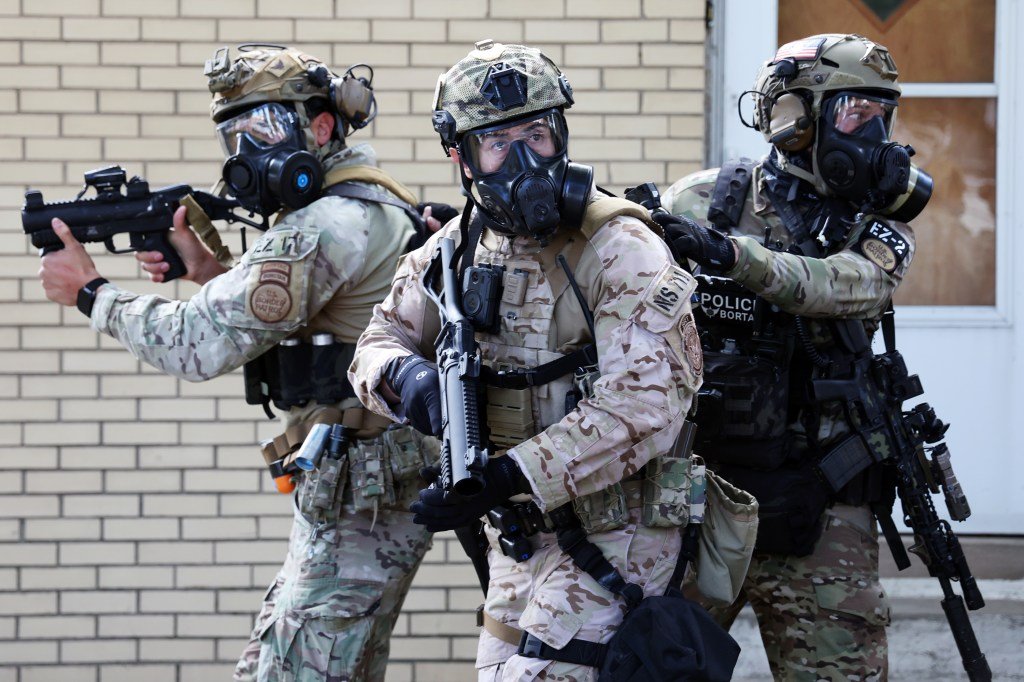
A federal judge on Thursday issued a scathing opinion that takes a deep dive into the use of force by immigration agents during Operation Midway Blitz, revealing new information gleaned from body-worn cameras and other evidence showing how agents used tear gas and flash-bang grenades on fleeing protesters, shot a praying minister in the face with pepper balls and even used ChatGPT to help write a report.
The 233-page written ruling by U.S. District Judge Sara Ellis, which memorializes her findings in issuing a preliminary injunction earlier this month, takes readers methodically through many of the high-profile melees between immigration agents and protesters during the two-month operation, including incidents in Albany Park, Old Irving Park, Evanston and the East Side.
Ellis wrote in the opinion that, over and over, body-worn camera footage from the agents undermined what was eventually put in their use-of-force reports, rendering their statements unreliable.
The reports also misidentified “neighborhood moms and dads, Chicago Bears fans, people dressed in Halloween costumes, and the lawyer who lives on the block” as professional agitators, Ellis wrote, while the body cameras at times captured the agents’ apparent glee in deploying tear gas and other munitions on residential streets.
“Just start throwing s—,” one agent told another during an incident on the East Side in October, according to Ellis’ report.
The judge also revealed for the first time that one body-worn camera video captured an immigration agent using the AI tool ChatGPT to “compile a narrative for a report based off of a brief sentence about an encounter and several images.”
“To the extent that agents use ChatGPT to create their use of force reports, this further undermines their credibility and may explain the inaccuracy of these reports when viewed in light of the BWC footage,” Ellis wrote.
Read the ruling: Injunction provides new look at ‘Operation Midway Blitz’
Elllis’ opinion was issued a day after her injunction was stayed by the 7th U.S. Circuit Court of Appeals, which called it “overbroad” and said it improperly targets virtually the entire executive branch, including President Donald Trump.
In agreeing to issue a stay, however, a three-judge appellate panel warned to “not overread” the order, saying Ellis’ findings “may support entry of a more tailored and appropriate preliminary injunction” down the line.
In a telephone hearing Thursday afternoon, Ellis said it would be best to hold off on setting a discovery schedule for a permanent injunction hearing — currently set for March 2 — until after the appellate court issues some guidance.
The judge also set a deadline at the end of the day Wednesday for the Department of Justice to make public some 47 videos of body-worn camera footage that she relied on to issue her injunction ruling.
Meanwhile, Ellis ordered the government to continue producing body camera footage and reports from incidents that occurred in the days after she issued her initial injunction order, including one in Little Village on Nov. 8, where the Department of Homeland Security has claimed that agents were fired upon.
The next status hearing in the case was set for Jan. 7. Arguments before the 7th Circuit, meanwhile, are scheduled for Dec. 17.
In her ruling Thursday, Ellis said that Border Patrol Cmdr. Gregory Bovino, the tough-talking field general who was the face of the Trump administration’s operation, was “evasive” during his three days of sworn testimony with plaintiffs’ attorneys, “either providing ‘cute’ responses” or “outright lying.”
In one high-profile incident in Little Village where Bovino initially claimed he’d been hit in the head with a rock, Ellis wrote the only object that came near him was a tear gas canister that protesters threw back in the vicinity of agents.
Footage showed Bovino “rolled a second canister” of tear gas at people as they fled, Ellis said, as another agent near Bovino fired a flash-bang grenade at the crowd.
Ellis also questioned Bovino’s testimony about seeing suspected Latin Kings gang members taking weapons out of the back of their car in Little Village and others on rooftops and in the crowd. Bovino testified the fact they were wearing “maroon hoodies … would signify a potential assailant or street gang member that was making their way to the location that I was present,” Ellis’ opinion said.
But maroon is not the color of the Latin Kings, Ellis noted. What’s more, the footage from that day only showed a few people wearing maroon clothing — and one of them was Ald. Byron Sigcho-Lopez.
The testimony about “individuals in maroon hoodies being associated with the Latin Kings and threats strains credulity,” the judge said.
In Brighton Park on Oct. 4, where a crowd gathered after the shooting of Marimar Martinez, Ellis describes footage of agents shooting flash-bang grenades at protesters, and one agent appearing to kick a protester who was on the ground as he walked away.
On Halloween in Evanston, agents caused a car crash after making a fast right turn at a red light, according to Ellis’ opinion, then scuffled with people on scene, with one agent pointing a gun at a man.
A woman walked to the intersection and began recording, spotting agents detaining people, including a man who was on “all fours” with agents on top of him, the opinion said. Witness accounts and videos portrayed scenes of agents twisting a man’s arm and bashing his head into the street.
“The man said several times that he could not breathe, and he appeared dazed as agents stood him up and put him in their SUV,” Ellis wrote.
Nearby, an Evanston resident started recording the scene when an agent turned and said, “Step back or I’m going to shoot you,” according to the opinion.
A photograph included in the opinion shows a bearded agent wearing sunglasses pointing a gun.
“This was not the first time the agent had pointed his gun at protesters, having done so less than a minute before,” Ellis wrote.
The opinion noted that after the scene in Evanston, Bovino posted on social media that a man who was hit in the head grabbed the agent’s genitals.
Ellis said the government did not provide any evidence to support that account.
On Oct. 14, a vehicle pursuit in the city’s East Side neighborhood led to another clash between immigration authorities and largely peaceful community residents, ending in another cloud of tear gas.
Ellis said that “regardless of the peaceful nature of the crowds,” many of the agents believed that the protesters would inevitably become violent, as captured on body-worn camera footage.
“I can tell you right now how it’s going to go,” an agent said in one video. “We’re going to try to get out, they’re going to block our vehicles, we’re going to tell them to move, they don’t, we gas ’em.”
Another agent responded: “We’re definitely gassing them when we leave. Just start throwing s—.”
Ellis noted, too, that some agents were also “actively attempting to rile up the protesters,” including one who told colleagues: “I like to poke the bear a little bit. But it is crazy ’cause like, nothing they’re saying is like, the slightest bit of reality whatsoever.”
On Oct. 12, Border Patrol agents tried to arrest two couples in Albany Park near Sawyer and Wilson avenues but they ran. One escaped but the agents captured the other. According to agents, a crowd of 40 to 50 people began to block their movement.
Agents drove slowly away from the crowd but did not warn the people what would happen if they did not get out of the way, Ellis wrote. The agents moved forward into a woman in a bathrobe who shouted, “You ran over my foot!”
The official use-of-force report stated that Border Patrol Agent Justin Elizalde told the crowd they were violating the law and obstructing agents and if they did not allow agents to leave with the arrested person, they would be arrested and gassed.
But body camera footage tells a different story, Ellis wrote. In it, an agent, presumably Elizalde, tells another that “if they don’t want to clear, we’re going to gas,” and the other agent responded, “(Expletive) it, let’s go.”
“Without giving the protesters an opportunity to comply, contrary to his claim in the use of force report that he waited ‘a considerable amount of time,’ Elizalde rolled a tear gas canister toward the protesters,” Ellis wrote.
Agents also “claimed that a woman threw her bicycle at agents, but video actually shows an agent throwing the bicycle out of the way and pushing someone down after having deployed tear gas,” Ellis wrote.
Ellis’ preliminary injunction, issued two weeks ago, prohibits immigration agents from deploying tear gas or other munitions before issuing two explicit warnings, requires agents in the field to have body cameras and wear clear identification on their uniforms and forbids law enforcement from targeting journalists or interrupting their news gathering in most circumstances.
Unlike a previously entered temporary restraining order, the preliminary injunction was to remain in effect until a final decision on the merits of the case is made, either at trial or through a settlement.
In asking the 7th Circuit for an emergency stay, lawyers for the U.S. Department of Justice wrote that the case was a “perfect example” of a growing trend in the nation’s courts to issue sweeping injunctions that violate the separation of powers and “superintend law-enforcement activities under threat of contempt.”
“The predictable result is to broadly obstruct the enforcement of the nation’s laws, chill the exercise of executive power, and subvert the constitutional structure,” the 22-page filing stated.
The filing also alleged the injunction is “unworkable in practice” and illegally transforms her into a “supervisory tribunal” for deciding whether federal officers were acting lawfully in their day-to-day operations.
In its order granting a stay, the 7th Circuit said the government was likely to succeed on those arguments.
“The preliminary injunction entered by the district court is overbroad,” the order said. “In no uncertain terms, the district court’s order enjoins an expansive range of defendants, including the President of the United States, the entire Departments of Homeland Security and Justice, and anyone acting in concert with them. … The practical effect is to enjoin all law enforcement officers within the Executive Branch.”
Ellis’ injunction also requires to submit all future guidelines for use of force to the court for review, “a mandate impermissibly infringing on principles of separation of powers on this record,” the appeals court said.
The injunction was also too “prescriptive” in barring the “use of scores of riot control weapons and other devices in a way that resembles a federal regulation,” the appellate court order said.
All three judges on the panel that issued the stay are Republican nominees. Judge Frank Easterbook was nominated by President Ronald Reagan, while Judge Michael Scudder and Judge Michael Brennan were each nominated by Trump in his first term.
Later Wednesday, the 7th Circuit issued an expedited appeal schedule, asking for the government’s brief no later than Nov. 26, and any reply by Dec. 3.
Chicago Tribune reporters Gregory Royal Pratt, Sam Charles and Rebecca Johnson contributed.
jmeisner@chicagotribune.com
mabuckley@chicagotribune.com
