

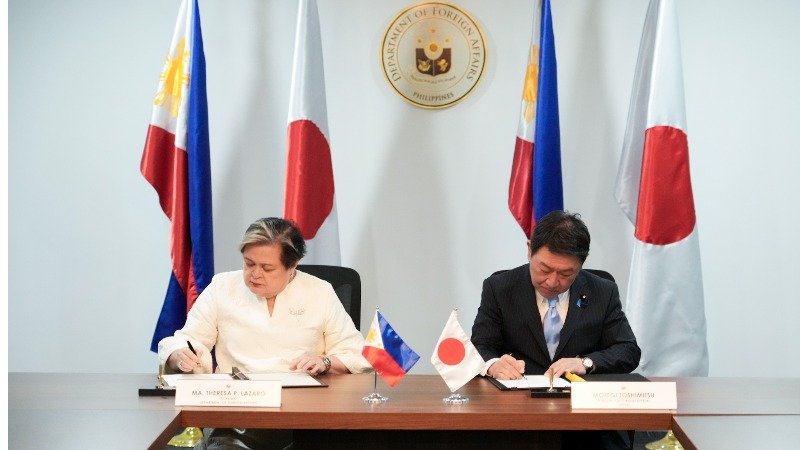
On January 15, the Japanese government signed an agreement with the Philippines to construct boathouses and slipways for rigid-hulled inflatable boats (RHIBs) used by the Philippine Navy under the Official Security Assistance (OSA) program administered by Japan’s Ministry of Foreign Affairs.
The capacity-building initiative[1] with Manila has been heralded by Tokyo as the first infrastructure project to be conducted within the OSA, Japan’s assistance program aimed specifically at providing material assistance to the armed forces of like-minded countries, which until now has focused on equipment provision.
At the same bilateral meeting between Japanese Foreign Minister Toshimitsu Motegi and his Philippine counterpart, Maria Lazaro, the two sides also signed an Acquisition and Cross-Servicing Agreement (ACSA) to enable the swift provision of supplies and services between the Japan Self-Defense Forces (JSDF) and the Armed Forces of the Philippines (AFP).[2]
During the bilateral, the two sides shared concerns over China’s attempts to change the status quo by force in the East and South China Sea and emphasized the need for continued United States engagement in the Indo-Pacific region.[3]
The OSA project and the ACSA further strengthen the strategic partnership between Tokyo and Manila, building on the Japan–Philippines Reciprocal Access Agreement (RAA) signed in 2024 to facilitate greater military cooperation, including the conduct of joint exercises and disaster relief operations.[4]
Japan’s OSA Program Forges Security Linkages with Manila
Following Japan’s launch of OSA in 2023, the Philippines was the first country for which assistance was announced and has since become a significant monetary focus for Tokyo’s security-focused support scheme.

Structured as a form of grant aid, OSA projects with Manila have thus far included the provision of RHIBs, coastal radar systems to the Philippine Navy and air surveillance radar system-related equipment to the Philippine Air Force.[6]
The OSA equipment provided to Manila is designed to strengthen the security of critical sea lanes vital to Tokyo, and to enhance the Philippines’ overall maritime and aerial monitoring and surveillance capabilities.

In explaining the latest round of projects, Japan’s Ministry of Foreign Affairs (MOFA) notes that “[t]he Philippines faces important sea lanes, including the South China Sea and the Luzon Strait,” and describes the country as a key strategic partner in Japan’s regional Free and Open Indo-Pacific (FOIP) strategy.[8]
Beyond its role as one of Japan’s most important bilateral partners in Southeast Asia in responding to China’s expanding naval presence, the Philippines is also working with Japan and the United States to deepen cooperation in a range of domains, including cyber defense.[9]
The Philippines as an Emerging Defense Market for Japan
Manila is not only a key strategic partner but is also becoming a significant market for Japan’s expansion of defense exports.
In 2023, the Philippines became the first country to which Japan successfully delivered a fully-assembled defense system, in this case an air surveillance radar, under Japan’s Three Principles on Transfer of Defense Equipment and Technology introduced in 2014.
This was the result of a contract first signed in 2020 between Manila and Mitsubishi Electric Corporation, valued at approximately USD 100 million for the FPS-3ME long-range 3D AESA (Active Electronically Scanned Array) radar, capable of detecting and tracking multiple aerial targets.[10]

Japan’s successful radar export to the Philippines has since led Tokyo to consider supplying additional air systems that could help Manila deter China’s growing military presence in the region while also enhancing interoperability between the JSDF and the AFP.
In December, reports[11] noted that Japan is considering exporting to the Philippines a command-and-control system that integrates radar and sensor data to detect and track aircraft and missiles. Adding such capabilities to the radar units already supplied by Japan would in turn help improve information sharing between the two countries.
Philippine defense officials have also been said to have shown renewed interest in Japan’s Type-03 medium-range surface-to-air missile. If integrated with the Japanese-supplied radar and prospective command-and-control system, this would allow the Philippines to conduct end-to-end detection, tracking, and interception operations using exclusively Japanese defense equipment.
Export of Japanese maritime capabilities is likewise an area of interest from Manila. Over the summer last year, the Philippine Navy expressed interest in the acquisition of used Abukuma–class destroyer escorts currently in service with the Japan Maritime Self-Defense Force (JMSDF).

Meanwhile, the Japanese government is already providing maritime capacity-building support to the Philippine Coast Guard (PCG) through the provision of Multi-Role Response Vessels (MRRVs), along with associated training, under a project implemented by the Japan International Cooperation Agency (JICA).
Conclusion
Japan’s security partnership with the Philippines has been steadily taking shape over the last few years in response to China’s increased maritime activities in the East and South China Seas.
Tokyo has now signed two significant agreements to institutionalise the relationship. First is the RAA, signed in 2024 and designed to facilitate smoother deployment of Japanese and Philippine forces on each other’s territory. Second is the ACSA, forged this month, which will enable the swift provision of supplies and services between the two forces.
Japan’s unprecedented initiatives under OSA to provide infrastructure support (the construction of boathouses and slipways for the Philippine Navy’s RHIBs, also supplied by Tokyo) represent a significant step in a partnership that appears to place particular emphasis on the maritime domain, though not exclusively, as air and cyber capabilities are also prominently featured.
Tokyo’s growing security partnership with Manila is in turn contributing to the emergence of the Philippines as a key export market for Japan’s defense industry.
Notes
[1] MOFA, “Signing and Exchange of Notes for Official Security Assistance (OSA) FY2025 Project to the Republic of the Philippines”, January 15, 2026, https://www.mofa.go.jp/s_sa/sea2/ph/pageite_000001_01457.html.
[2] MOFA, “Signing of the Agreement between the Government of Japan and the Government of the Republic of the Philippines Concerning Reciprocal Provision of Supplies and Services between the Self-Defense Forces of Japan and the Armed Forces of the Philippines”, January 15, 2026, https://www.mofa.go.jp/s_sa/sea2/ph/pageite_000001_01456.html.
[3] NHK News, “Japanese Foreign Minister visits Philippines and India”, January 16, 2026, https://www3.nhk.or.jp/nhkworld/en/news/20260116_25/.
[4] MOFA, “Signing of the Japan-Philippines Reciprocal Access Agreement”, July 8, 2024, https://www.mofa.go.jp/s_sa/sea2/ph/pageite_000001_00432.html.
[5] MOFA, “Official Security Assistance (OSA) Programme in implementation FY2023”, Updated January 6, 2026, “Official Security Assistance (OSA) Programme in implementation FY2024”, Updated January 6, 2026, “Official Security Assistance (OSA) Programme in implementation FY2025”, Updated January 6, 2026, “Signing and Exchange of Notes for Official Security Assistance (OSA) FY2025 Project to the Republic of the Philippines”, January 15, 2026, https://www.mofa.go.jp/s_sa/sea2/ph/pageite_000001_01457.html.
[6] MOFA, “OSA: Japan’s Initiative to underpin International Peace and Security”, https://www.mofa.go.jp/files/100826252.pdf.
[7] MOFA, “OSA for Fiscal Year 2023”, “OSA for Fiscal Year 2024”, “Signing and Exchange of Notes for Official Security Assistance (OSA) FY2025 Project to the Republic of the Philippines”, January 15, 2026, https://www.mofa.go.jp/s_sa/sea2/ph/pageite_000001_01457.html.
[8] MOFA, “Signing of the Agreement between the Government of Japan and the Government of the Republic of the Philippines Concerning Reciprocal Provision of Supplies and Services between the Self-Defense Forces of Japan and the Armed Forces of the Philippines”, January 15, 2026, https://www.mofa.go.jp/s_sa/sea2/ph/pageite_000001_01456.html.
[9] Indo-Pacific Defense Forum, “Philippines fortifies cyber defense, partnering with Japan, U.S. and others”, January 19, 2025, https://ipdefenseforum.com/2025/01/philippines-fortifies-cyber-defense-partnering-with-japan-u-s-and-others/.
[10] JMOD, “フィリピンへの警戒管制レーダーの移転について” [The Transfer of the Air Surveillance Radar Systems to the Philippines], November 2, 2023, Mitsubishi Electric Corporation, “FPS-3ME – Advanced Air Surveillance Radar”, https://www.mitsubishielectric.com/defense/products/fps-3me/index.html.
[11] Mizuki Sato, “Japan moves to export defense command system to Philippines”. Asahi Shimbun, December 3, 2025, https://www.asahi.com/ajw/articles/16198175.
This article was originally posted on NSBT Japan, the first defense and security industry network in Japan. The publication provides the latest information on security business trends both within Japan and overseas. Asian Military Review began exchanging articles with NSBT Japan in April 2024.
Read the original article here.
