

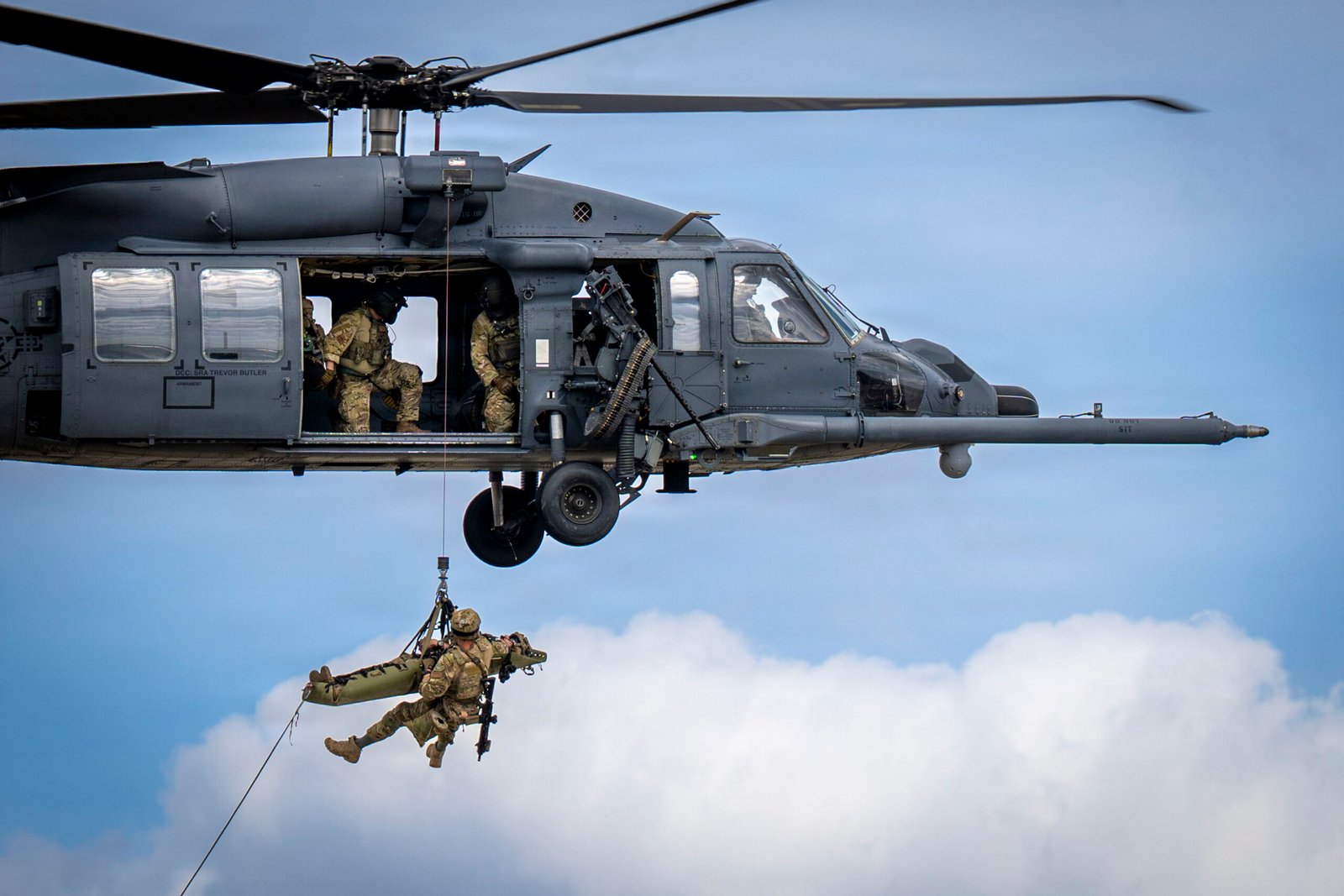
The dramatic and sprawling two-day operation to save the crew of an F-15E Strike Eagle shot down over Iran on April 3 involved hundreds of personnel, dozens of aircraft—and multiple close calls.
In an April 6 press briefing at the White House, President Trump and top government officials walked reporters through how the massive rescue operation unfolded and outlined new details of the risky, high-stakes operation.
Trump, who spoke alongside Defense Secretary Pete Hegseth, Chairman of the Joint Chiefs of Staff Air Force Gen. Dan Caine, and CIA Director John Ratcliffe, called the successful operation “one of the largest, most complex, most harrowing combat … search and rescue mission[s] ever attempted by the military.”
He attributed the mission’s success to the “great talent” and “genius” of those involved, the breadth of the military and CIA’s joint response, and “a little luck too, I would say.”
“This is a rescue that’s very historic,” Trump said. “It’ll go down in the books.”
The emergency began in the early morning hours of April 3 local time—late April 2 on the U.S. East Coast—when an Iranian missile slammed into a two-seater F-15E which bore the call sign DUDE 44.
Trump later said that while U.S. forces had eliminated Iran’s anti-aircraft capability in the area, an Iranian service member “got lucky” with a shoulder-fired heat-seeking missile that “got sucked right in by the engine” of the F-15.
At 4:40 a.m. local time in Iran, Caine said the military’s Joint Personnel Recovery Center declared the F-15’s two crew members—a pilot and a weapons system officer—were down in hostile territory. They had safely ejected, Caine said, but were isolated behind enemy lines.
The military confirmed their rescue beacons were active, Caine said, and on Hegseth and Trump’s orders, launched a mission to bring them both safely home.
Within a few hours of the F-15’s crash, Trump said, 21 military aircraft flew into hostile airspace, operating for seven hours in broad daylight, making the operation even more perilous. Many flew at such a low altitude they were being shot at by rifles, Trump said, and all faced heavy enemy fire.
“We have a helicopter that’s got a lot of bullets in it,” Trump said. “It’s amazing. We just realized how good those weapons are, those machines. The flight crews and warfighters aboard those aircraft took extraordinary risks to rescue their fellow service members.”
Caine said that combat search and rescue task force included A-10 Warthogs, HC-130 Combat King IIs, HH-60W Jolly Green II rescue helicopters, drones, and special warfare Airmen such as combat rescue officers and pararescuemen. Caine confirmed the veracity of videos showing the helicopters refueling from the HC-130s to penetrate further into Iranian territory.
The A-10s were carrying out the Warthogs’ traditional combat search-and-rescue mission, referred to as “Sandy,” laying down withering, close-quarters suppressing fire to keep Iranian forces away from the pilot, Caine said.
One A-10, whose pilot had been in contact with the downed F-15 pilot, was hit by enemy fire, Caine said. The pilot kept fighting, Caine said, and after exiting the battlespace, concluded the plane could not be safely landed. That pilot bailed out over Kuwait and was safely rescued soon afterwards.
Caine said the A-10 force and other rescuers performed admirably in rescuing the pilot.
“A Sandy has one mission: Get to the survivor, bring the rescue force forward, and put themselves between that survivor on the ground and the enemy,” Caine said. “They are committed to this. This is what they live for, and this is what they’ve trained for over many, many years.”
The first wave of rescuers reached the F-15E pilot—dubbed DUDE 44 Alpha—and safely recovered him aboard an HH-60W under close range gunfire.
But they weren’t yet out of the woods. The HH-60W “was engaged by every single person in Iran who had a small arms weapon,” Caine said. Another helicopter trailing behind took several hits from small arms fire, he said. A crew member aboard that helicopter sustained a minor injury, Caine said, but will be fine.
“This was an incredibly dangerous mission, an incredibly dangerous undertaking,” Caine said. “But a filled promise made to every American warfighter that you will not be left behind. We will always come find you, and we will always bring you home.”
And the fight to save the WSO had just begun.
DUDE 44 Bravo
The second Airman, dubbed DUDE 44 Bravo, is a colonel who Trump said is “highly respected.” He had landed a significant distance away from the pilot—and he was “injured quite badly.”
What’s worse, Trump said, the area was “teeming” with Iranian personnel—including forces from the Islamic Revolutionary Guard Corps, the Basij militia, and local authorities—who were aggressively hunting the WSO.
Iran was eager to capture the WSO, which would have given its government both a powerful bargaining chip to use against the U.S. as well as a tremendous propaganda victory. Iran’s government placed a large bounty out to capture the WSO, and local communities were looking for him.
The WSO followed his training, Trump said, and started moving away from his ejection site to evade capture. Despite his injuries, Trump said, the WSO started climbing into “treacherous mountain terrain” to reach a higher altitude—scaling cliffs while “bleeding rather profusely.”
Once the WSO was at a safer spot in his “mountain holdout,” Trump said he treated his own wounds and contacted American forces to transmit his location.
The U.S. military swung into action. The second rescue wave was even more massive than the first, encompassing 155 aircraft, Trump said. That included four bombers, 64 fighters, 48 refueling tankers, and 13 rescue aircraft, among others, flying for another seven hours in darkness.
Subterfuge was a crucial component of the operation, Trump said. The CIA helped deceive and confuse Iran to send them in the opposite direction from where the WSO actually was. And Trump said the deception operation also included sending aircraft to different sites to lure Iranian forces away from where the WSO really was.
At one point, Trump said, the U.S. flew nine planes over another location 25 miles away from the WSO’s actual hiding spot.
“We wanted to have them think he was in a different location, because they had a vast military force out there,” Trump said. “Thousands of people were looking. … They had seven different locations where they thought—and they were very confused. They said, ‘well, wait a minute, they’ve got groups here, they’ve got groups there.’”
CIA Director John Ratcliffe said the agency used both human assets and sophisticated intelligence technologies to help find the WSO while misdirecting Iranian forces.
Meanwhile, Trump said, the WSO kept climbing to even more remote spots on the mountain to become even harder for the Iranians to find. Ratcliffe said that on the morning of April 4, the CIA confirmed the WSO was alive and concealed in a mountain crevice.
Trump said Ratcliffe told him U.S. forces had trained a camera on the WSO’s suspected location from 40 miles away, watching for the downed aviator to move. He stayed remarkably still, however, concealed in thick mountaintop bushes and trees, and it was unclear if he was actually there. Finally, after about 45 minutes, the WSO stood up from his cover and the CIA knew it was him.
As night fell, the time had come to pull him out, once and for all.
It was a massive logistical effort. Two MC-130J Air Force Special Operations planes flew in vast amounts of equipment needed to reach the mountaintop. Trump said that included three “small, unbelievably powerful” helicopters—likely referring to MH-6 Little Bird helicopters—which were rapidly assembled on site. Photographs emerged on social media afterwards showing wreckage of the Little Birds, which appear to have been destroyed by the U.S. rather than be extracted.
The rescue force also battled poor weather. The MC-130s became bogged down in the wet, sandy surface and later could not fly out, so they were also destroyed to prevent adversaries from examining U.S. air defenses and other technologies, Trump said.
Joint U.S. forces continued to pound Iranian forces to keep them away from the WSO, Caine said, and A-10s once again flew Sandy protection missions throughout the night on April 4 into the morning of April 5.
In what Trump called “a breathtaking show of skill and precision, lethality, and force,” U.S. forces engaged Iranian forces near the WSO’s mountaintop sanctuary and rescued him. DUDE 44 Bravo had been on the run, bleeding and alone, for nearly 48 hours.
Caine said that during all that time, the WSO evaded capture from Iranian forces “using every means available.” Both aviators showed “grit and warfighting tenacity,” Caine said, and that spirit was the deciding factor in their safe recovery.
“The single most important contributor to a successful rescue operation is the spirit of attack inside the heart of that downed aviator,” Caine said. “Their will to survive, their will to evade, their will to recover is everything. In this case, the [WSO’s] absolute commitment to surviving made much of our efforts possible.”
