

Abstract: In 2019, the author, with Arnel David, argued that the United States military’s conception of lethality was dangerously narrow—focused almost exclusively on kinetic destruction while neglecting strategic influence as a decisive instrument of war. That argument has been validated by events: adversaries have waged and won influence campaigns at a fraction of the cost of conventional warfare, while the United States has continued to pay an astronomical bill for kinetics-first strategies with diminishing strategic returns. This article revisits and builds on the 2019 thesis, surveys the strategic ledger since then, and introduces the Power and Ideology Lethality (PIL) simulation platform—a new analytical tool designed to help practitioners plan, assess, and wargame influence competition as a core component of lethal strategy.
Introduction
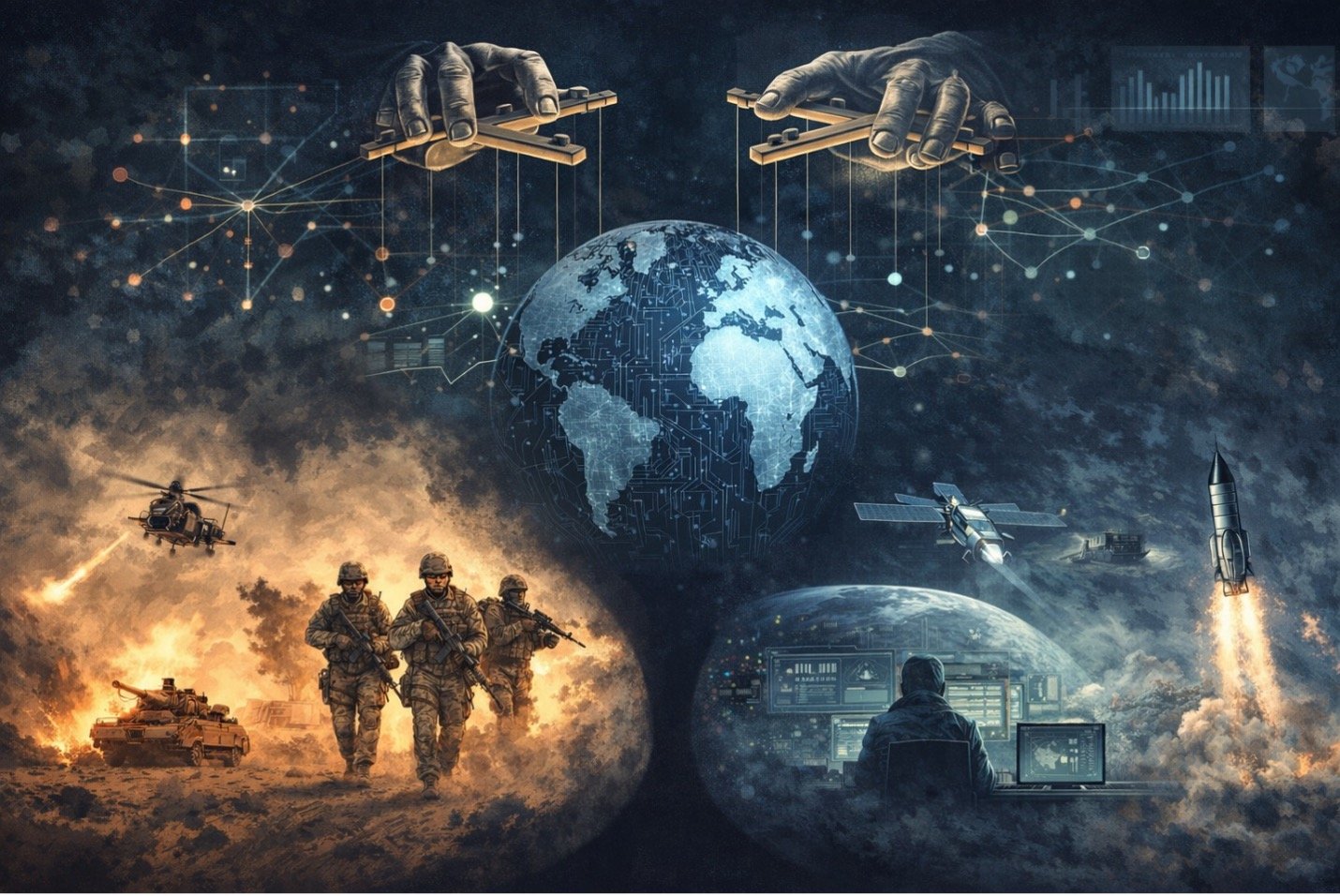
In February 2019, the author, with Arnel David, argued in these pages that the United States military’s understanding of lethality was dangerously incomplete. The concept had become a defining priority of the Department of Defense (DoD)—appearing across modernization strategies, acquisition frameworks, and doctrinal literature—yet it was treated almost exclusively as a physical phenomenon: the ability to find, fix, and destroy enemy forces. We argued then that this was insufficient. To view lethality only through a physical lens limits its full potential. Lethality at the strategic level, we contended, must also include the capacity to break an adversary’s will to fight. And that capacity is increasingly exercised not through firepower, but through influence. We have used influence to support kinetic action. This paper argues that this order of events is inverted: kinetic action should operate within the framework of strategic influence, not the other way around.
The strategic competition between the United States and its rivals has intensified. The cost of kinetic warfare—in blood, treasure, and strategic credibility—has grown exponentially. Meanwhile, peer and near-peer competitors have continued to invest heavily in influence-based strategies, reshaping political environments, undermining alliances, and projecting power without firing a shot. The gap between what the United States understands as lethality and what its adversaries practice as strategy has not closed. If anything, it has widened.
This piece returns to the 2019 argument—not to relitigate it, but to stand on it and build on it. The world has changed in ways that make our original warning more urgent. We survey those changes, examine the cost of inaction, and introduce a new analytical tool—the Power and Ideology Lethality (PIL) simulation platform—designed to help practitioners think about influence lethally and strategically. PIL is the doctrinal equipment this argument demands.
What We Argued in 2019—and Why It Still Stands
The 2019 article identified a fundamental conceptual failure in the DoD’s understanding of its own organizing principle. The term lethality had become something everyone claimed to understand, but no one could coherently define. In practice, it defaulted to the physical and the tactical: weapons systems, targeting speed, and force protection. What was missing was any serious reckoning with lethality at the strategic level—the capacity not simply to destroy enemy forces, but to compel an enemy to stop fighting.
Here is the inversion that the 2019 article pointed toward, and that the intervening years have confirmed: kinetic operations do not achieve strategic decisions on their own. They set the conditions under which influence achieves a decision. If the strategic return on kinetics has been inadequate despite overwhelming physical success—and it has been, repeatedly—then the physical is no longer the decisive variable. It is the setup for the influence punch. The most expensive bill in modern military history was run up by a doctrine that had the sequence backwards.
Wars are not decided by the annihilation of forces alone. As we saw in Iraq, the destruction of the Iraqi Army only led to a prolonged asymmetric war. Wars end when one side concludes that the contest is no longer worth its cost. The will to fight—an adversary’s political resolve, domestic legitimacy, coalition cohesion, and narrative control of the conflict—is therefore as much a target as any weapons system. And influence, properly understood, is the mechanism through which that target is engaged.
We defined strategic influence as the use of the elements of national power—diplomatic, military, economic, with and through information—to shape the information and operational environment to erode the enemy’s will. Lt. Gen. (ret.) James Dubik identified foreign influence operations as the single most important strategic-level preparation that civilian and military leaders must make for the next war. The Special Operations Forces community understood this instinctively and through decades of experience. The rest of the joint force had not caught up.
That diagnosis has not changed. What has changed is the price of ignoring it.
Legacy Lethality vs. Information Lethality
| Feature | Legacy Lethality (Physical) | Information Lethality (Strategic) |
| Primary Target | Enemy forces & equipment | Enemy will & decision calculus |
| Mechanism | Kinetic destruction | Strategic influence |
| Success Metric | Attrition/body count | Narrative control, legitimacy, coalition coherence |
| Role of Kinetics | The decisive blow | Conditions-setting for the influence decision |
| Time Horizon | Battle/campaign | Competition continuum |
| Adversary Counter | Armor, air defense, hardening | Narrative resilience, proxy insulation, gray zone ambiguity |
The Strategic Ledger Since 2019
The years since 2019 have provided a running demonstration of influence lethality in action—mostly by adversaries.
Russia’s renewed invasion of Ukraine in February 2022 combined kinetic operations with an information campaign of considerable sophistication. Moscow sought to fracture Western coalition support, delegitimize the Ukrainian government, and shape the information environment both domestically and internationally—sustaining the Russian will to fight while eroding it elsewhere. The kinetic campaign has been costly and, in many respects, underperforming. The influence campaign has been more durable: exploiting fault lines in Western publics, amplifying war fatigue, and contesting the narrative architecture of the conflict across multiple platforms simultaneously.
China, meanwhile, has accelerated a long-game strategy of displacing American influence—not primarily through force, but through economic leverage, technological dependency, institutional access, and narrative shaping. The Confucius Institute case warrants a label it rarely receives: Lethal Influence in the homeland. China invested systematically in educational and cultural influence operations at American universities for nearly two decades, reshaping curricula, suppressing discussion of sensitive topics, and curating a generation of students’ understanding of China—without a single shot fired on American soil. As Bottomley documents, by 2023, fewer than five of the roughly 100 Confucius Institutes once operating on US campuses remained—not because China’s strategy failed, but because American institutions finally recognized what was happening and moved to close them. The asymmetry is stark: China spent an estimated $8 billion on public diplomacy in 2020 alone, compared to roughly $2 billion by the United States. The competition for influence is not hypothetical. It is funded, structured, and ongoing—and it reaches inside US borders.
Non-state actors have not stood still either. Violent extremist organizations, criminal networks, and proxy forces continue to demonstrate that narrative warfare—the contest over who controls the meaning of events—can be as strategically consequential as any kinetic operation. Recruitment, radicalization, and the erosion of state legitimacy in contested spaces remain influence-driven phenomena.
The cost of kinetic approaches, meanwhile, has become impossible to ignore. Vietnam received 13 million tons of high explosives—more than six times the weight dropped in all theaters during World War II. The United States killed an estimated one to two million people. It lost the war. Iraq and Afghanistan produced variations on the same lesson: tactical lethality delivered at enormous cost produced no strategic decision. The physical destruction of forces does not compel adversaries to abandon political objectives. It may, in fact, harden them—generating civilian casualties that fuel hostile narratives, strengthen recruitment, and sustain the will to fight against the United States.
The bill for a kinetics-first strategy is astronomical. The strategic return has been inadequate. And yet the conceptual framework that produced these outcomes—lethality as destruction—persists.
The Problem Is Not That We Don’t Practice Influence—It’s That We Don’t Think About It Lethally
It would be a mistake to conclude that the United States does not engage in influence operations. It does—extensively. Public diplomacy, information operations, strategic communications, civil affairs, psychological operations, and foreign internal defense are all influence activities conducted worldwide by the U.S. government and military elements.
The problem is doctrinal, not operational. The United States does not consider these activities to be lethal. They are treated as supporting efforts—force multipliers at best, soft-power adjuncts at worst—rather than as core instruments of strategic compellence. The planning architecture, resource allocation, and assessment frameworks of the US military continue to treat kinetic action as the decisive variable and influence as the supporting one. The strategic logic runs backward.
The gray zone—that contested space of competition below the threshold of conventional conflict—is fundamentally an influence environment. Gray zone operations pursue political objectives through integrated campaigns, mostly using nonmilitary tools, operating below key escalatory thresholds, moving gradually toward objectives rather than seeking rapid, decisive results. Adversaries have designed their strategies around this space precisely because US conventional superiority makes direct military confrontation unattractive. That workaround is effective because the United States has no coherent strategic framework for competing in it.
Countering gray zone competition requires treating influence as a lethal instrument: targeted, resourced, assessed, and integrated into strategic planning at the same level as kinetic capabilities. The US military does not currently do this. What it needs is not more influence activity. It needs a doctrinal architecture—and analytical tools—that make influence legible as a form of lethality.
A Weapons System for the Fight: The PIL Simulation Platform
Recognizing a problem is not enough. Practitioners need equipment. The Power and Ideology Lethality (PIL) Simulation Platform is equipment—built specifically to operationalize what this article argues and to give intelligence (S-2) and operations (S-3) staffs a rigorous framework for planning, assessing, and wargaming influence competition alongside kinetic operations.
PIL is a theory-driven, agent-based geopolitical simulation engine that models the behavior of nation-states and other actors across the full spectrum of competitive instruments—not just kinetic military action, but diplomatic, economic, informational, cyber, technological, space, and gray-zone operations. The architecture embodies the argument: influence operations are not peripheral categories in PIL. They are first-class domains, treated as structurally equivalent to kinetic action in the model’s move-selection logic. A narrative legitimacy strike can be more strategically permanent than a sunk ship. PIL is designed to see both and to assess both on the same strategic terms.
Consider a concrete example. A challenger state operating as a ‘regional patron’ deploys a sequence of economic coercion moves, coordinated information operations, and proxy pressure against a US partner nation—incrementally eroding that partner’s will to host U.S. basing rights, without ever crossing the threshold of armed conflict. Traditional wargaming struggles to model this: the moves are non-kinetic, the effects are political and psychological, and the timeline is measured in months or years rather than hours. PIL models the full move sequence, assesses the legitimacy and coalition coherence costs at each step, and surfaces the countermove options available to the United States and its partners—including influence countermoves that legacy planning tools cannot represent.
PIL is built on role theory as developed in international relations scholarship. States do not simply maximize interests—they perform roles. A hegemon, a challenger, a spoiler, a regional patron: each role carries behavioral expectations, resource constraints, and characteristic move repertoires. PIL models 15 such roles, and role assignment can change dynamically during a simulation in response to external shocks, resource depletion, or competitive pressure. Delegitimizing an adversary’s claimed role is itself a form of strategic lethality—and PIL makes that target visible and plannable.
PIL also incorporates a modernized event ontology—the Policy Instrument and Leadership Observatory Taxonomy (PILOT)—that substantially expands the legacy Conflict and Mediation Event Observations (CAMEO) coding framework. CAMEO was built for a different world: it could not code a state-sponsored botnet operation, a supply chain coercion move, a coordinated influence campaign, or an electronic warfare event, because those categories did not exist in its ontology. Keeping CAMEO as the analytical standard for event data in 2026 is analogous to navigating great-power competition with a map drawn before the internet existed. PILOT provides native vocabulary for all these domains. It gives analysts the language to see what legacy frameworks could not.
One concern the 2019 article raised directly bears repeating here: artificial intelligence (AI) and machine-learning tools must be held suspect until vetted. PIL is not a black box. It is a transparent, theory-driven platform in which every move, every probability weight, and every outcome can be traced back to its underlying logic. A commander does not have to trust an algorithm—they can interrogate the model’s reasoning at every step. PIL supplements human expertise; it does not supplant it. Scenario outputs can be shared and audited as readily in a spreadsheet, making the platform accessible to the analyst and commander alike. This is explainable AI in the service of strategic judgment, not a replacement for it.
Conclusion: The Most Decisive Blows
In 2019, we warned that an exclusively physical understanding of lethality was insufficient for the strategic environment the United States faced. That warning was not heeded with the urgency the situation demanded. The years since have supplied the evidence.
Competitors have continued to invest in influence-based strategies. The cost of kinetics-first campaigns has mounted. The gap between what the United States understands as lethality and what its adversaries practice as strategy remains dangerously wide. And the institutional culture of the DoD—its planning frameworks, resource priorities, and assessment architectures—continues to treat influence as a supporting capability rather than a decisive one.
The argument is not that kinetic force is irrelevant. It is that kinetic force is insufficient—and that a strategic culture which cannot conceive of influence as lethal will continue to spend enormously, fight hard, and struggle to achieve decisive outcomes. The inversion must be completed: kinetics sets the conditions; influence achieves the decision.
Wars end when one side decides to quit the field. The objective of the strategy is to compel that decision. In the 21st century, the most powerful mechanisms for achieving that objective are often not weapons. They are narratives, networks, legitimacy, and the sustained shaping of the information environment. The most decisive blows may be struck not with weapons, but with influence. Building the doctrine, the institutions, and the analytical tools to deliver those blows strategically is the most important work the US military has left undone. PIL is the weapons system for that fight.
