

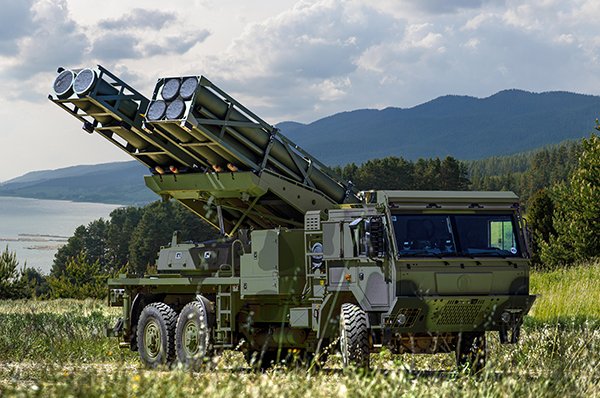
The Indian Army announced on 3 January 2026 that it had awarded an INR29.3 billion (US$35 million) contract to local firm Nibe to deliver Elbit Systems Precise and Universal Launching System (PULS) long-range multiple rocket launchers.
Nibe had executed an agreement in August 2025 for production of the PULS system in India. The agreement includes technology transfer, and it could cover future requirements for not only the Indian Army, but other potential international customers too.
The Indian version of the PULS is named Suryastra, and the first example appeared in India’s Republic Day parade on 26 January. This suggests the unit was produced in only four months.
According to the contract, the first production units are to be delivered within twelve months, though the quantity has not yet been unveiled. Fielding of the Suryastra will enhance the Indian Army’s deep-strike precision fires capabilities, and it is in line with the service’s broader long-range missile development initiatives.
The PULS system is integrated onto a Tatra T815 6×6 tactical truck built under license in India by BEML. The launcher shown in the parade was configured with a four-missile pod that contains EXTRA rockets.
The PULS/Suryastra is referred to as a universal rocket launcher system. As such it is intended to fire 122mm, 160mm and 306mm rockets. The EXTRA rocket has a range of up to 150km, and its 20kg warhead has a circular error probable (CEP) accuracy of 10m.
Other munitions that the PULS can fire are the Predator Hawk in a two-missile pod, this having a 300km range. It has a 140kg warhead and a 10m CEP. The PULS can also can fire Accular rockets, 18 of which are carried in a pod. These have a range of up to 40km.
There has been speculation that the full-production Suryastra may utilise KamAZ truck chassis produced locally in India. In fact, a PULS on a KamAZ chassis was shown at the ADEX 2022 international defence exhibition.
Other projected users of the PULS include the Israel Defense Force, Denmark and the Netherlands, plus joint local development/production is being approached by the Royal Thai Army, Spain and possible European KNDS/Elbit collaboration.
by Stephen W. Miller
