

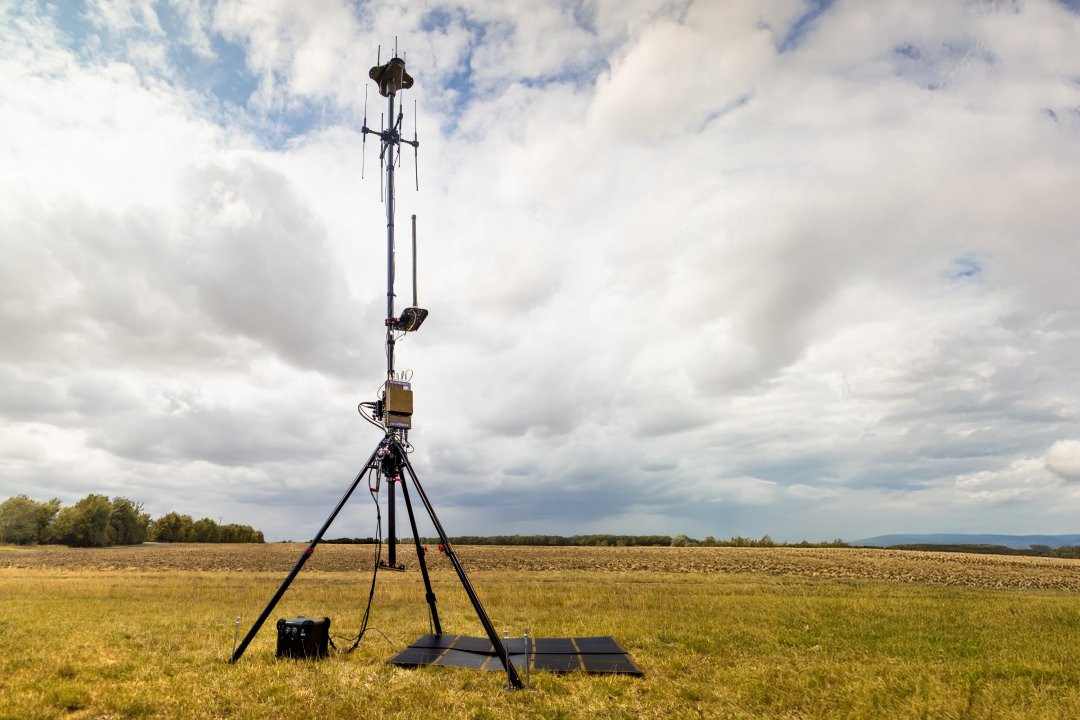
BLUF: Passive RF sensors turn small units into autonomous actors in the electromagnetic spectrum, enhancing awareness, maneuver, and initiative in heavily contested spectrum environments.
The modern spectrum has never been denser and more contested. Battlegroups or maneuver units operating on all levels need increased situational awareness of the recognized electromagnetic picture through passive RF sensing. Giving small units organic EW capabilities will provide them with increased agency and the ability to exercise mission command. It will also allow them to operate independently in the electromagnetic environment—even when they have been cut off from the mesh bubble or when they need to operate autonomously from this.
Small infantry teams have a range of options to obtain organic RF sensing capability: Mechanized and motorized units can use vehicle-mounted mast passive RF sensors or tethered UAVs with lightweight sensor payloads to rapidly increase line-of-sight. Dismounted infantry units can use man-portable spectrum monitoring backpack kits. These low SWaP deployment options allow units to achieve spectrum awareness with minimal logistic overhead.
Passive RF sensors can provide small infantry teams with an early warning of red force emissions: enemy radios, telemetry links from UAVs, and radar signals. This technology provides intelligence when visual or optical systems are out of range. Early warning capabilities allow teams to change maneuver tactics and approaches, helping to keep the warfighter safe. RF sensors give units tactical SIGINT capabilities, leading to insights such as what enemy elements are active, the frequencies they operate on, and when they operate. With this intelligence, platoon and section commanders will have an understanding of the enemy’s Order of Battle (ORBAT) and can plan offensive and defensive actions accordingly.

Once RF signals have been detected, organic geolocation capability turns SIGINT into actionable intelligence. For example, precise TDoA geolocations of hostile transmissions can act as targeting data, allowing units to request tactical air support before a ground assault. Also, this intelligence gives smaller teams the ability to act faster without waiting for higher-echelon ISR data, enabling immediate, more precise responses. The ability to detect and geolocate locally significantly reduces the sensor-to-shooter cycle, giving small formations tactical agency, allowing them to coordinate the right effects with the right maneuver.
In GNSS-denied environments where small teams are cut off from the C2 network, RF sensing can continue to provide reliable intelligence. They will be able to locate enemy positions while knowing that their PNT data has been compromised, requiring a switch to alternative navigation and targeting methods. Similarly, RF sensing can allow the teams to monitor their own emission control (EMCON)—changing frequencies and power levels to reduce visibility and maintain operational security.

Beyond protection and situational awareness, passive sensing of red force emissions allows small teams to dynamically shape the battlespace non-kinetically. Understanding the frequencies on which the enemy is transmitting can provide intelligence for commanders to target with cyber payload delivering effects electromagnetically. The resulting misdirection can produce asymmetric force multiplication and deception while allowing space for the small infantry to maneuver more effectively.
On the strategic level, militaries across the globe recognize that the electromagnetic spectrum becomes ever more contested, congested, and constrained. NATO’s recent investment in a new Electronic Warfare Planning and Battle Management (EWPBM) system shows high level commitment to integrating the electromagnetic spectrum into all levels of operations. The same principles shape the tactical level, giving small units passive RF sensing is no longer a luxury—it’s a prerequisite for survival and decision superiority.
Visit CRFS for further information on how CRFS helps military and EW operators: https://www.crfs.com/electromagnetic-spectrum-operations-guide
