

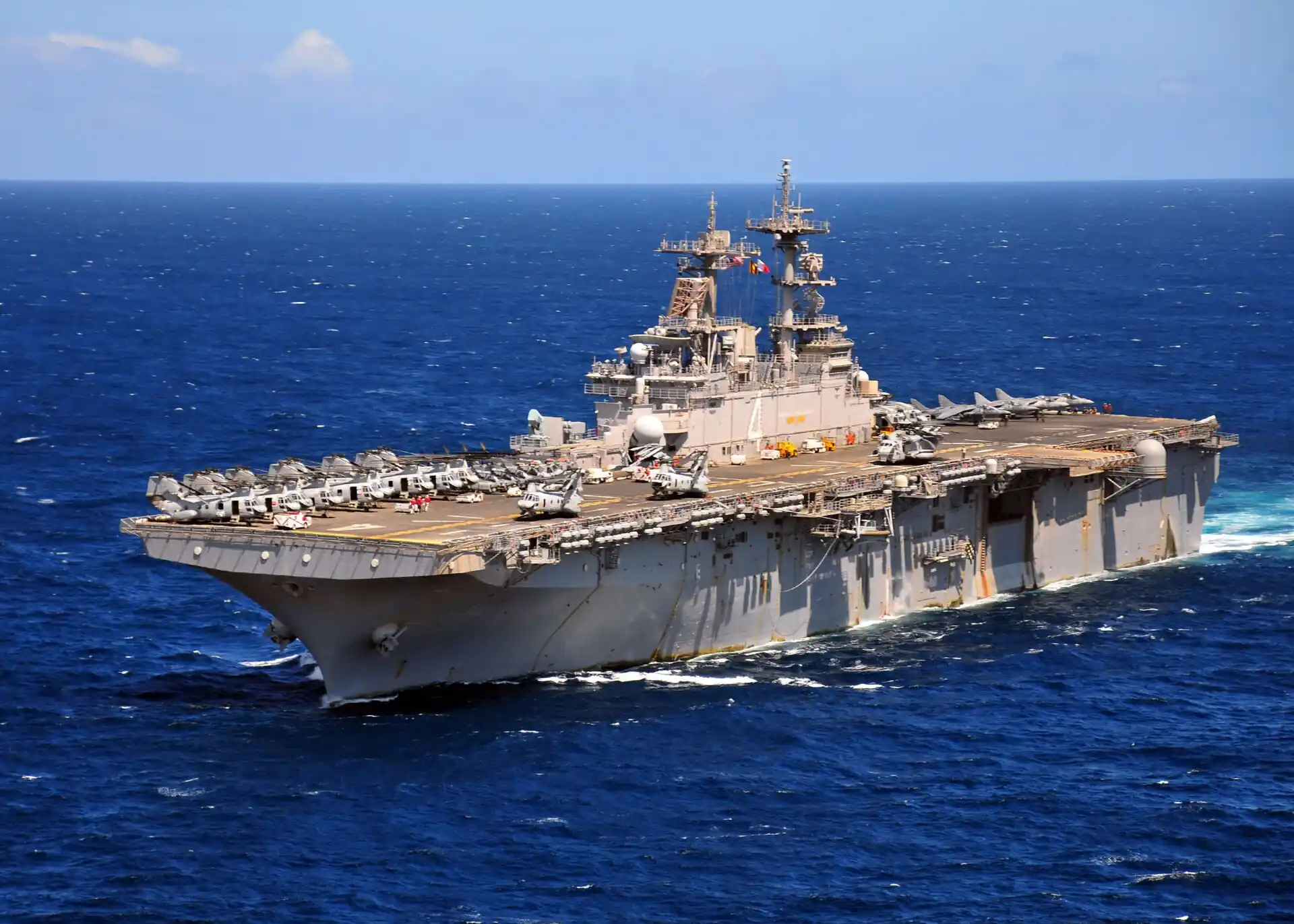
At first glance, the USS Boxer (LHD-4) looks like an aircraft carrier. Flat deck. Towering island. Jets and helicopters parked like chess pieces waiting to move.
But here’s the twist, it’s not an aircraft carrier. Not really.
The USS Boxer is something more flexible, maybe even more interesting: a floating launchpad for Marines, aircraft, and amphibious assaults, all rolled into one steel giant. If a traditional carrier is a sword, the USS Boxer amphibious assault ship is more like a Swiss Army knife, less flashy, but endlessly adaptable.
Now imagine this scenario. A crisis unfolds near a coastline, no friendly bases nearby, no time to build infrastructure. Within days (sometimes hours), the USS Boxer ship shows up offshore. Helicopters lift troops inland. Landing craft spill out from its well deck. Command centers come online. A miniature military ecosystem, self-contained, mobile, and ready.
That’s the real power here. Not just size, but independence.
Commissioned in the mid-1990s, the USS Boxer LHD-4 has quietly participated in everything from combat operations to humanitarian missions. It doesn’t always make headlines, but it’s almost always where it needs to be.
And that’s what makes it worth understanding.
In this post, we’re going to unpack what the USS Boxer actually does, how it operates, and why ships like it are becoming increasingly relevant in a world where conflicts don’t wait for runways or ports to be built.
Because sometimes, the most important base… is the one that floats.
What Is USS Boxer (LHD-4)?
So, what exactly is the USS Boxer (LHD-4)? The short answer: it’s an amphibious assault ship. The longer, more interesting answer, it’s a hybrid warship that blurs categories in a way few vessels do.
The USS Boxer belongs to the Wasp-class, a line of ships designed to project power from sea to land without relying on local bases. That’s the key idea. No ports? No problem. The ship is the base.

Let’s decode the name for a second. “LHD” stands for Landing Helicopter Dock. It sounds technical (because it is), but the meaning is pretty straightforward:
- Landing → delivering troops and equipment ashore
- Helicopter → launching air assaults
- Dock → carrying landing craft inside the ship itself
Put those together, and you get something unusual, a vessel that can launch operations both from above and below its own deck.
Commissioned in 1995, the USS Boxer amphibious assault ship was built to support U.S. Marine Corps operations. But over time, its role has stretched beyond that original mission. Today, it handles everything from combat deployments to disaster relief. Earthquake zones, conflict regions, evacuation missions, it adapts.
Read also: USS Tripoli (LHA-7): The US Navy’s Lightning Carrier
There’s also this nickname you’ll hear tossed around: “mini aircraft carrier.” It’s not entirely accurate, but not wrong either. The USS Boxer ship can operate advanced aircraft like jump jets and tiltrotors, giving it surprising airpower for its size.
Still, its true identity isn’t about replacing carriers. It’s about flexibility. The USS Boxer LHD-4 doesn’t dominate one domain, it connects them. Sea, air, and land, all in motion, all at once.
Key Specifications of the USS Boxer
Numbers don’t always tell the full story, but with the USS Boxer (LHD-4), they come pretty close. This ship is big. Not abstractly big. City-block-on-water big.
Here’s a snapshot of the core specifications of the USS Boxer amphibious assault ship:
| Specification | Details |
| Class | Wasp-class amphibious assault ship |
| Length | ~844 feet (257 meters) |
| Displacement | ~40,500 tons (full load) |
| Speed | 20+ knots (≈ 37 km/h) |
| Crew | ~1,100 sailors |
| Marine Capacity | Up to 2,000 Marines |
| Aircraft Capacity | 30+ aircraft (varies by mission) |
| Builder | Ingalls Shipbuilding, Mississippi |
Now, pause on that length for a second. 844 feet. That’s longer than two football fields laid end to end. Walking from bow to stern isn’t a quick stroll; it’s a bit of a commitment.
But the real story isn’t just size, it’s density. The USS Boxer ship is packed with functionality. Inside that steel hull, you’ll find:
- A full-length flight deck (like a carrier)
- A hangar bay for aircraft maintenance
- A well deck that floods to launch landing craft
- Medical facilities that can rival small hospitals
It’s less like a ship and more like a layered system.
Propulsion-wise, the USS Boxer LHD-4 runs on steam turbines, old-school, but reliable. Not as fast as nuclear-powered carriers, sure, but speed isn’t its main job. Staying on station and supporting operations? That’s where it shines.

And then there’s capacity. Carrying thousands of Marines alongside aircraft and vehicles means the USS Boxer can essentially deliver an entire fighting force… without touching land first.
That’s not just impressive. It’s strategically disruptive.
Aircraft and Combat Capabilities of the USS Boxer
If the USS Boxer (LHD-4) were just a floating transport ship, it wouldn’t be nearly as interesting. What really changes the equation is what it carries, and more importantly, what it can launch.
The flight deck of the USS Boxer amphibious assault ship is where things start to feel a bit like an aircraft carrier. You’ll typically find a mix of aircraft, and the exact lineup shifts depending on the mission. It’s not fixed, it’s curated, almost like a toolkit.
Here’s a typical air wing configuration:
| Aircraft Type | Role |
| F-35B Lightning II | Short takeoff/vertical landing (STOVL) strike fighter |
| MV-22 Osprey | Tiltrotor for troop and cargo transport |
| CH-53 Super Stallion | Heavy-lift helicopter |
| AH-1Z Viper | Attack helicopter (close air support) |
| UH-1Y Venom | Utility and light attack |
Now, the standout here is the F-35B. Unlike traditional jets, it doesn’t need a runway. It can take off in a short burst and land vertically, almost like a helicopter. That capability turns the USS Boxer ship into a light carrier when needed, capable of launching precision strikes far inland.
But airpower is only half the story.
Below deck, the USS Boxer LHD-4 houses a well deck, a floodable compartment that launches landing craft like LCACs (air-cushion hovercraft). These can carry tanks, vehicles, and troops straight onto a beach. No port required. No permission needed.

So you’ve got aircraft lifting Marines from above, and landing craft delivering them from the sea, all coordinated from one platform.
It’s a bit like watching a two-layered assault unfold.
And that’s the real strength of the USS Boxer. It doesn’t just fight in one dimension. It operates vertically and horizontally at the same time, air, sea, and land stitched together into a single, moving force.
Weapons and Defense Systems of the USS Boxer
The USS Boxer (LHD-4) isn’t built to go looking for fights on its own, but it’s definitely not defenseless. In fact, its protection strategy is layered, a bit like an onion. You don’t notice it at first glance, but peel it back, and there’s more going on than you’d expect.
Unlike destroyers or cruisers, the USS Boxer doesn’t carry heavy offensive missile batteries. That’s intentional. Its primary role is to deliver Marines and support operations, not to act as a front-line strike ship. Still, it needs to survive in contested environments, and that’s where its defensive systems come in.
Here’s a simplified look at its core defenses:
| System | Purpose |
| Phalanx CIWS | Close-in defense against missiles and drones |
| RIM-7 Sea Sparrow | Short- to medium-range air defense |
| Rolling Airframe Missile (RAM) | Fast-response missile interception |
| Electronic Warfare Systems | Jamming and decoy deployment |
The standout here is the Phalanx CIWS, a rapid-fire, radar-guided gun that tracks incoming threats and fires thousands of rounds per minute. If something gets too close, this is the last line of defense. It’s loud, fast, and very precise.
Then you’ve got missile systems like the Sea Sparrow and RAM, designed to intercept threats before they reach the ship. Think of them as the outer shield, engaging targets at a safer distance.

But here’s the subtle part: the USS Boxer ship rarely operates alone. It’s usually part of a larger strike group, surrounded by escort ships with far more extensive weapon systems. In that sense, its defense isn’t just onboard, it’s shared.
So while the USS Boxer LHD-4 might not look heavily armed, it’s protected in layers, some visible, others not so obvious.
Operational History and Deployments of the USS Boxer
If ships could talk, the USS Boxer (LHD-4) would probably tell its story in fragments, heat, noise, long stretches of ocean, then sudden bursts of urgency. Its operational history isn’t one long narrative. It’s a collection of moments, scattered across decades and oceans.
The USS Boxer was commissioned in 1995 and conducted its first major deployment in 1997. Since then, it’s spent a significant portion of its life moving between the Western Pacific, the Persian Gulf, and other strategically sensitive regions. Not always in the spotlight, but consistently present.
A Pattern of Presence
Unlike some warships that are tied to specific roles, the USS Boxer amphibious assault ship has been used in a wide range of missions:
- Supporting combat operations in the Middle East
- Acting as a forward-deployed Marine platform
- Participating in joint exercises with allied nations
There’s a rhythm to it: deploy, operate, return, refit, then back out again.

Notable Moments
One of the more widely discussed incidents came in 2019, when the USS Boxer ship was involved in a defensive action in the Strait of Hormuz, reportedly neutralizing an approaching drone. It was a small event in scale, but symbolically significant, highlighting how these ships operate in tense, unpredictable environments.
More recently, the USS Boxer LHD-4 has faced maintenance challenges, leading to delays in scheduled deployments. Not unusual for a vessel of its age, but a reminder that even highly capable platforms require constant upkeep.
More Than Combat
Here’s the part that often gets overlooked: the USS Boxer isn’t just about warfare. It has supported humanitarian missions, disaster response, and evacuation operations.
Which, in a way, makes its history more complex.
It’s not just where it’s been, it’s what it’s been asked to do when it got there.
Strategic Importance of the USS Boxer
The USS Boxer (LHD-4) doesn’t just exist as a piece of hardware, it plays a role in a much bigger game. Strategy, deterrence, presence… the kind of things that aren’t always visible but shape decisions behind the scenes.

At a basic level, the USS Boxer amphibious assault ship extends reach. It allows the U.S. to operate in regions where permanent bases might not exist, or might not be politically accessible. That alone changes the equation. When a ship like this appears offshore, it brings options with it. Diplomatic ones, military ones, sometimes both at the same time.
There’s also the matter of geography. The USS Boxer ship has spent much of its operational life in the Indo-Pacific and Middle East, regions where distances are vast and tensions can shift quickly. In those environments, having a mobile platform that can respond without waiting for permission is… useful. Quietly powerful.
And then there’s deterrence. Not the loud, obvious kind, but the subtle version. The presence of the USS Boxer LHD-4 signals capability without immediate escalation. It says: we’re here, and we can act if needed. Sometimes, that’s enough to influence behavior without anything actually happening.
Another layer, often overlooked, is its role in partnerships. The USS Boxer regularly participates in joint exercises with allied nations. That builds familiarity, coordination, and trust. Not flashy, but essential.
In a way, the ship operates in the space between action and intention. It doesn’t always fire weapons. It doesn’t always deploy troops.
But its presence alone can shape outcomes.
And that’s a different kind of power, less visible, maybe, but no less real.
