

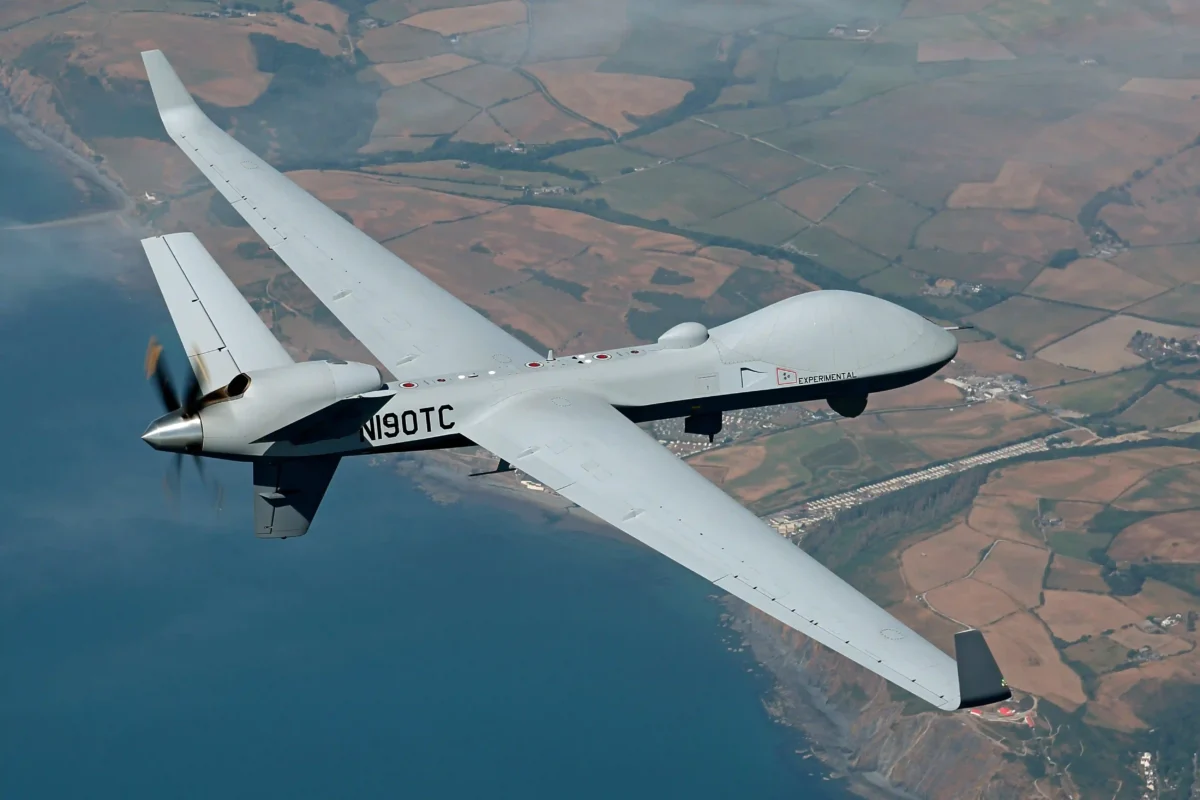
Look up at the sky on any given day and you probably won’t see it. That’s the point.
The MQ-9B SkyGuardian isn’t built for spectacle, it’s built for persistence. While fighter jets make headlines with sonic booms, this long-endurance unmanned aircraft quietly rewrites the rules of surveillance, maritime patrol, and strategic deterrence. It doesn’t rush. It loiters. It watches. For 40+ hours at a stretch.
Developed by General Atomics Aeronautical Systems, Inc., the MQ-9B SkyGuardian is the next evolution of the battle-tested MQ-9 family. But calling it “just an upgrade” misses the bigger picture.
This aircraft was designed from the ground up to operate in civil airspace, comply with NATO STANAG 4671 airworthiness standards, and integrate seamlessly into allied operations. That’s a major shift in how military drones function globally.
So what makes the MQ-9B different?
It’s classified as a MALE (Medium-Altitude Long-Endurance) UAS, capable of flying above 40,000 feet and covering over 6,000 nautical miles.
In practical terms, that means it can patrol an entire coastline without refueling. Or track maritime activity across vast stretches of open ocean. Or provide ISR (Intelligence, Surveillance, Reconnaissance) support during multinational operations, without ever landing.
Think of it less like a drone and more like a satellite that can move.
In today’s defense landscape, where maritime boundaries are contested, supply chains are vulnerable, and gray-zone conflicts simmer, the MQ-9B SkyGuardian represents something subtle but powerful: sustained awareness. And in modern strategy, awareness is leverage.
What Is the MQ-9B SkyGuardian? A Next-Generation MALE UAS Explained
At its core, the MQ-9B SkyGuardian is a remotely piloted aircraft system built for endurance, compliance, and adaptability. But that clinical definition barely scratches the surface.
This isn’t just another unmanned aircraft, it’s a platform engineered to operate where earlier military drones couldn’t. Unlike legacy systems that were restricted to segregated military airspace, the MQ-9B was designed to safely integrate into civilian-controlled skies. That’s a technical and regulatory leap forward.

To understand its place in the ecosystem, it helps to compare it to its predecessor, the MQ-9 Reaper. While the Reaper earned its reputation as an armed ISR and strike drone, the SkyGuardian pushes further into endurance, maritime surveillance, and multinational interoperability. It’s less about direct combat and more about persistent presence.
The MQ-9B SkyGuardian isn’t just tactical, it’s strategic.
It carries advanced detect-and-avoid systems, de-icing capability, and lightning protection. In other words, it behaves more like a traditional aircraft than a conventional drone. That matters when you’re flying over busy sea lanes or coordinating with NATO allies.
And perhaps most interestingly, the SkyGuardian reflects a broader shift in defense thinking: persistent surveillance as deterrence. Not flashy. Not loud. Just there, constantly watching.
Technical Specifications of the MQ-9B SkyGuardian
If endurance is the headline feature of the MQ-9B SkyGuardian, then engineering discipline is the fine print, and it’s impressive.
Start with the wingspan: roughly 24 meters (79 feet). That’s wider than a Boeing 737’s wings.
The long, high-aspect-ratio wing isn’t for speed; it’s for efficiency. It allows the aircraft to sip fuel slowly while cruising at altitudes above 40,000 feet. The result? More than 40 hours of continuous flight under optimal conditions.
Under the hood sits a turboprop engine derived from the proven PT6 family, manufactured by Pratt & Whitney Canada. It’s reliable, globally supported, and built for sustained operations in harsh climates, from salt-heavy maritime air to desert heat.
Here’s a snapshot of core specifications:
| Specification | MQ-9B SkyGuardian |
| Wingspan | ~24 m (79 ft) |
| Maximum Endurance | 40+ hours |
| Maximum Range | 6,000+ nautical miles |
| Service Ceiling | 40,000+ ft |
| External Hardpoints | 9 |
| Maximum Takeoff Weight | ~12,500 lb |
But raw numbers only tell part of the story.
The MQ-9B supports multi-mission payload configurations. Electro-optical/infrared (EO/IR) sensors for high-resolution imaging. Maritime surveillance radar for tracking vessels. Signals intelligence packages for electronic monitoring. And yes, depending on customer requirements, it can carry precision-guided munitions.
There’s also full de-icing capability and lightning protection, details that sound mundane until you realize most drones don’t have them.

In short, the MQ-9B SkyGuardian isn’t optimized for quick sorties. It’s optimized for patience. And patience, in modern surveillance strategy, is everything.
How the MQ-9B SkyGuardian Actually Gets Used
Specs are nice on paper. Missions are where the MQ-9B SkyGuardian earns its keep.
At its heart, this aircraft is an ISR workhorse, Intelligence, Surveillance, and Reconnaissance. But that acronym barely captures the scale of what it can do.

Picture a single drone monitoring thousands of square miles of ocean, identifying vessel traffic patterns, flagging anomalies, and streaming real-time data back to command centers half a world away. No fatigue. No cockpit crew rotation. Just steady persistence.
Maritime domain awareness is one of its strongest suits. With advanced surface-search radar and automatic identification system (AIS) integration, the SkyGuardian can detect ships operating “dark” (without broadcasting identity). For island nations or countries with vast coastlines, that capability shifts the balance of awareness dramatically.
Then there’s signals intelligence. Equipped with modular SIGINT payloads, the MQ-9B can collect and analyze electronic emissions, radar signals, communications, and other electromagnetic activity. It’s less visible than a fighter jet, but arguably more informative.
Some operators also configure the aircraft for precision strike roles. With up to nine hardpoints, it can carry guided munitions when required. The design remains flexible, surveillance first, strike optional.
A particularly interesting development is the airborne early warning adaptation developed in collaboration with Saab. Integrating AEW&C radar systems into a long-endurance UAV platform could extend radar coverage at a fraction of the cost of traditional crewed aircraft.
In a way, the MQ-9B SkyGuardian is less about force projection and more about strategic patience. It observes. It maps patterns. It fills intelligence gaps quietly, until someone realizes the gaps are gone.
Global Operators of the MQ-9B SkyGuardian
Follow the procurement trail and you’ll see something interesting: the MQ-9B SkyGuardian isn’t confined to one doctrine or geography. It’s quietly becoming a multinational standard.
Take the United Kingdom. The Royal Air Force operates a variant known as the Protector RG Mk1, derived directly from the MQ-9B platform and supplied by General Atomics Aeronautical Systems, Inc.

The UK chose it not just for endurance, but for its civil airspace certification, meaning it can depart from domestic bases without extraordinary airspace restrictions. That’s operational flexibility most drones simply don’t have.
Germany followed with an order tailored toward maritime surveillance and even anti-submarine mission support. Belgium has moved into operational training phases, integrating the system into NATO-aligned ISR frameworks.
Meanwhile, Taiwan’s acquisition underscores a different priority: maritime deterrence and gray-zone monitoring in contested waters.
Here’s a simplified overview:
| Country | Primary Role | Status |
| United Kingdom | ISR & strike (Protector RG Mk1) | Operational rollout |
| Germany | Maritime surveillance | On order |
| Belgium | ISR, NATO integration | Training phase |
| Taiwan | Maritime domain awareness | Delivery pipeline |
What ties these operators together isn’t identical mission sets, it’s geography. Coastlines. Air corridors. Strategic chokepoints.
The MQ-9B SkyGuardian fits nations that need persistent oversight rather than short bursts of airpower. It’s particularly attractive to mid-sized powers that want wide-area awareness without the expense of large crewed patrol aircraft fleets.
Different flags on the tail, same logic: know more, for longer, with fewer constraints.
How the MQ-9B SkyGuardian Was Built for the Long Haul
The MQ-9B SkyGuardian didn’t appear overnight. It evolved, slowly, deliberately, out of operational lessons learned from nearly two decades of unmanned flight.
Its lineage traces back to the MQ-9 Reaper, but the jump from MQ-9A to MQ-9B wasn’t cosmetic. Engineers essentially reworked the aircraft to meet stringent airworthiness standards typically reserved for crewed planes. That’s a different design philosophy altogether.

One milestone that often gets overlooked? Civil airspace certification efforts. The MQ-9B was built to comply with NATO STANAG 4671 standards, which meant adding:
- Detect-and-avoid systems
- Lightning protection
- Full de-icing capability
- Redundant flight controls
These aren’t flashy upgrades. They’re structural commitments.
Even more telling was the fatigue testing program. The airframe underwent structural testing equivalent to 80,000 flight hours, a simulated lifespan that signals long-term durability. For operators, that translates into predictable lifecycle costs and reduced downtime.
Early flight demonstrations included extended over-the-horizon operations and transatlantic-style endurance profiles. The point wasn’t speed. It was proof of reliability.
Think of it this way: fighter jets are built to win moments. The MQ-9B SkyGuardian was built to win time.
And in modern strategy, time equals intelligence. Intelligence shapes decisions. Decisions shape outcomes. The development path of the MQ-9B reflects that logic, less adrenaline, more architecture. Less sprinting, more staying power.
Where the MQ-9B SkyGuardian Changes the Game
It’s one thing to admire the engineering of the MQ-9B SkyGuardian. It’s another to see how it reshapes real-world operations.
Start with border security. Countries with thousands of miles of coastline, or porous land borders, face a math problem: too much territory, not enough aircraft. Traditional patrol planes burn fuel fast and require large crews. Satellites offer coverage, but not flexibility.

The MQ-9B sits in the sweet spot. It can orbit a region for nearly two days, adjust course mid-mission, and stream high-resolution ISR data in real time.
Maritime domain awareness is where it really stretches its legs. Imagine monitoring a busy shipping lane where hundreds of vessels move daily.
The SkyGuardian’s radar and EO/IR systems can track patterns, detect vessels that disable identification transponders, and cue naval assets only when needed. That efficiency matters.
There’s also humanitarian application, an angle people rarely discuss. After natural disasters, persistent airborne surveillance helps map flooded areas, locate isolated communities, and coordinate relief logistics. Because the MQ-9B can stay airborne so long, it reduces the need for multiple rotating aircraft during crisis response.
Coalition operations? That’s another layer. NATO-aligned missions benefit from shared ISR feeds, and the MQ-9B’s interoperability makes data exchange smoother.
The real advantage isn’t firepower. It’s continuity.
Where a crewed aircraft might provide snapshots, the MQ-9B SkyGuardian provides a time-lapse. And sometimes the story between the frames is what matters most.
