

Imagine an aircraft that doesn’t just fly through the sky, it watches everything. Hundreds of miles in every direction. Fighters, bombers, drones, even ships slipping quietly across open water.
Long before satellites became the buzzword of modern surveillance, the E-3 Sentry was already up there, orbiting silently like an airborne referee, calling the shots.
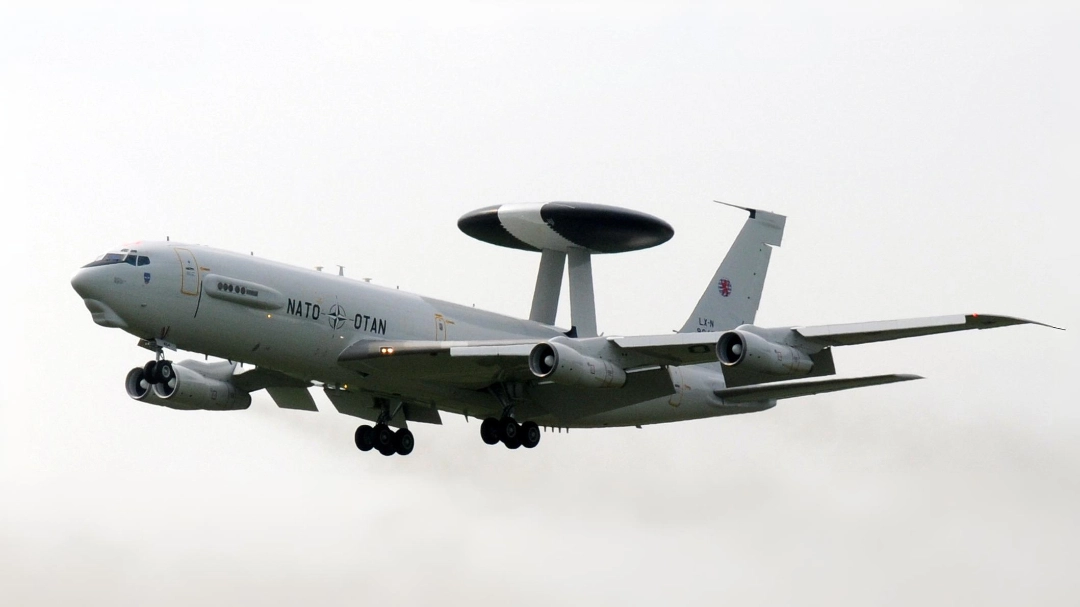
At first glance, it looks… unusual. A large jet with a massive spinning disc perched on its back, like a giant vinyl record frozen mid-spin. That disc isn’t decoration, it’s the heart of one of the most influential airborne warning and control systems ever built by Boeing. And for nearly five decades, this aircraft has served as the eyes and brain of air forces across the world.
Here’s the thing most people don’t realize: the E-3 Sentry doesn’t fight. It doesn’t fire missiles. It doesn’t chase enemies. Yet without it, modern air combat becomes dramatically less effective, almost blind.
During major conflicts, including operations led by the United States Air Force and NATO, this aircraft has quietly coordinated hundreds of fighters at once, preventing chaos in crowded skies.
Think of it like air traffic control, but mobile, militarized, and capable of operating anywhere on Earth.
In this post, you’ll discover how the E-3 Sentry works, why it was built, what makes its radar so effective, and why, decades later, it still matters.
What Is the Boeing E-3 Sentry?
At its core, the E-3 Sentry is a flying radar station, but calling it just that is like calling a smartphone “a telephone.” Technically correct, but wildly incomplete.
The Boeing E-3 Sentry is an Airborne Warning and Control System (AWACS) aircraft designed to detect, track, and manage airborne threats across massive distances, all while flying safely far from danger.
Built by Boeing and based on the aging but reliable Boeing 707 airliner, the E-3 transforms a civilian airframe into something entirely different: a command nerve center in the sky. Its most recognizable feature, the rotating radar dome mounted above the fuselage, is called a rotodome. This 9-meter (30-foot) disk rotates continuously, sweeping radar signals across the horizon in every direction.
Here’s where things get interesting.
The E-3 Sentry doesn’t just detect aircraft. It identifies them, tracks their speed and altitude, and even helps coordinate friendly fighters.
Imagine an air traffic controller, but instead of guiding passenger planes to runways, they’re directing fighter jets during high-stakes military operations.
Inside the aircraft, you’ll find a crew of specialists sitting at radar consoles surrounded by glowing displays and streams of data. These operators monitor hundreds of targets simultaneously.
They can distinguish between friendly aircraft, potential threats, and unknown contacts. That clarity prevents confusion, and confusion, in combat, can be deadly.

The E-3 Sentry also solves a physics problem most people never think about: Earth is round. Ground radar can’t see beyond the horizon, but an airborne platform can extend that visibility dramatically. From altitude, the E-3’s radar can monitor airspace over 400 kilometers away.
In simple terms, the E-3 doesn’t fight wars directly. It makes winning them possible.
History and Development of the E-3 Sentry
The E-3 Sentry was born out of a Cold War anxiety that’s easy to forget today: fear of surprise attack. In the 1960s, radar coverage from the ground had blind spots, especially at low altitude.
Enemy aircraft could, in theory, slip under detection by hugging the terrain. That vulnerability made military planners uncomfortable. Very uncomfortable.
The solution? Put radar in the sky.

Before the E-3, the U.S. relied on propeller-driven aircraft like the Lockheed Corporation EC-121 Warning Star. It worked, but it was aging, slower, and technologically limited. The leap to a jet-powered airborne early warning platform marked a generational shift.
In 1975, the first production E-3 flew. By 1977, it entered service with the United States Air Force. Between 1977 and 1992, a total of 68 aircraft were built. That number may seem small compared to fighter fleets, but the E-3 was never about quantity. Each aircraft acted as a force multiplier.
During the 1991 Gulf War, the E-3 proved its value dramatically. It flew continuous missions, managing more than 120,000 sorties and helping coalition aircraft achieve air superiority with minimal friendly-fire incidents.
One often-cited statistic: coalition forces maintained near-total control of Iraqi airspace within days. That level of coordination doesn’t happen by accident.
NATO soon adopted its own fleet, operating from Geilenkirchen Air Base in Germany. The multinational crew concept added another layer of complexity, and success.

Here’s a subtle but important point: the E-3 wasn’t revolutionary because of speed or stealth. It was revolutionary because it changed decision-making speed. By shortening the time between detection and response, it quietly rewrote air warfare doctrine.
And that shift? It still shapes modern combat planning today.
Design and Technical Specifications of the E-3 Sentry
At its core, the E-3 Sentry is a fascinating hybrid, a civilian airliner transformed into a military intelligence nerve center. Its foundation comes from the reliable Boeing 707 airframe, but almost everything inside and above the fuselage has been reimagined for surveillance and command.
The most obvious feature, of course, is the radar dome. That rotating disc mounted above the fuselage isn’t just large, it’s structurally isolated from the aircraft to reduce vibration and ensure radar stability.
Measuring about 9.1 meters in diameter and weighing roughly 5,400 kilograms, it rotates at six revolutions per minute. That steady rotation allows the radar to scan 360 degrees continuously, like a lighthouse beam sweeping across the horizon.
Despite its bulky appearance, the aircraft performs surprisingly well. It cruises comfortably at around 30,000 feet (9,000 meters), high enough to dramatically extend radar visibility.
At that altitude, the E-3 can monitor airspace covering more than 300,000 square kilometers in a single sweep. That’s roughly the size of Italy, watched by one aircraft.
Here’s a simplified technical overview:
| Specification | Details |
| Length | 46.6 meters |
| Wingspan | 44.4 meters |
| Height | 12.7 meters |
| Engines | 4 × Pratt & Whitney TF33 turbofan engines |
| Maximum Speed | ~853 km/h |
| Range | Over 8,000 km |
| Mission Endurance | 8–12 hours (longer with refueling) |
| Crew | 4 flight crew + 13–19 mission crew |
Inside, the aircraft feels more like a flying operations room than a cockpit-focused plane. Rows of radar consoles line the cabin, where operators analyze targets, track aircraft, and coordinate missions.
One of the E-3’s greatest strengths is endurance. With aerial refueling, it can remain on station for over 24 hours. That kind of persistence means constant surveillance, no gaps, no blinking radar screens, just uninterrupted awareness floating high above the world.
How the E-3 Sentry Sees Everything
The true power of the E-3 Sentry isn’t its engines or size, it’s what it sees.
The aircraft’s radar system transforms empty sky into a detailed, living map filled with symbols, vectors, and intent. To mission operators onboard, every blip tells a story. Speed. Direction. Altitude. Threat level. Sometimes all within seconds.
At the heart of this capability is the AN/APY-1 and AN/APY-2 pulse-Doppler radar system, housed inside that iconic rotating rotodome.
Unlike simple radar that only detects objects, pulse-Doppler radar can distinguish moving targets from background clutter. That means it can spot a low-flying aircraft even when terrain, weather, or ground reflections try to hide it.

Under ideal conditions, the radar can detect fighter-sized aircraft at distances exceeding 400 kilometers. Larger targets, bombers, tankers, can be detected even farther away. But range isn’t the only advantage.
The system can track hundreds of targets simultaneously, prioritizing threats automatically while operators make strategic decisions.
Here’s where things get interesting.
The E-3 doesn’t just collect information; it distributes it. Using secure data links like Link 16, the aircraft shares real-time battlefield awareness with fighters, ships, and ground command centers.
A pilot flying hundreds of kilometers away can receive targeting updates directly from the E-3 without ever turning on their own radar. That reduces their visibility and increases survivability.
Inside the cabin, mission crew sit at radar consoles resembling compact control stations. Each operator focuses on specific sectors, tracking aircraft and coordinating intercepts. Some specialize in surveillance. Others manage fighter control. It simplifies chaos.

Additional systems enhance survivability, including:
- Identification Friend or Foe (IFF) transponders
- Electronic support measures (ESM) to detect enemy emissions
- Secure voice and digital communications
- Electronic countermeasure resistance
In many ways, the E-3 functions less like an aircraft and more like an airborne information network.
What the E-3 Sentry Actually Does in Combat
The E-3 Sentry doesn’t drop bombs or fire missiles. And yet, without it, modern air operations would feel disorganized, almost primitive. Its real job is coordination. It watches the battlefield unfold in real time and quietly tells everyone else where to go, when to move, and what to avoid.
Think of it as the conductor of an airborne orchestra.
One of its primary roles is airborne battle management.
From 30,000 feet above the conflict zone, the E-3 monitors friendly and enemy aircraft simultaneously. Mission operators guide fighters toward threats, assign intercept missions, and prevent aircraft from overlapping dangerously. This reduces pilot workload dramatically. Instead of searching blindly, pilots receive precise instructions, heading, altitude, and timing.
During large operations, this coordination becomes essential. In crowded airspace, dozens or even hundreds of aircraft may operate at once, fighters, tankers, drones, and reconnaissance aircraft.
The E-3 ensures they don’t interfere with each other while maintaining tactical advantage.

Another major role is long-range surveillance.
Because radar range increases with altitude, the E-3 can detect threats much earlier than ground radar. This early detection provides valuable reaction time, sometimes 15 to 20 extra minutes. In combat, that margin can determine whether forces intercept a threat, or get surprised.
The aircraft also plays a key role in defensive air patrols and homeland defense.
For example, after the September 11 attacks, E-3 aircraft were deployed over major U.S. cities to monitor airspace continuously. Their presence provided reassurance and immediate threat detection capability.
Beyond combat, the E-3 supports:
- Maritime surveillance and ship tracking
- Border monitoring and anti-smuggling operations
- Disaster response coordination
- Large-scale military exercises
Its versatility makes it one of the most adaptable airborne command platforms ever created. Not flashy, but absolutely essential.
How the E-3 Sentry Stayed Relevant for Nearly 50 Years
The remarkable thing about the E-3 Sentry isn’t just that it worked well in the 1970s, it’s that it kept evolving. Instead of becoming obsolete, it adapted. Quietly, steadily, upgrade by upgrade. Like renovating a house without ever moving out.
The earliest version, the E-3A, was the baseline model delivered to both the United States Air Force and NATO. It introduced the core concept: airborne radar surveillance paired with command-and-control workstations. But technology moves fast, and within a few years, improvements became necessary.
That led to the E-3B, which added stronger electronic counter-countermeasures (ECCM). In plain English, it became harder to jam. During the Cold War, electronic warfare was a serious threat, so improving radar resistance wasn’t optional; it was survival.
Then came the E-3C, which introduced one of the biggest leaps forward: digital data processing. Earlier versions relied heavily on analog systems. The E-3C could process more targets, faster, and share that data more efficiently with friendly aircraft. This upgrade dramatically improved situational awareness across entire battle groups.

But the most transformative upgrade arrived decades later: the Block 40/45 modernization program. This wasn’t a simple patch, it replaced the aircraft’s core mission computer. Processing speed increased significantly, allowing operators to track more targets with greater precision. The system also integrated modern digital displays, replacing aging analog screens that looked straight out of a 1980s movie.
Here’s a simplified overview of major variants:
| Variant | Key Improvements | Operator |
| E-3A | Original production model | USAF, NATO |
| E-3B | Enhanced anti-jamming capability | USAF |
| E-3C | Advanced radar processing and tracking | USAF |
| E-3D | British-specific modifications | Royal Air Force |
| E-3F | French Air Force variant | France |
| Block 40/45 | Modern computers and digital systems | Multiple operators |
These upgrades extended the aircraft’s operational life far beyond expectations. What was originally designed for Cold War threats continued serving into the era of drones, stealth aircraft, and network-centric warfare.
Not bad for an aircraft whose bones date back over half a century.
Final Thoughts: Why the E-3 Sentry Still Matters
The E-3 Sentry was never the fastest aircraft in the sky. It wasn’t stealthy. It didn’t carry bombs. And yet, for nearly half a century, it quietly shaped how wars were fought and how airspace was controlled.
Its genius wasn’t in brute force; it was in perspective. By lifting radar and command systems thousands of feet above the Earth, the E-3 changed the tempo of decision-making. It gave commanders time. And in combat, time is everything.
What makes the E-3 remarkable isn’t just its technology, but its philosophy: see first, understand first, act first. That mindset now defines modern network-centric warfare. Every new airborne early warning platform, including its successor, builds on that foundation.
So while the airframes may retire, the concept doesn’t. The E-3 proved that information dominance wins battles before missiles are ever launched.
And honestly? That spinning radar dome became more than hardware. It became a symbol of awareness, coordination, and control in a chaotic sky.
