

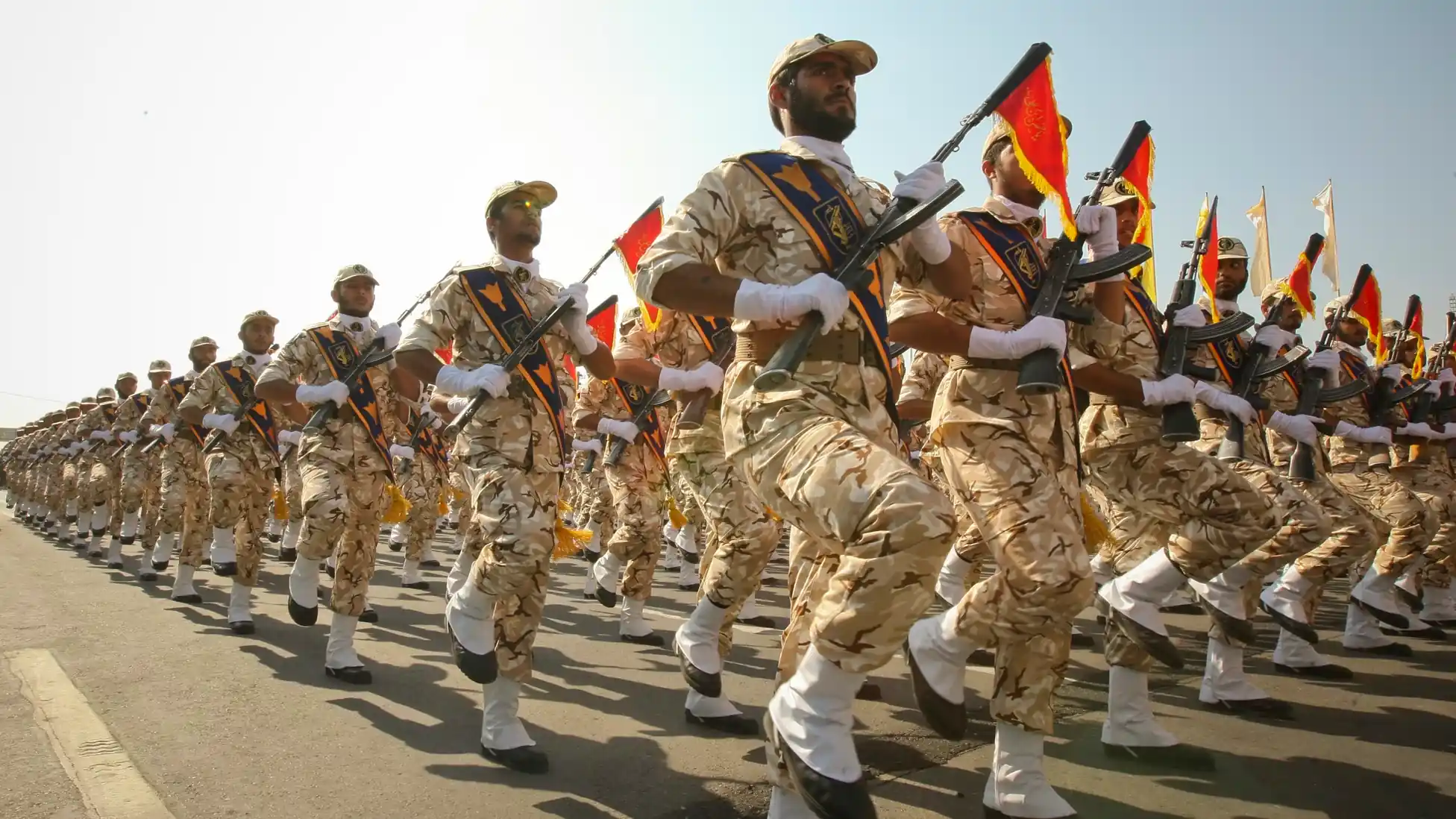
Power doesn’t always announce itself with parades and flyovers. Sometimes it hums quietly in the background, embedded in ports, politics, proxy groups, and production lines. That’s where the Islamic Revolutionary Guard Corps (IRGC) lives. And if you’ve ever wondered how powerful is the IRGC, you’re asking the right question, but probably the wrong way.
Most military power is easy to picture: tanks rolling, jets screaming overhead, neat columns of soldiers.
The IRGC doesn’t really do neat. It does layered. Messy. Strategic in a way that feels more like a spiderweb than a battering ram. Tug one strand in Lebanon, Syria, Iraq, or the Persian Gulf, and something twitches back in Tehran.
Created after Iran’s 1979 revolution, the IRGC was never meant to be just another army. It was designed as an insurance policy for the regime, and over time, it evolved into something far bigger.
Today, it’s part military force, part intelligence network, part economic empire, part ideological enforcer. That combination is what makes measuring IRGC strength so tricky, and so fascinating.
This post takes a different route than the usual headline math. Yes, we’ll talk numbers. Yes, we’ll dig into weapons and missiles and drones. But we’ll also explore how the IRGC converts resources into influence, why it often outmaneuvers stronger conventional armies, and what its power looks like when it doesn’t look like power at all.
What Is the IRGC, Really?
If you’re trying to understand how powerful the IRGC is, you first have to drop the idea that it’s simply Iran’s version of the army. It isn’t.
The Islamic Revolutionary Guard Corps was built to do a very specific job: protect the system, not just the country.
Born From Revolution, Not Tradition
The IRGC was created in 1979, right after Iran’s Islamic Revolution, when the new leadership didn’t fully trust the existing military.
The regular army, the Artesh, had been shaped under the Shah. The IRGC, by contrast, was designed from scratch to be ideologically loyal to the revolution and, above all, to Iran’s Supreme Leader.

That origin story still matters. Unlike traditional armed forces that swear loyalty to a constitution or state, the IRGC answers directly to the Supreme Leader. That single chain of command gives it enormous political weight and operational freedom.
Read also: How Strong Is Iran’s Military?
A Parallel State With a Uniform
Here’s where things get unusual. The IRGC operates alongside Iran’s regular military, not beneath it. In many strategic areas, missiles, drones, asymmetric warfare, it actually outranks the Artesh.
Over time, it evolved into something closer to a parallel state, complete with its own intelligence services, media outlets, and economic empires.
This structure allows the IRGC to move fast. When decisions are made, they’re not bogged down in bureaucratic loops. Orders flow down quickly. Resources follow.

More Than Soldiers
Another key distinction: IRGC commanders don’t “retire” quietly. Many move into senior government roles, parliamentary seats, or leadership positions in state-linked corporations. That revolving door between military command and political power quietly reinforces the IRGC’s influence from the inside.
So when people ask how powerful the IRGC is, the better question might be: powerful compared to what? A normal military? Absolutely. A political institution? Still yes. An economic actor? Surprisingly, yes again.
The IRGC isn’t just armed. It’s embedded. And that makes it far harder to challenge than a force you can see lined up on a battlefield.
IRGC Size and Manpower: Numbers That Only Tell Half the Story
When people search how powerful is the IRGC, they usually start with troop numbers. Fair enough. Size still matters. But with the IRGC, headcount is only the surface layer, and not even the most interesting one.
How Big Is the IRGC, on Paper?
Most credible estimates place the IRGC’s active-duty strength between 125,000 and 190,000 personnel. The wide range isn’t an accident.
The IRGC doesn’t publish clean figures, and it benefits from staying a little opaque. What we do know is that it’s smaller than Iran’s regular army overall, but far more concentrated in elite and strategic roles.
Here’s a simplified snapshot often used by defense analysts:
| Component | Estimated Personnel | Primary Role |
| IRGC Ground Forces | 100,000+ | Internal security, land warfare |
| IRGC Navy | ~20,000 | Persian Gulf, asymmetric naval ops |
| IRGC Aerospace Force | ~15,000 | Missiles, drones, air defense |
| Quds Force | 5,000–15,000 | External operations |
| Basij (reserve/paramilitary) | Hundreds of thousands+ | Mobilization, internal control |
The last row, the Basij, is where things get slippery.
The Basij Factor: Manpower on Demand
The Basij isn’t a standing army in the traditional sense. It’s a nationwide paramilitary network embedded in neighborhoods, universities, factories, even offices.
In a crisis, it can swell the IRGC’s effective manpower dramatically, fast, locally, and with ideological buy-in.
That means Iran doesn’t need to maintain a massive, expensive standing force. Instead, it keeps a mobilization engine on standby. From a strategic perspective, that’s efficient, and unsettling.

Quality Over Quantity
Here’s the overlooked angle: the IRGC doesn’t aim to overwhelm enemies with sheer numbers. It prioritizes control, loyalty, and specialization. Units are trained for missiles, drones, cyber operations, urban suppression, and proxy coordination, not mass infantry battles.
So yes, the IRGC is large. But more importantly, it’s scalable. It can stay compact in peacetime, then expand rapidly when pressure rises. That elastic manpower model is a quiet source of power, and one many conventional armies struggle to match.
IRGC Weapons and Military Capabilities
The IRGC doesn’t try to outgun Western militaries head-on. It knows it can’t.
So instead, it invests in tools that punish distance, uncertainty, and hesitation. When people ask how powerful is the IRGC militarily, this is where the answer gets interesting, because its weapons are less about dominance and more about leverage.
Start with missiles.
The IRGC’s Aerospace Force controls Iran’s ballistic and cruise missile arsenal, one of the largest in the Middle East. These systems range from short-range rockets to medium-range ballistic missiles capable of reaching regional targets. Precision has improved over time, not to perfection, but enough to matter.

The 2020 missile strike on U.S. bases in Iraq, following the killing of Qassem Soleimani, was a case study: no attempt at escalation control through air power, just calibrated, visible force.
Read also: Iran’s Nuclear Weapons Program
Then there’s drones. Lots of them. Cheap, adaptable, exportable.
The IRGC treats unmanned systems like consumables, not crown jewels. Some surveil. Some harass. Some explode. Their value isn’t in sophistication, it’s in volume and persistence.
Naval capabilities follow the same logic. Instead of large surface combatants, the IRGC Navy favors fast attack craft, coastal missiles, naval drones, and mines. In the narrow lanes of the Persian Gulf, that’s a nightmare equation for any superior fleet.
A simplified view of IRGC military assets:
| Capability | Strategic Purpose |
| Ballistic missiles | Regional deterrence |
| Cruise missiles | Precision strikes |
| UAVs & loitering munitions | Surveillance, attrition |
| Fast attack boats | Swarm tactics at sea |
| Air defense systems | Denial, not control |
What ties it all together is doctrine. The IRGC designs its arsenal to complicate an enemy’s planning cycle. Every system asks the same question: Is this target worth the response it will provoke? Over time, that hesitation becomes power.
The Quds Force: Where IRGC Power Travels Without a Flag
If the IRGC were only a domestic military force, its power would be impressive, but contained. The reason it shows up in so many regional calculations is the Quds Force, the IRGC’s outward-facing arm and arguably its most strategically effective component. When people debate how powerful the IRGC really is, this is usually the quiet subtext.
The Quds Force isn’t large by conventional standards. Estimates typically place its strength somewhere between 5,000 and 15,000 personnel. But raw numbers miss the point.

The Quds Force doesn’t fight wars directly; it shapes them. Its officers operate as trainers, planners, financiers, and connectors, linking Tehran to allied militias and political movements across the Middle East.
Instead of deploying divisions, the Quds Force builds relationships.
In Lebanon, it helped turn Hezbollah from a guerrilla group into a hybrid army-political actor. In Iraq, it cultivated militia networks that became both battlefield forces and parliamentary blocs. In Yemen, support to the Houthis transformed a local insurgency into a regional pressure point. The pattern repeats: modest investment, long patience, outsized return.
Think of the Quds Force as a venture-capital model of warfare. Small teams seed capability, provide guidance, then let local actors do the heavy lifting. Losses are deniable. Successes are scalable.
A quick breakdown of how Quds Force power operates:
| Function | Impact |
| Training & advising | Improves proxy combat effectiveness |
| Funding & logistics | Sustains long-term operations |
| Intelligence coordination | Aligns local actions with Iranian strategy |
| Political liaison | Converts military success into influence |
This indirect approach is why the IRGC can exert pressure far beyond Iran’s borders without formally declaring war. It’s also why neutralizing that influence has proven so stubbornly difficult.
IRGC Strategic Power in the Region
Here’s where the question how powerful is the IRGC stops being theoretical and starts showing up on maps. Not invasion maps, network maps. Lines of influence rather than borders crossed.
The IRGC’s strategic power isn’t about holding territory long-term; it’s about shaping outcomes so others can’t ignore Tehran’s interests.
The Guard’s regional strategy rests on three quiet principles: depth, deniability, and disruption.
First, depth. By embedding allies and proxy forces across Iraq, Syria, Lebanon, and Yemen, the IRGC pushes potential conflicts far from Iran’s own borders. Any pressure on Tehran risks blowback elsewhere, often in places its adversaries are already overstretched. This creates what military planners call strategic depth, but achieved politically rather than territorially.
Second, deniability. The IRGC rarely needs to pull the trigger directly. Missiles launched by partners, drones flown by “local forces,” maritime harassment carried out by semi-official units, each action sits in a gray zone. Response becomes complicated. Escalation ladders get slippery.
Third, disruption. The IRGC doesn’t aim for total battlefield victory. It aims to make stability expensive. Shipping lanes become uncertain. Borders feel porous. Governments face armed groups that are politically entrenched and militarily trained. That ambient instability shifts negotiations long before formal talks begin.
This strategy has played out repeatedly:
- In Iraq, militias aligned with the IRGC gained leverage over both security and politics.
- In Syria, IRGC coordination helped stabilize an allied regime when collapse looked imminent.
- In the Red Sea and Gulf, indirect pressure affects global trade calculations, not just regional ones.
The result? The IRGC doesn’t need to win wars to be powerful. It just needs to make sure no one else can win cleanly either.
Economic & Political Clout: The IRGC’s Invisible Power Layer
One of the most underestimated answers to how powerful is the IRGC has nothing to do with missiles or manpower. It’s money. And access. And the quiet ability to turn economic weight into political gravity.
Over the years, the IRGC has embedded itself deep inside Iran’s economy. Not as a shadow actor, but as a dominant one. Through a web of holding companies, foundations, and “private” contractors, IRGC-linked firms operate in construction, energy, telecommunications, transportation, mining, and port management. Major infrastructure projects, dams, highways, pipelines, often flow through companies tied to the Guard.

Why does this matter strategically? Because economic control buys resilience. Sanctions squeeze the state; the IRGC adapts. It reroutes supply chains, manages informal trade networks, and profits from scarcity.
In some cases, sanctions have actually strengthened the Guard’s role by sidelining competitors and pushing economic activity into semi-official channels it already controls.
Then there’s politics. Former IRGC commanders routinely transition into senior government roles: parliament, ministries, provincial governorships. This isn’t accidental. Military service within the Guard functions as a grooming pipeline for political leadership, one built on loyalty, shared history, and ideological alignment.
A simplified look at IRGC influence beyond the battlefield:
| Sphere | Form of Influence |
| Economy | Construction, energy, logistics |
| Politics | Parliament, ministries, local власти |
| Security | Intelligence, internal stability |
| Society | Media, veterans’ networks |
This fusion of gun, gavel, and balance sheet is rare. It means the IRGC doesn’t just defend the system, it is the system in many places. And power that’s woven into daily life is far harder to dislodge than power that merely patrols it.
Where the IRGC Is Formidable and Where It Isn’t
No serious assessment of how powerful the IRGC is would be complete without friction.
For all its reach and adaptability, the organization isn’t invincible. Its strengths are real, but so are its constraints, and the tension between the two shapes how it operates.
Where the IRGC Is Strongest
First, adaptability.
The IRGC excels at learning in real time. Setbacks tend to produce adjustments, not paralysis. When airpower dominance isn’t possible, it leans into drones. When direct confrontation is risky, it activates proxies. When sanctions bite, it turns inward and builds substitutes.
Second, ideological cohesion. Loyalty to the Supreme Leader provides internal discipline that many armed forces struggle to maintain. Defections are rare. Fractures are usually managed quietly.
Third, cost efficiency. Compared to Western militaries, the IRGC does more with less. Its drones, missiles, and asymmetric tactics deliver strategic impact without trillion-dollar budgets.
Where the Cracks Show
Conventional warfare remains a weakness. The IRGC lacks modern air forces, integrated joint command at scale, and the logistical depth needed for prolonged high-intensity war against a peer military.
Technology is another limit. Sanctions slow access to cutting-edge components, forcing reliance on reverse engineering and incremental upgrades. That works, until it doesn’t.
And then there’s legitimacy. Regional influence built through proxies can provoke backlash, especially when local populations feel squeezed between competing powers.
The Balance Sheet
The IRGC knows these limits. Its strategy is designed around them. It avoids scenarios where its weaknesses dominate and nudges adversaries into gray zones where its strengths matter more.
That self-awareness may be its most underrated asset. Power isn’t about winning every fight, it’s about choosing the ones you don’t have to lose.
Final Thoughts
So, how powerful is the IRGC, really? The most honest answer is that its power doesn’t sit in one place long enough to be measured cleanly.
If you look only at tanks, jets, or parade formations, the IRGC can seem overrated. If you look only at sanctions, assassinations, or internal dissent, it can seem brittle. But that’s the trap. The IRGC’s strength lives in the seams, between war and politics, state and non-state actors, legality and deniability.
It has built a system where losses are survivable, pressure is distributable, and influence travels faster than accountability. Missiles deter. Proxies entangle. Economic networks cushion shocks. Ideology supplies justification when logic runs out. None of these elements are decisive on their own. Together, they form a kind of strategic inertia that’s hard to reverse.
What makes the IRGC especially consequential is not that it always wins, but that it rarely collapses. It adapts. When blocked, it reroutes. When confronted directly, it sidesteps. When ignored, it embeds. This is power designed for a long game, one measured in decades, not campaigns.
For policymakers, analysts, and ordinary observers alike, the takeaway is simple but uncomfortable: the IRGC cannot be wished away, bombed into irrelevance, or sanctioned out of existence easily. Understanding its power means accepting that modern influence doesn’t always look like conquest. Sometimes it looks like persistence.
And persistence, in geopolitics, has a way of shaping the map even when no one is officially redrawing it.
