

For decades, the relationship between the United States and China has been a mix of cooperation, competition, and quiet suspicion. They trade billions of dollars’ worth of goods, sit across from each other at global summits, and yet increasingly plan for a future where their interests collide, especially at sea.
Lately, that tension feels a little harder to ignore. From uneasy encounters in the South China Sea to rising talk of Taiwan, the ocean has become the main stage where this rivalry plays out.
Ships, submarines, and aircraft carriers were signals. When the United States Navy (USN) sails through contested waters, it’s making a statement about rules and presence.
When the People’s Liberation Army Navy (PLAN) launches new warships at a rapid pace, it’s signaling ambition and confidence. Neither side says outright what comes next, but the message is usually clear enough.
So when headlines keep hinting that China now has more ships, or that the U.S. is doubling down on alliances and advanced technology, it naturally raises a bigger question. Not just how big is China’s navy or how many warships does China have, but what all this naval buildup actually means and whether sheer numbers, experience, or strategy will matter most if rivalry ever turns into something more serious.
Overview of U.S. and Chinese Naval Power
For a long time, the U.S. Navy has basically been the gold standard at sea.
Since World War II, it’s gotten used to operating almost everywhere, not just near home, but across the globe. Aircraft carriers roaming thousands of miles (roughly 6,000–8,000 km / 3,700–5,000 miles) from U.S. shores, long supply chains, combat experience, and a huge network of allies all helped cement that dominance.
China’s story looks very different. Instead of decades of global dominance, the PLAN has been on a fast, focused buildup. In just the past couple of decades, China has launched warships at a pace that’s hard to ignore.

On paper, it now fields a larger number of ships than the U.S., which naturally sparks headlines. Still, skeptics often point out that not all ships are equal, and expanding fast can sometimes raise questions about training, integration, and real-world experience.
Why does naval power matter so much today?
It’s tempting to think wars are all about missiles and cyberattacks now and sure, those matter. But navies sit underneath almost everything else. Control of the sea shapes trade routes, energy flows, and how easily a country can move forces across long distances.
Read also: How Strong Is China’s Military? Power Breakdown
In a crisis, naval power decides who can show up early, who can stay longest, and who can back up diplomacy with something more than words.
So when people ask whether the Chinese Navy vs US Navy balance is shifting, they’re really asking a bigger question: in a world where influence travels by sea as much as by screen, who gets to set the rules and who has to adapt?
Chinese Navy vs US Navy: Fleet Size and Ship Composition
| Category | Chinese Navy (PLAN)* | United States Navy (USN)* |
| Total ships & vessels | ~370–390 ships | ~290–305 ships |
| Destroyers | ~45–50 | ~90–95 |
| Frigates / LCS-type ships | ~50–55 frigates | ~20–30 (LCS & frigates combined) |
| Cruisers | 0 | ~20–22 |
| Amphibious & support ships | Large and growing fleet | Large, globally deployed fleet |
At first glance, the headline number is what usually grabs attention. By sheer count, the People’s Liberation Army Navy (PLAN) now operates more ships overall than the United States Navy (USN). That’s a real shift from the past and one that understandably fuels the “how big is China’s navy?” conversation.
But that top-line figure can be a little misleading on its own, since not all ships play the same role or carry the same weight.
When you zoom in on surface combatants, the picture gets more interesting. The U.S. still fields far more destroyers; mostly large, heavily armed ships built for air defense, missile strikes, and long-range operations.
China, meanwhile, has been rapidly adding modern destroyers and frigates, many of them newer and designed around regional missions closer to home. Some analysts argue this gives China an edge in nearby waters, even if the U.S. retains advantages in experience and integration.
Read also: How China is Modernizing its Military Defence
The biggest contrast often shows up in amphibious and support ships. China has been steadily expanding its ability to move troops, vehicles, and supplies by sea.
The U.S., on the other hand, already operates a massive amphibious and logistics fleet designed to sustain operations thousands of kilometers away (roughly 5,000–10,000 km / 3,100–6,200 miles). That global reach still matters, even if it’s expensive and increasingly contested.
Aircraft Carriers and Naval Aviation
When people picture naval power, they usually picture aircraft carriers.
The U.S. Navy has been doing carrier operations longer than anyone else, and it shows. Its fleet of large, nuclear-powered carriers is built for sustained, long-range missions, often operating thousands of kilometers (several thousand miles) from home ports. These ships are command hubs backed by decades of combat experience, refined logistics, and tight coordination with escorts, submarines, and allies.
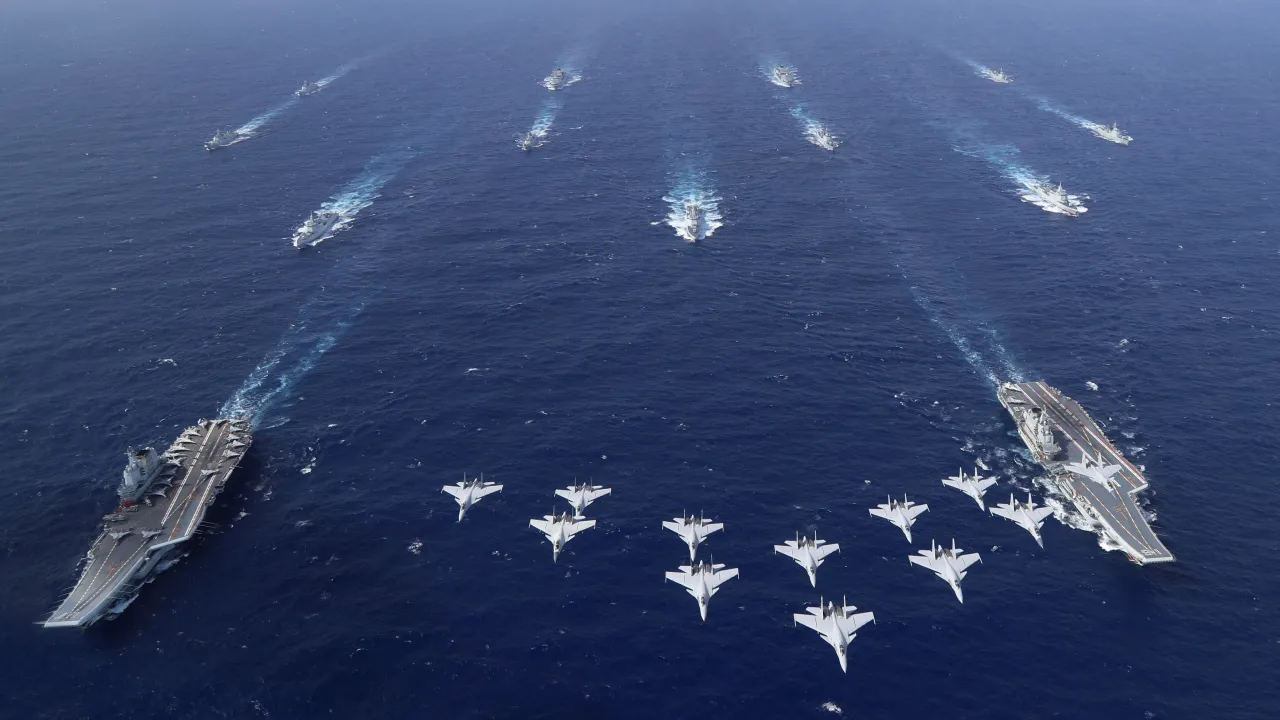
China’s approach is newer and more experimental, but it’s moving fast. The PLAN now operates multiple aircraft carriers, each one more capable than the last. While China’s carriers are smaller and less battle-tested than their U.S. counterparts, they seem tailored for regional power projection, especially in nearby seas.
Development plans suggest China is treating carriers as a long-term project, learning by doing rather than trying to match U.S. capabilities overnight.

Carrier-based aircraft are where the gap still feels noticeable. U.S. carriers deploy a mature mix of fighters, early-warning aircraft, and support planes that allow them to strike deep, defend themselves, and stay operational for long periods.
China’s carrier air wings are improving, but analysts often hedge that training tempo, deck operations, and integration are still catching up.
So in terms of power projection, the U.S. still looks more comfortable projecting force globally, while China seems focused on controlling and influencing its immediate neighborhood.
The real question isn’t whether China’s carriers rival U.S. ones today; maybe it’s how quickly experience, technology, and doctrine might narrow that gap over time.
Submarine Forces and Undersea Warfare
A lot of naval power today is about what you don’t see, and both the U.S. and China have invested heavily in undersea forces, even if they’ve taken slightly different paths.
The United States Navy operates a large fleet of nuclear-powered submarines, roughly 65–70 boats, including attack subs and ballistic missile submarines. These are built for endurance and global reach, able to stay submerged for months and operate far from home.
They’re widely considered among the quietest in the world, with advanced sensors and long-range cruise missiles that let them strike targets on land or at sea without much warning.
China’s submarine force is smaller overall but still substantial, with an estimated 55–60 submarines in total. This includes a growing number of nuclear-powered submarines, though many analysts hedge that these are still noisier than U.S. equivalents.

Where China really stands out is in diesel-electric submarines. These boats are shorter-range but extremely well-suited for regional waters, especially in shallow or crowded seas. In those environments, they can be frustratingly hard to detect and that alone changes the risk calculus for any opposing fleet.
When it comes to stealth, sensors, and missiles, the U.S. likely retains an edge in overall integration and undersea experience. That said, China has been steadily improving its sonar networks, quieting technology, and submarine-launched missiles.
Some critics argue the PLAN doesn’t need perfect global submarines, it just needs enough credible undersea threat to make U.S. operations near China’s coast far more complicated.

So while the U.S. submarine force still looks stronger on paper, undersea warfare is one area where China’s regional focus could matter more than raw numbers.
And because submarines operate mostly in silence, this might be the hardest balance to measure and the easiest to misjudge.
Weapons, Technology, and Combat Systems
So what actually makes these navies dangerous, the ships, or what’s on them? Honestly, it’s the weapons and the digital systems tying everything together. Hulls matter, but modern naval combat is increasingly about who can see first, strike first, and disrupt the other side before shots are even fired.
Missiles and hypersonic weapons: who has the edge?
China has put a lot of emphasis on missiles, especially long-range anti-ship weapons designed to keep enemy fleets at a distance. Some of these systems, including hypersonic designs, are often framed as “carrier killers.”

The U.S., meanwhile, fields a broader mix of cruise missiles, air-launched weapons, and sea-based strike systems, backed by decades of operational testing. That said, hypersonics are still evolving for everyone, and there’s debate about how decisive they’d really be in a chaotic, real-world fight.
What about radar, electronic, and cyber warfare?
The U.S. Navy has long invested in layered radar, electronic warfare, and jamming systems designed to work together across fleets and allies.
China has been rapidly closing the gap, especially in electronic warfare and cyber capabilities meant to blind sensors or disrupt communications.
Read also: Chinese Quantum Radar: The End of U.S. Stealth Technology?
Who actually controls the battlefield?
Command, control, and surveillance might be the least flashy but arguably the most important part of naval power. The U.S. benefits from a massive surveillance network, satellites, undersea sensors, and real-time data sharing with partners.
China is building its own version of this ecosystem, focused heavily on regional coverage. It may not need global awareness if its goal is to dominate nearby seas.
Defense Budgets and Shipbuilding Capacity
| Category | United States Navy (USN) | Chinese Navy (PLAN) |
| Annual defense budget (total) | ~$800+ billion | ~$225–250 billion (official) |
| Naval share | Largest single slice of budget | Growing share within PLA |
| Shipbuilding approach | Fewer, highly complex ships | More ships, built faster |
| Industrial focus | Global sustainment & upgrades | Rapid production & expansion |
At first glance, the U.S. Navy budget looks overwhelming and in raw dollars, it is. The U.S. spends more on defense than the next several countries combined, and the Navy benefits from that scale.
A big chunk of that money, though, goes toward sustainment: maintaining aging ships, upgrading systems, paying personnel, and keeping a global fleet operating thousands of kilometers from home. Some critics argue this makes the U.S. Navy incredibly capable, but also financially stretched and slower to modernize.
China’s military spending tells a different story. Officially, Beijing reports a much smaller defense budget, but analysts often hedge that real spending may be higher once research, shipyards, and indirect costs are factored in.
What stands out isn’t just how much China spends, but how it spends it. A growing share appears aimed at naval expansion, modern shipyards, and rapid production rather than long-term overseas sustainment.
That difference really shows up in shipbuilding speed and scale. Chinese shipyards can launch multiple warships in the time it takes the U.S. to build one complex destroyer or carrier.

The U.S. model prioritizes cutting-edge technology and survivability, but that also means longer build times and higher costs.
China’s model favors momentum; steady output, faster timelines, and numbers that accumulate quickly.
So while the U.S. still outspends China by a wide margin, money doesn’t translate neatly into hulls in the water.
Global Reach vs Regional Dominance
One of the biggest differences in the Chinese Navy vs US Navy debate is where each navy is built to operate.
The U.S. Navy has spent decades setting itself up as a global force. Bases, logistics hubs, and long-standing alliances stretch across Europe, the Middle East, and especially the Indo-Pacific. That network means U.S. ships can show up quickly and, just as importantly, stay on station thousands of kilometers from home.
Of course, critics argue that this global footprint also creates vulnerabilities and political constraints, since access often depends on partners saying yes.
China’s navy is playing a different game.
The PLAN is heavily focused on the Indo-Pacific, particularly waters close to home. Rather than trying to match U.S. presence everywhere, China seems intent on making its nearby seas difficult, risky, and expensive for outsiders to operate in.
That regional focus arguably plays to China’s strengths: geography, shorter supply lines, and dense layers of air, naval, and missile coverage.

This is where power projection and anti-access strategies collide. The U.S. excels at projecting force outward; sending carriers, amphibious groups, and strike aircraft far from its shores.
China, meanwhile, has invested in systems designed to slow, disrupt, or deter that approach, even if it doesn’t seek full control of distant oceans.
Who Has the Advantage in a Potential Conflict?
Short answer: it depends heavily on where the fight happens.
In places like the Taiwan Strait or the South China Sea, China would likely start with some built-in advantages; shorter distances, nearby bases, and layers of missiles and sensors already in place. That local setup could make it harder and riskier for U.S. forces to operate freely, at least early on.
That said, the U.S. Navy brings different strengths to the table: deeper combat experience, better integration with air and space assets, and the ability to work seamlessly with allies. Its limitation is distance, projecting power across thousands of miles takes time, logistics, and political coordination.
China’s limitation, on the other hand, is reach; operating far beyond its region is still something it’s learning to do.
This is where geography and allies quietly tip the scales. Islands, choke points, and nearby partner nations can either amplify U.S. power or complicate China’s plans.
So rather than a clear winner, most analysts hedge that any conflict would be messy, risky, and highly dependent on who controls access, information, and partnerships in those first critical days.
