

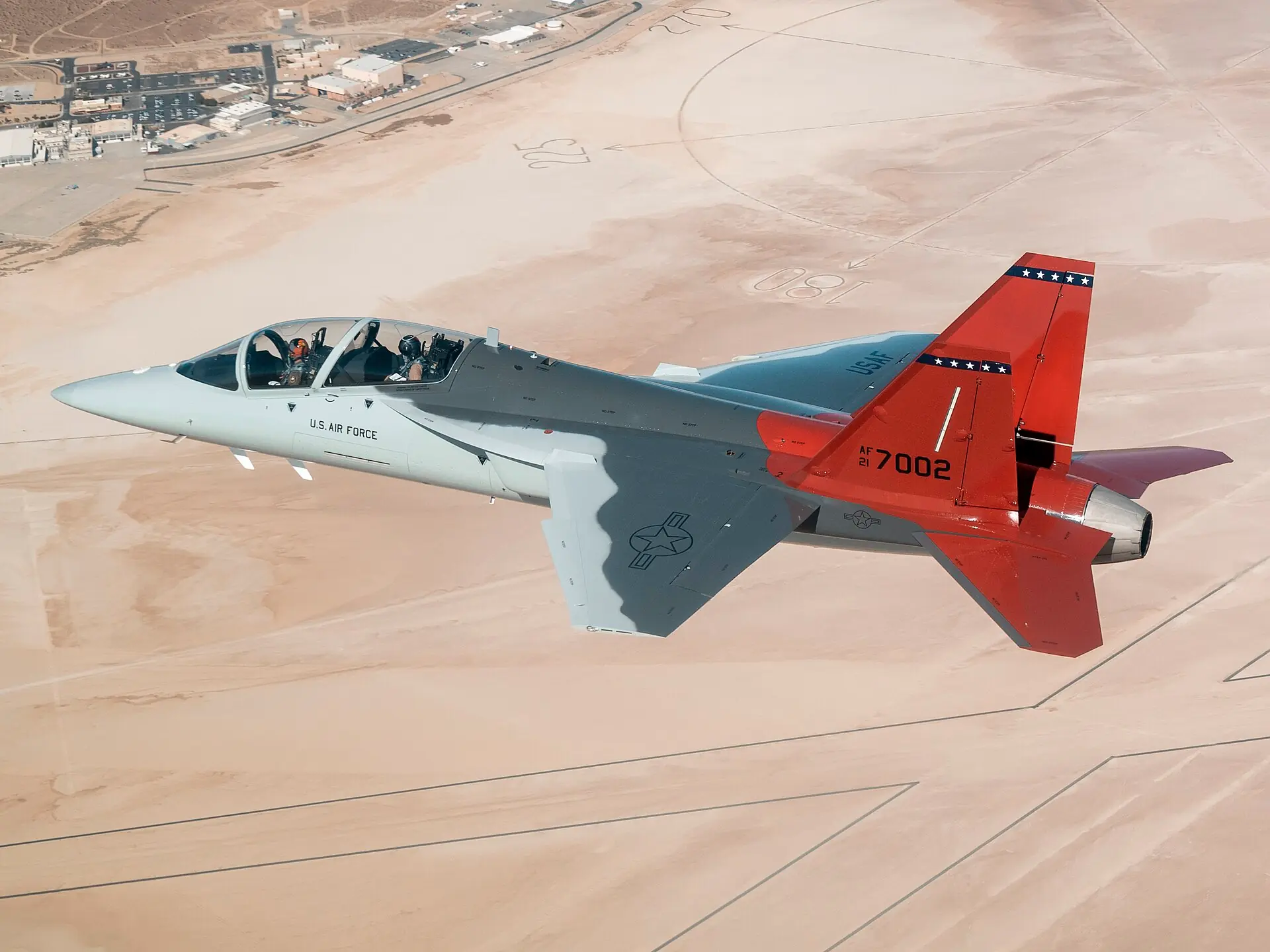
Most fighter pilots don’t start in a frontline combat jet. They start in something quieter. Something forgiving. Something designed to teach them how not to die.
That’s exactly where the T-7A Red Hawk enters the picture, and it’s not just another training aircraft. It’s the first jet trainer built from scratch in the digital age, engineered to prepare pilots for machines that didn’t even exist when the last trainer, the T-38 Talon, was introduced back in 1961.
Let that sink in. The previous trainer is older than the moon landing.
Developed through a partnership between Boeing and Saab, the T-7A Red Hawk represents a complete reset in how military pilots learn. Instead of treating training as a stepping stone, this aircraft treats it as the foundation. Its cockpit mirrors the digital environments pilots will later see in stealth fighters like the F-35 and future sixth-generation aircraft. No more outdated gauges. No more training gaps.
For the United States Air Force, the stakes couldn’t be higher. They train over 1,300 pilots every year, and each one needs to master supersonic flight, tactical awareness, and split-second decision-making.
The T-7A Red Hawk was designed to accelerate that learning curve while reducing cost and maintenance headaches.
But here’s what makes it fascinating: the Red Hawk isn’t just replacing an old jet. It’s redefining what pilot training means in an era where software matters as much as speed.
And that changes everything.
What is the Boeing T-7A Red Hawk?
The T-7A Red Hawk isn’t simply a newer version of an older trainer, it’s a different philosophy entirely. Think of it less like a replacement car and more like the shift from flip phones to smartphones. Same category. Completely different experience.

At its core, the T-7A Red Hawk is an advanced supersonic jet trainer built specifically to prepare pilots for modern combat aircraft. It’s designed for two people: a student in the front seat and an instructor in the rear.
That tandem seating isn’t random, it creates a real combat-style environment where the student takes full control while the instructor observes, ready to step in if needed.
Here’s a quick snapshot of what defines the aircraft:
| Category | Details |
| Role | Advanced jet trainer |
| Crew | 2 (student and instructor) |
| Manufacturers | Boeing and Saab |
| First flight | December 2016 |
| Maximum speed | Supersonic (Mach 1+) |
| Primary operator | United States Air Force |
What makes the T-7A Red Hawk stand out isn’t just performance. It’s the digital backbone. Unlike older trainers, which required physical modifications to simulate new aircraft, the Red Hawk can mimic different fighter jets using software. That means pilots can train for multiple combat scenarios without ever leaving the ground, or even changing aircraft.
There’s also symbolism baked into the name. The “Red Hawk” honors the Tuskegee Airmen, the first African American military aviators in U.S. history. Their aircraft tails were painted red, and the T-7A continues that legacy.
So yes, it’s a trainer. But it’s also a bridge, to the future of air combat.
Why Was the T-7A Red Hawk Developed?
To understand why the T-7A Red Hawk exists, you have to imagine training for a modern video game… using a controller from the 1980s. Technically possible. But wildly inefficient.
That’s exactly the situation the United States Air Force faced with the aging Northrop T-38 Talon. Introduced in 1961, the T-38 has trained generations of pilots. It was revolutionary in its time, fast, sleek, and supersonic. But modern combat aircraft have evolved into flying computers. The T-38 never did.
Here’s the uncomfortable truth: pilots were graduating from training with a massive technology gap.
Modern fighters like the F-35 rely heavily on digital displays, sensor fusion, and software-driven systems.
The T-38 uses analog gauges and limited onboard simulation. That disconnect forced pilots to relearn critical skills after training, wasting time and increasing costs.
The Red Hawk fixes that problem at its root.
Instead of teaching outdated habits, the T-7A introduces pilots to the exact digital environment they’ll encounter in frontline aircraft. Its cockpit features large multifunction displays, modern controls, and simulated radar and weapons systems. Students learn relevant skills from day one, not outdated workarounds.
There’s also a scale problem. The Air Force needs to train roughly 1,300 pilots every year. The T-38 fleet, now over 60 years old, requires intensive maintenance. Parts are harder to find. Downtime increases. Costs creep upward.
The T-7A Red Hawk was designed to reverse that trend. It requires fewer maintenance hours per flight hour, improves reliability, and allows faster pilot progression.
In simple terms, it doesn’t just train pilots better. It trains them smarter, and faster.
Boeing T-7A Red Hawk Specifications
Numbers tell a story, and in the case of the T-7A Red Hawk, they reveal an aircraft engineered for balance. Not the fastest. Not the biggest. But precisely tuned for one job: turning inexperienced pilots into confident operators of supersonic combat jets.

Let’s start with the physical dimensions. The T-7A measures about 46.9 feet (14.3 meters) long, with a wingspan of 30.6 feet (9.3 meters). That compact footprint matters more than you might think.
Smaller aircraft are more responsive, and responsiveness builds pilot instinct. When a student makes a control input, the aircraft reacts immediately. No delay. No ambiguity.
Here’s a detailed breakdown:
| Specification | T-7A Red Hawk |
| Length | 46.9 ft (14.3 m) |
| Wingspan | 30.6 ft (9.3 m) |
| Height | 13.1 ft (4 m) |
| Crew | 2 |
| Engine | General Electric F404 afterburning turbofan |
| Maximum speed | Mach 1.04 (approx. 1,300 km/h) |
| Service ceiling | 50,000 ft (15,240 m) |
| Range | Approx. 1,140 miles (1,835 km) |
The engine deserves special attention. The F404 turbofan, the same engine family used in aircraft like the McDonnell Douglas F/A-18 Hornet, produces enough thrust to push the Red Hawk beyond the speed of sound. That’s essential. Student pilots must experience supersonic flight before transitioning to frontline fighters.
But raw performance isn’t the real advantage. It’s predictability.
The aircraft uses fly-by-wire controls, meaning computers assist and stabilize pilot inputs. This makes the jet forgiving when students make mistakes, something that happens often, especially early on.
In short, the T-7A Red Hawk isn’t built to impress spectators. It’s built to shape reflexes. And that’s far more important.
T-7A Red Hawk Features and Technology
If older trainer jets were classrooms, the T-7A Red Hawk is more like a full-immersion simulator that just happens to fly at Mach 1.
What makes this aircraft different isn’t visible from the outside. It’s the invisible layer, the software, computing systems, and digital architecture, that transforms how pilots learn.
The Red Hawk was the first military aircraft designed entirely using digital engineering. Engineers from Boeing and Saab built and tested the aircraft in a virtual environment before any metal was cut. That shaved years off development time and reduced costly redesigns later.
Inside the cockpit, everything feels familiar to pilots destined for aircraft like the Lockheed Martin F-35 Lightning II. Large digital displays replace traditional gauges. Information is centralized, clean, and customizable. Instead of scanning ten instruments, pilots process everything in one integrated view, just like they will in real combat aircraft.

Here’s where it gets even more interesting: the Red Hawk can simulate threats and combat situations without external aircraft.
Key technology features include:
| Feature | Why It Matters |
| Embedded simulation | Pilots can train against virtual enemies mid-flight |
| Fly-by-wire system | Stabilizes aircraft and reduces pilot workload |
| Open architecture software | Easy upgrades without hardware redesign |
| Digital cockpit displays | Matches modern fighter jet environments |
| Advanced data recording | Allows instructors to replay and analyze flights |
This means pilots can practice radar tracking, threat evasion, or complex missions without firing a single weapon.
Even maintenance benefits. Sensors throughout the aircraft monitor system health and predict failures before they happen. Less guesswork. Less downtime.
In a way, the T-7A Red Hawk teaches pilots and teaches itself at the same time.
How the T-7A Red Hawk Trains Modern Fighter Pilots
There’s a moment every student pilot remembers. The first time the aircraft accelerates hard enough to press their body into the seat. The horizon tilts. The engine roars. And suddenly, flying stops feeling like theory, it becomes instinct.
The T-7A Red Hawk was engineered to make that transformation happen faster and more effectively than any trainer before it.
Older training systems relied heavily on imagination. Instructors would say, “Pretend there’s an enemy aircraft at your 2 o’clock.” The student had to visualize it. React hypothetically. It worked, but it wasn’t ideal.

The Red Hawk removes the guesswork.
Using embedded simulation, the aircraft can generate virtual enemy aircraft, missile threats, and combat scenarios directly on the pilot’s display. From the student’s perspective, it feels real. They see threats. They respond. They learn under pressure, without ever firing a weapon or deploying into actual combat.
This is especially critical for preparing pilots to fly aircraft like the Lockheed Martin F-22 Raptor and the F-35, where information processing matters as much as physical flying skill.
The training progression becomes more efficient:
| Training Stage | Traditional Trainer | T-7A Red Hawk |
| Basic flight control | Learn aircraft handling | Same |
| Combat simulation | Ground simulator only | Airborne embedded simulation |
| Threat response | Limited realism | Fully immersive digital threats |
| Transition to fighters | Steep learning curve | Much smoother transition |
Another advantage is cognitive conditioning. Pilots learn to manage workload, tracking targets, monitoring systems, and flying simultaneously. That mental multitasking is essential in modern air combat.
The Red Hawk doesn’t just teach pilots how to fly.
It teaches them how to think like fighter pilots.
T-7A Red Hawk Cost and Contract Value
Military aircraft are expensive. That’s not surprising. What is surprising is how the T-7A Red Hawk manages to reduce long-term costs while introducing more advanced technology than its predecessor.

In 2018, the United States Air Force awarded Boeing a contract worth $9.2 billion. At first glance, that number feels staggering. But here’s the important nuance: the contract doesn’t just cover aircraft. It includes simulators, ground training systems, maintenance infrastructure, and long-term support. It’s an entire training ecosystem, not just a jet.
The Air Force plans to acquire approximately 351 T-7A Red Hawk aircraft, along with 46 simulators. When you break the math down, the estimated average unit cost falls into a range considered efficient for a supersonic military trainer.
Here’s a simplified cost overview:
| Cost Category | Estimated Value |
| Total program contract | $9.2 billion |
| Planned aircraft quantity | 351 jets |
| Simulator systems | 46 units |
| Estimated unit cost per aircraft | $25–30 million |
| Service life expectancy | 30–40 years |
But the real savings don’t come from purchase price. They come from operations.
Older aircraft like the T-38 require extensive maintenance hours for every hour flown. Components wear out faster. Parts are scarce. Technicians spend more time fixing than preparing.
The T-7A Red Hawk flips that equation.
Its digital design allows predictive maintenance, meaning technicians can fix components before they fail. Its modular systems make replacement faster. And its modern engine is built for efficiency and reliability.
Over decades, these improvements could save billions.
In military aviation, the cheapest aircraft isn’t the one that costs the least upfront. It’s the one that costs the least to keep flying.
T-7A Red Hawk vs T-38 Talon
Comparing the T-7A Red Hawk to the Northrop T-38 Talon is like comparing a modern electric car to a classic muscle car. The T-38 still flies. It still trains pilots. But it belongs to a different technological era, one where software wasn’t the center of everything.

The T-38 entered service in 1961. At the time, it was revolutionary. Supersonic speed. Twin engines. Exceptional handling. It trained generations of pilots who went on to fly aircraft like the F-15 and F-16.
But modern fighters like the Lockheed Martin F-22 Raptor and F-35 operate in highly digital environments. Training in an analog cockpit creates a disconnect that slows pilot progression.
The T-7A Red Hawk was built specifically to close that gap.
Here’s a side-by-side comparison that reveals just how dramatic the leap really is:
| Feature | T-7A Red Hawk | T-38 Talon |
| First flight | 2016 | 1959 |
| Cockpit | Fully digital glass cockpit | Analog gauges |
| Simulation capability | Embedded virtual combat training | Limited or external only |
| Design method | Fully digital engineering | Traditional drafting |
| Maintenance efficiency | Predictive, sensor-based | Manual inspection heavy |
| Engine | Single modern turbofan | Twin older turbojets |
| Training relevance | Built for 5th-gen fighters | Built for Cold War era aircraft |
One subtle but important difference is adaptability. The T-38 is essentially “frozen” in its original design. The T-7A, by contrast, can evolve through software updates. New threats, new tactics, new mission profiles, all can be introduced without redesigning the aircraft.
That flexibility ensures the Red Hawk won’t become obsolete anytime soon.
It’s not just replacing the Talon. It’s replacing an entire training philosophy.
