

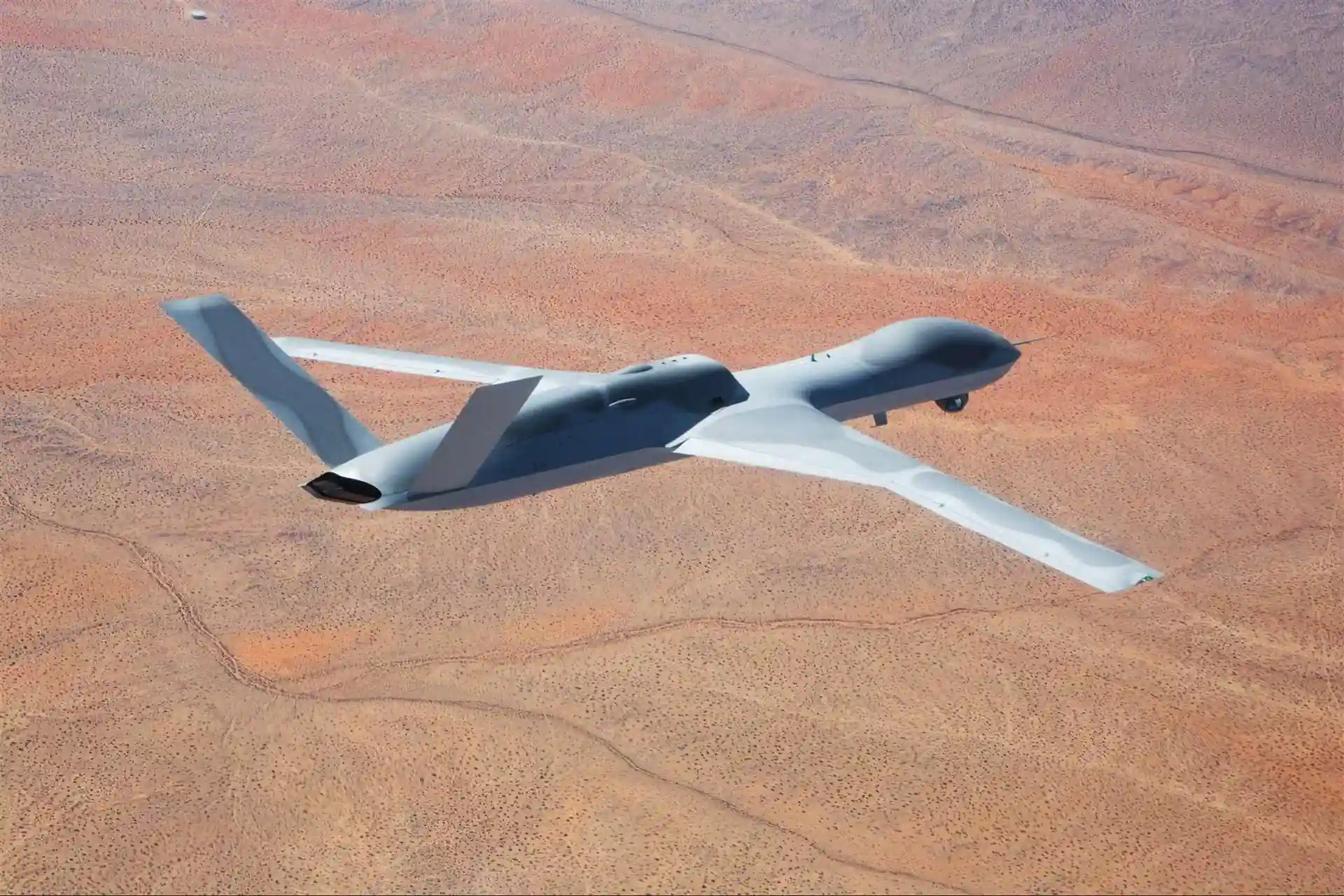
Warplanes used to have pilots. Then came drones. Now, we’re entering a stranger phase, aircraft that don’t just fly without pilots, but think, decide, and fight with a kind of mechanical independence.
That’s where the MQ-20 Avenger steps in. It isn’t just another unmanned aircraft circling high above the clouds. It’s something closer to a test run for the future of air combat itself.
At first glance, the MQ-20 Avenger looks sleek. Almost shark-like. No propeller out front, no obvious signs of the older drone era. Instead, it’s powered by a turbofan jet engine, the same basic concept used in fighter jets, allowing it to fly faster, higher, and far more stealthily than its predecessors.
Built by General Atomics Aeronautical Systems, the Avenger represents a deliberate shift away from slow, surveillance-focused drones toward autonomous combat platforms designed for contested airspace.
But what makes the MQ-20 truly fascinating isn’t speed or stealth alone. It’s what the aircraft represents. Think of it as a bridge between two worlds: today’s remotely piloted drones and tomorrow’s AI-assisted combat aircraft that fly alongside human pilots, or without them entirely.
Military planners aren’t just testing a drone. They’re testing a concept. A world where autonomous aircraft can escort fighters, intercept threats, and make split-second decisions faster than any human ever could.
And here’s the part most people miss: the MQ-20 Avenger isn’t a distant prototype gathering dust in a lab. It’s already flying. Already learning. Already shaping what air warfare will look like in the next decade.
This post will walk you through exactly how, and why, it matters.
What Is the MQ-20 Avenger?
The MQ-20 Avenger isn’t just a newer drone, it’s a completely different philosophy wearing the familiar skin of an unmanned aircraft. Earlier drones, like the famous MQ-9 Reaper, were designed primarily as persistent observers. They lingered for hours, watching, tracking, occasionally striking.

The MQ-20 Avenger, by contrast, was built to survive, and operate, in airspace where enemies shoot back.
Originally known as Predator C, the Avenger was designed to solve a growing problem. Traditional drones were too slow and too visible. Against modern air defenses and fast-moving fighter jets, they’d struggle to survive.
So engineers made a radical shift. They gave the MQ-20 a turbofan jet engine, internal weapons storage, and a streamlined body that minimizes its radar signature. The result? A drone that behaves less like a surveillance camera and more like a true combat aircraft.
What makes the Avenger different is how it’s used. It’s often described as a “surrogate”, a flying laboratory where militaries test artificial intelligence, autonomy software, and future combat tactics.
Imagine a robotic wingman flying beside a human pilot. Matching speed. Sharing sensor data. Even intercepting threats on its own. That’s the real purpose of the MQ-20 Avenger, not just to fight today’s battles, but to rehearse tomorrow’s.
MQ-20 Avenger Drone Specifications
Numbers don’t always tell the full story, but in the case of the MQ-20 Avenger, they reveal just how dramatic the leap really is. This isn’t an incremental upgrade. It’s a shift from propeller-era drones into something that behaves much more like a stealthy jet fighter, minus the human limitations.
The heart of the MQ-20 Avenger is its turbofan engine, built by Pratt & Whitney. Unlike turboprop engines used on older drones, a turbofan delivers smoother thrust, higher speeds, and, critically, better survivability. It allows the Avenger to cruise at roughly 740 km/h (about 460 mph), more than twice as fast as many legacy unmanned aircraft. Speed, in air combat, often equals survival.
Here’s a clear breakdown of the Avenger’s core specifications:
| Specification | MQ-20 Avenger |
| Length | 13.4 meters |
| Wingspan | 20.1 meters |
| Height | 4.7 meters |
| Maximum speed | ~740 km/h |
| Endurance | 20+ hours |
| Service ceiling | Over 15,000 meters |
| Engine type | PW545B turbofan |
| Payload capacity | Approx. 1,600 kg |
One detail that rarely gets attention: endurance combined with speed creates strategic flexibility. Older drones could stay airborne a long time, but they couldn’t reposition quickly. The MQ-20 can. It can patrol one region, then relocate hundreds of kilometers away without needing to land or refuel. That kind of mobility changes how commanders use unmanned aircraft.
Another quiet advantage lies in its payload flexibility. The Avenger carries weapons internally to reduce radar visibility, but it can also mount external payloads when stealth isn’t the priority. It’s adaptable. Almost modular in spirit.

Think of it less like a single-purpose drone, and more like a flying multi-tool designed for unpredictable battlefields.
Stealth Features and Advanced Design
If you saw the MQ-20 Avenger flying overhead, you might not notice anything unusual. And that’s exactly the point. Its most important feature isn’t visible at all, it’s what enemy radar doesn’t see.
Earlier drones were never designed with stealth as a priority. They flew slowly, often in uncontested skies. But the MQ-20 Avenger was engineered for environments filled with radar networks, surface-to-air missiles, and hostile fighter aircraft. Survival required a different approach. So engineers reshaped the aircraft from the inside out.
One of the most critical stealth elements is its internal weapons bay. Instead of carrying missiles and bombs on external pylons, which reflect radar signals, the Avenger hides them inside its fuselage. When weapons stay enclosed, the aircraft presents a much cleaner radar profile. It’s a trick borrowed directly from stealth fighters like the F-35 Lightning II.

The engine design also plays a quiet but crucial role.
The MQ-20 uses an S-shaped air intake and shielded exhaust system. This reduces both radar reflections and infrared heat signature. Why does that matter? Because modern missiles don’t just look for radar returns, they track heat. Lower heat visibility makes the Avenger harder to lock onto.
The aircraft’s smooth, blended body shape contributes further. There are fewer sharp angles, fewer exposed components. Radar waves scatter instead of bouncing directly back to the source. It’s subtle. Almost architectural.
But stealth isn’t just about hiding, it’s about buying time. Time to observe. Time to strike. Time to leave undetected.
In real-world combat, even a few extra seconds of invisibility can mean the difference between mission success and loss. The MQ-20 Avenger was designed to win those seconds quietly, without anyone noticing it was there at all.
MQ-20 Avenger Capabilities
The MQ-20 Avenger isn’t impressive just because of how it looks or flies, it’s impressive because of what it can do. And what it can do stretches far beyond the traditional role people associate with drones. This aircraft isn’t just watching battlefields anymore. It’s participating in them.
Start with surveillance.
The Avenger carries advanced sensors capable of tracking vehicles, aircraft, and ground activity across enormous distances. Its radar systems can see through clouds, dust, and darkness. That means it doesn’t depend on perfect weather or daylight. It watches constantly. Patiently. Like a chess player waiting for the right move.

But unlike older surveillance drones, the MQ-20 can immediately act on what it sees. Its internal weapons bay allows it to carry precision-guided munitions, meaning it can identify a target and engage it without needing another aircraft nearby. This reduces response time dramatically. In fast-moving situations, minutes matter. Sometimes seconds matter more.
Then there’s its speed advantage. Because the Avenger is jet-powered, it can intercept airborne threats or reposition itself quickly. It’s no longer stuck orbiting one zone at slow speeds. Instead, it can shift roles mid-mission, surveillance one hour, strike platform the next.
What really pushes the MQ-20 into new territory, though, is autonomy. The aircraft has been used to test AI systems that can navigate, track targets, and even perform intercept maneuvers. Not science fiction. Actual flight tests.
Think of it as a drone that doesn’t just follow instructions, it understands objectives.
That distinction changes everything. Because once an aircraft understands objectives, it becomes more than a tool. It becomes a partner in the mission.
Role in Collaborative Combat Aircraft (CCA)
The MQ-20 Avenger’s most important job isn’t dropping weapons or flying surveillance missions. Its real mission is helping create a new kind of air force, one where humans and autonomous aircraft operate as coordinated teams. This concept is known as Collaborative Combat Aircraft, or CCA. And it’s quietly reshaping military strategy around the world.

Traditionally, fighter pilots carried the full burden of combat, navigation, threat detection, decision-making, and weapons deployment, all while flying at high speeds. It’s an enormous workload.
Now imagine those pilots supported by autonomous aircraft flying beside them. Not behind. Not remotely controlled. Beside them, acting as extensions of their awareness.
The MQ-20 Avenger serves as a test platform for exactly that scenario.
In practical terms, the Avenger can fly ahead of manned aircraft, scanning for threats. It can identify enemy radar systems, track hostile fighters, or even draw attention away from human pilots. This creates tactical advantages. If an autonomous drone takes the riskier position, the human pilot remains safer while still controlling the engagement strategy.
Here’s how the MQ-20 fits into the CCA ecosystem:
| Role | What the MQ-20 Avenger Does |
| Forward scout | Detects threats ahead of manned aircraft |
| Escort | Flies alongside fighters as protection |
| Decoy | Attracts enemy radar and missiles |
| Strike support | Engages targets under supervision |
| Data relay | Shares sensor data across aircraft |
Think of the MQ-20 like a robotic wingman. Loyal. Precise. Tireless.
Perhaps the biggest advantage? It doesn’t get tired. It doesn’t panic. And it doesn’t lose focus under pressure.
That allows human pilots to concentrate on strategy instead of survival, which fundamentally changes how air combat works.
MQ-20 Avenger vs MQ-9 Reaper
At first glance, the MQ-20 Avenger and the MQ-9 Reaper might seem like close relatives. They’re both unmanned. Both built by General Atomics Aeronautical Systems. Both capable of surveillance and strike missions. But under the surface, they belong to completely different generations.

The MQ-9 Reaper was designed during an era when drones operated mostly uncontested. It uses a turboprop engine, the kind you’d find on a small commuter plane. Efficient, reliable, but not fast. Its top speed is around 480 km/h.
The MQ-20 Avenger, with its turbofan jet engine, pushes closer to 740 km/h. That speed difference isn’t just technical, it’s tactical. Faster aircraft can survive in more dangerous environments.
Stealth is another dividing line. The Reaper carries weapons externally, which increases its radar visibility. The Avenger hides its weapons inside the fuselage, reducing its radar signature. This allows it to operate in defended airspace where the Reaper would be far more vulnerable.
Here’s a side-by-side comparison that highlights the generational leap:
| Feature | MQ-20 Avenger | MQ-9 Reaper |
| Engine | Turbofan jet | Turboprop |
| Top speed | ~740 km/h | ~480 km/h |
| Stealth features | Yes (internal weapons bay) | Limited |
| Survivability | High in contested airspace | Best in low-threat areas |
| Primary role | Autonomous combat test platform | ISR and strike missions |
| Future role | Loyal wingman / AI combat | Traditional drone operations |
There’s also a philosophical difference. The Reaper is remotely piloted. The Avenger is increasingly autonomous.
In simple terms, the MQ-9 Reaper represents the peak of yesterday’s drone technology. The MQ-20 Avenger represents the beginning of tomorrow’s.
Final Thoughts
The MQ-20 Avenger represents something bigger than a single aircraft. It’s a signal, a quiet but unmistakable shift in how air power is designed, deployed, and understood.
For decades, air combat revolved around human skill alone. Now, machines like the Avenger are beginning to share that burden, extending human reach rather than replacing it.
What makes the MQ-20 remarkable isn’t just its speed, stealth, or payload. It’s its adaptability. It can scout ahead, carry weapons, deploy smaller drones, and operate with increasing autonomy. Few platforms combine all of those roles in one airframe.
More importantly, the Avenger is helping militaries answer a critical question: how do humans and intelligent machines fight together effectively?
The answer is still unfolding. But one thing is clear, the MQ-20 Avenger isn’t the end of drone evolution.
It’s the beginning of something far more transformative.
