

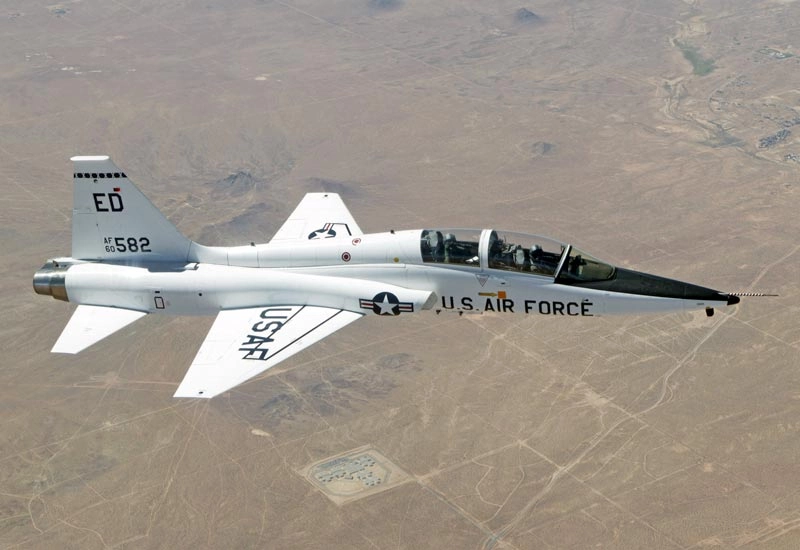
There’s something almost rebellious about the T-38 Talon. It looks like a fighter jet. It flies like a fighter jet. It even breaks the sound barrier. But here’s the twist, it isn’t built for combat. It’s built for learning.
Developed by Northrop Corporation and introduced in 1961, the T-38 Talon became the world’s first supersonic trainer aircraft, and it changed military aviation education forever.
Before it existed, pilots trained on slower jets that didn’t fully prepare them for modern fighters. The Talon closed that gap overnight.
Its influence is staggering. More than 72,000 pilots have trained in this aircraft, including generations of aviators from the United States Air Force and astronauts from NASA.
In fact, astronauts still fly it today, not because they have to, but because nothing else replicates the mental workload and precision required for spaceflight quite the same way.
What makes the T-38 remarkable isn’t just its speed. It’s its longevity. Over six decades later, this slim, twin-engine jet continues to shape pilots who will eventually fly billion-dollar fighters and spacecraft. Not bad for an airplane designed when slide rules were still common.
And that’s where the story really begins.
What Is the T-38 Talon?
At its core, the T-38 Talon is a teacher. A brutally honest one. It doesn’t tolerate sloppy flying, and it doesn’t hide your mistakes. That’s exactly why it works so well.
The Talon is a two-seat, twin-engine supersonic trainer jet designed to prepare pilots for high-performance combat aircraft. Both seats are arranged in tandem, one behind the other, so the instructor can monitor everything the student does. No shortcuts. No guessing. Every movement is visible, correctable, teachable.

What makes the T-38 different from earlier trainers is simple: speed and responsiveness. Most training aircraft ease you into advanced flight.
The Talon doesn’t ease you in, it hands you the real experience early. With a top speed exceeding Mach 1.0 (around 1,350 km/h or 840 mph), student pilots learn how aircraft behave at supersonic speeds long before they ever touch a front-line fighter.
What pilots remember most is how alive it feels. The controls are sharp, almost surgical. A small input produces immediate feedback. That’s intentional. The Talon teaches precision, not comfort.
It also introduces pilots to realities they’ll face later, high workload, rapid decision-making, and the strange psychological effect of moving faster than sound itself. Your brain has to keep up, or you fall behind.
In other words, the T-38 Talon doesn’t just teach flying. It teaches thinking at supersonic speed.
Northrop T-38 Talon Specifications
Numbers alone don’t make an aircraft legendary, but in the case of the T-38 Talon, they explain why it feels so different from typical trainer jets. This machine wasn’t designed to simulate performance. It delivers the real thing.
At full throttle, the Talon pushes past Mach 1.08, which translates to roughly 822 mph (1,323 km/h). That’s faster than a rifle bullet traveling across a football field.
For student pilots, this isn’t just impressive, it’s transformative. They experience supersonic flight early in their training pipeline, which dramatically shortens the learning curve when transitioning to operational fighters.
Its power comes from two General Electric J85 turbojet engines. These engines are compact, but don’t let their size fool you. Each produces around 2,900 pounds of thrust with afterburner.
Together, they give the Talon its signature acceleration, smooth at first, then suddenly urgent, like being pushed forward by an invisible force.
Here’s a clear breakdown of the T-38 Talon specs:
| Category | Specification |
| Maximum speed | Mach 1.08 (822 mph / 1,323 km/h) |
| Cruise speed | 469 mph (755 km/h) |
| Range | 1,140 miles (1,835 km) |
| Service ceiling | 55,000 ft (16,764 m) |
| Rate of climb | 33,600 ft per minute |
| Length | 46 ft 4 in (14.1 m) |
| Wingspan | 25 ft 3 in (7.7 m) |
| Maximum takeoff weight | 12,093 lbs (5,486 kg) |
| Engines | 2 × GE J85-5 turbojets |
| Crew | 2 (student and instructor) |
One overlooked detail is its climb rate, 33,600 feet per minute. That means the Talon can reach cruising altitude in less than two minutes. Commercial airliners take closer to 20.
This performance forces pilots to think ahead constantly. Things happen fast. Decisions must happen faster. And that’s exactly the point.
T-38 Talon Design Features
At first glance, the T-38 Talon looks almost too small to be supersonic. Its fuselage is thin, needle-like, with short wings that seem barely large enough to hold it up. But that minimalism is intentional. Every curve, every angle, every surface was shaped for speed and control, not comfort.
One of its defining characteristics is its extremely low drag profile. The Talon’s narrow fuselage reduces air resistance, allowing it to slice cleanly through the atmosphere. Think of it like a dart compared to a paper airplane. Less drag means more speed using less fuel, which was critical when the aircraft was designed.

The wings are another interesting choice. They’re short and straight, not swept back dramatically like modern fighters. This gives the aircraft excellent stability and predictable handling, which is essential when you’re teaching pilots who are still building muscle memory at supersonic speeds.
The cockpit itself is surprisingly simple, at least compared to modern fighters. Early versions relied heavily on analog gauges, round dials, needles, mechanical indicators. No flashy screens. This forced pilots to develop strong instrument scanning habits, constantly cross-checking altitude, speed, and engine performance.

Interestingly, many pilots say the Talon “talks” to you. Not literally, of course, but through vibrations, control pressure, and subtle feedback. You feel what the aircraft is doing.
It’s not just a machine. It’s a conversation between pilot and physics.
Northrop T-38 Talon Training Role
The real mission of the T-38 Talon isn’t speed. It’s transformation. This is the aircraft that takes a pilot who knows how to fly, and teaches them how to think like a fighter pilot.
By the time pilots reach the Talon, they’ve already trained in slower aircraft like the turboprop trainer. But the jump to the T-38 is dramatic. Suddenly, everything happens two or three times faster. Turns tighten. Distances shrink. Mistakes arrive quicker than expected.
This phase is called advanced jet training, and it’s where pilots prove they can handle high-performance aircraft. The T-38 introduces them to real-world fighter concepts, including:
| Training Skill | Why It Matters |
| Formation flying | Essential for combat coordination |
| High-altitude operations | Prepares pilots for fighter mission profiles |
| Supersonic flight | Teaches aircraft handling beyond Mach 1 |
| Instrument navigation | Critical for poor visibility conditions |
| Energy management | Helps pilots control speed and maneuverability |
One exercise, for example, involves flying just a few feet away from another aircraft at 500+ mph. It sounds insane, and honestly, it kind of is. But it builds trust, precision, and discipline.
The United States Air Force relies on the T-38 as the final stepping stone before pilots move on to aircraft like the F-15, F-16, or F-22. Without mastering the Talon, pilots simply don’t progress.
There’s also a psychological shift that happens here. Student pilots stop reacting to the aircraft and start anticipating it. They learn to stay ahead of the jet, to think 10, 20, even 30 seconds into the future.
That mental transition is the real purpose of the Talon. It doesn’t just train your hands. It trains your mind.
Northrop T-38 Talon Variants
Not all T-38 Talon aircraft are the same. Over its long life, the jet has evolved quietly, almost invisibly, adapting to new training demands without ever losing its original personality. Think of it less like a single aircraft and more like a lineage, each variant refining the formula.
The original version, the T-38A, entered service in 1961. It was barebones by modern standards. Analog gauges filled the cockpit, and pilots relied heavily on instinct and experience. No digital displays. No automation safety nets. Just raw flying.
But as fighter aircraft became more advanced, the Talon needed upgrades to stay relevant.
The most important modernization came with the T-38C, which transformed the aircraft internally while preserving its external shape.

The United States Air Force upgraded avionics, navigation systems, and cockpit displays to match modern fighter environments. Suddenly, pilots could train using digital instrumentation similar to what they’d see in frontline aircraft.
Here’s a breakdown of the key variants:
| Variant | Description | Key Improvements |
| T-38A | Original production version | Basic analog cockpit |
| AT-38B | Weapons training version | Added weapons simulation capability |
| T-38C | Modernized trainer | Glass cockpit, GPS, updated avionics |
The T-38C upgrade was particularly critical. Instead of retiring the aircraft, the Air Force essentially gave it a new brain. This extended its operational life by decades.
There’s something remarkable about that. The airframe, the physical body, was so well-designed that it didn’t need replacement. Only the electronics needed to evolve.
It’s like upgrading a classic sports car with a modern dashboard. Same soul. Smarter reflexes.
Advantages of the T-38 Talon
The T-38 Talon wasn’t supposed to last this long. Most military aircraft are designed for maybe 20 or 30 years of service. The Talon has blown past that expectation, staying relevant for over six decades. That doesn’t happen by accident. It happens because the aircraft gets a surprising number of things exactly right.

One of its biggest advantages is cost efficiency. Compared to modern fighter jets, the Talon is dramatically cheaper to operate. A frontline fighter like the F-22 can cost over $60,000 per flight hour.
The T-38, by comparison, costs a fraction of that. This allows training programs to fly more often, which produces better pilots without destroying budgets.
Another key advantage is performance balance. The Talon is fast enough to be supersonic, but not so complex that it overwhelms trainees. It sits in a sweet spot between beginner trainers and full combat aircraft.
Here’s a closer look at its core strengths:
| Advantage | Why It Matters |
| Supersonic capability | Prepares pilots for real fighter speeds |
| Low operating cost | Enables frequent training flights |
| Reliable engines | Proven performance over millions of flight hours |
| Predictable handling | Helps students build confidence safely |
| Lightweight design | Excellent climb rate and acceleration |
Maintenance crews also appreciate the Talon. Its systems are relatively simple compared to modern stealth aircraft. Fewer complex components mean fewer failures, and faster turnaround between flights.
But perhaps its greatest advantage isn’t mechanical. It’s psychological.
The Talon builds discipline. It demands precision. Pilots can’t rely on automation to save them. They must stay sharp, focused, and ahead of the aircraft at all times.
And that mindset carries forward, into every aircraft they fly afterward.
Limitations and Replacement
For all its strengths, the T-38 Talon carries something you can’t upgrade away: age. Many of the aircraft flying today were built in the late 1960s and early 1970s. That means some airframes are older than the pilots flying them, and in aviation, time is relentless.
Metal fatigues. Wiring insulation breaks down. Structural stress accumulates silently over decades of supersonic flight. Even with meticulous maintenance, no aircraft lasts forever.
One of the biggest limitations is that the Talon wasn’t designed for modern avionics from the beginning. While upgraded T-38C variants now include digital displays, the aircraft still lacks the fully integrated systems found in modern fighters like the F-35. There’s no advanced radar simulation, no sensor fusion, and limited embedded training capability.
Here’s a breakdown of its main limitations:
| Limitation | Operational Impact |
| Aging airframes | Increased maintenance requirements |
| Outdated design origin | Limited compatibility with modern systems |
| No embedded radar simulation | Less realistic fighter training |
| Safety margin constraints | Requires careful operational limits |
| Limited growth potential | Difficult to add new technology |
Recognizing these issues, the United States Air Force began searching for a replacement. The result is the Boeing–built Saab T-7A Red Hawk, a next-generation trainer designed specifically for modern combat preparation.

The T-7 introduces fully digital avionics, embedded simulation, and safer, more efficient engines. It’s not just a replacement, it’s a reset.
And yet, even as the Red Hawk enters service, the Talon continues flying. Not because it’s the newest. But because it’s still good enough, and that says everything.
Final Thoughts
The T-38 Talon isn’t just an aircraft, it’s a proving ground. For more than 60 years, it has shaped the instincts, confidence, and judgment of pilots who would go on to fly the world’s most advanced fighters and spacecraft. That alone would secure its place in aviation history.
But what makes the Talon truly special is its honesty. It doesn’t hide flaws. It doesn’t soften reality. It teaches pilots to stay ahead of the aircraft, to think faster, to act with precision. Those habits don’t fade, they carry forward into every mission that follows.
Even now, as newer trainers arrive, the Talon’s influence remains embedded in modern pilot training philosophy.
Some aircraft win wars. Others explore space. The T-38 Talon does something quieter, but just as important.
It prepares the humans who do both.
