

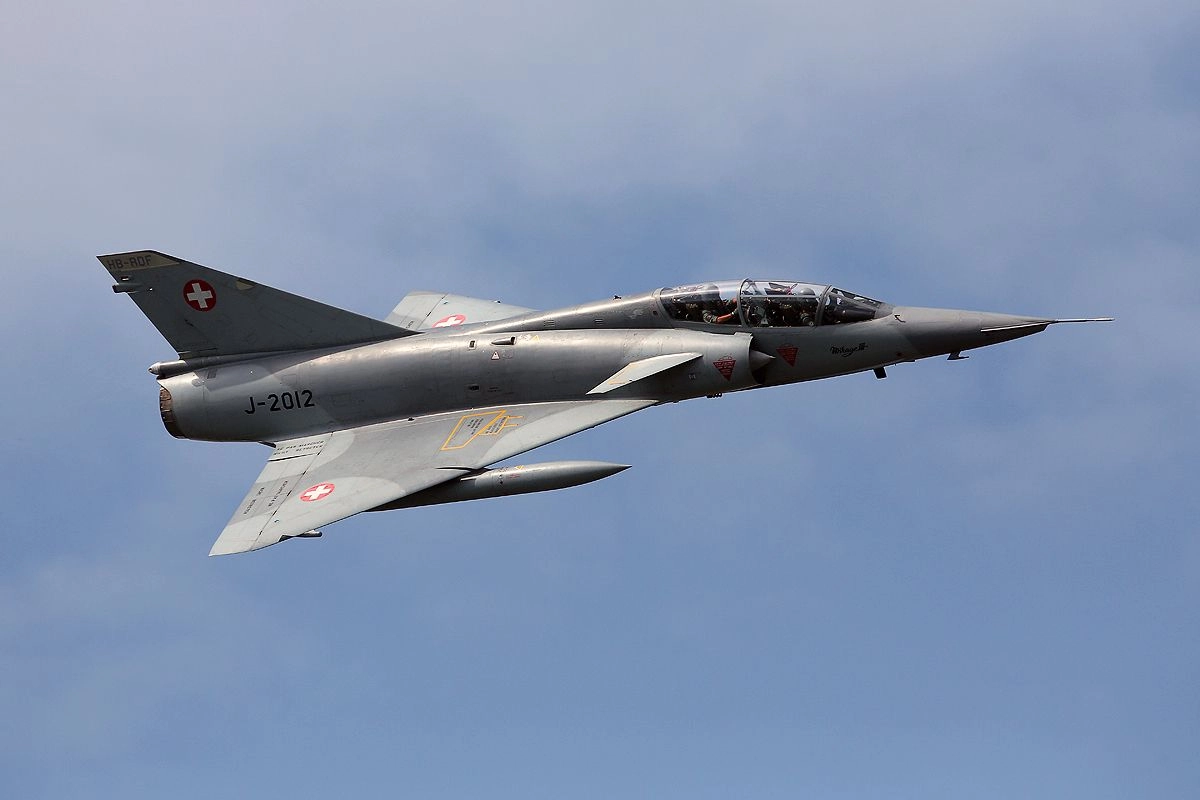
Picture this: it’s the late 1950s, the Cold War is humming ominously in the background, and fighter jets are still figuring out what “supersonic” really means. Then the Mirage III shows up and calmly punches through Mach 2 like it’s late for dinner. No drama. No excuses. Just speed, altitude, and intent.
That first impression never really faded.
The Mirage III isn’t just another Cold War fighter jet; it’s a statement. A sharp, triangular delta-winged statement that told the world France could design, build, and export a top-tier supersonic aircraft without copying anyone else’s homework. While other nations were still wrestling with complexity, the Mirage III leaned into elegant simplicity: one engine, one mission, ruthless efficiency.
What makes the Mirage III especially fascinating is how many lives it lived. Interceptor. Fighter-bomber. Recon platform. Export bestseller. It wasn’t locked into a single identity. Instead, it adapted, sometimes imperfectly, sometimes brilliantly, across continents, climates, and combat doctrines. From the clear skies over the Middle East to the thin air of the Andes, this aircraft kept showing up where it mattered.
In this post, we’re not just listing Mirage III specifications or recycling familiar history-book lines. We’re unpacking why this aircraft worked, how its design choices shaped real-world combat outcomes, and what its long service life says about smart engineering versus flashy tech.
How the Mirage III Took Shape and Took Off
The story of the Dassault Mirage III doesn’t begin with a finished jet rolling onto a runway. It begins with a problem, one France badly needed to solve.
In the early 1950s, French air defense planners wanted a lightweight interceptor that could climb fast, hit hard, and meet Soviet bombers before they reached French airspace. Not escort them. Not chase them. Stop them. Cold.
Read also: Dassault Rafale – France’s Advanced Multirole Jet
Dassault’s answer wasn’t obvious at first. Early concepts like the Mystère Delta looked more like experiments than future legends.

Delta wings were still controversial, great at high speed, tricky at low speed, and unforgiving if you got sloppy. But Marcel Dassault doubled down anyway. Less drag. Better high-altitude performance. Fewer moving parts. The logic was brutally practical.
Read also: Russian MiG-21 Fishbed: What Makes It a Cold War Icon
The breakthrough came when the design married that delta wing to a powerful engine and a clean, minimalist airframe.
On 17 November 1956, the Mirage III prototype flew and almost immediately rewrote expectations. Within a few years, it became the first Western European aircraft to exceed Mach 2 in level flight, a milestone that quietly shifted the global balance of aerospace credibility.

What’s rarely talked about is how iterative this development was.
The Mirage III wasn’t born perfect. Early versions struggled with range and landing speeds. Engineers responded not with radical redesigns, but surgical tweaks, fuel capacity here, avionics there, mission flexibility everywhere.
The result wasn’t a fragile prototype queen. It was a production-ready fighter that air forces could actually live with.
By the early 1960s, the Mirage III entered service, not as a gamble, but as a confident bet. And history, as it turns out, was happy to take that bet.
Why the Mirage III Looked Simple, and Wasn’t
At first glance, the Mirage III almost looks too clean to be dangerous. No canards. No variable geometry wings. Just that unmistakable delta shape, sharp as a paper cut. But that simplicity is deceptive. Every line on this aircraft earns its keep.
The delta wing is the headline act. With its large surface area and thin profile, it gave the Mirage III excellent performance at high speeds and high altitudes, exactly where interceptors needed to live. Fewer control surfaces also meant fewer mechanical failures.
The trade-off? Higher landing speeds and longer runways. Dassault accepted that compromise without flinching. This jet was built to fight, not float.
Power came from a single SNECMA Atar afterburning turbojet, an engine known less for elegance and more for raw determination. It wasn’t the most fuel-efficient engine of its era, but it delivered reliable thrust and blistering acceleration. In interceptor missions, minutes mattered more than mileage.

Avionics were intentionally modest by modern standards. Early Mirage III variants relied on straightforward radar systems and pilot skill rather than sensor overload.
In practice, this made training faster and combat decisions clearer. Pilots often described the aircraft as “honest”, it told you exactly what it was doing, right up until it demanded respect.
Here’s a snapshot of the core technical traits that defined the Mirage III’s personality:
| Feature | Design Choice | Real-World Impact |
| Wing | Delta configuration | High-speed stability, excellent climb |
| Engine | SNECMA Atar | Mach 2+ capability |
| Airframe | Lightweight, minimal systems | Easier maintenance, high reliability |
| Controls | Mostly manual | Direct pilot feedback |
The Mirage III didn’t chase complexity. It chased effectiveness. And more often than not, it caught it.
Specifications That Mattered: Numbers with Real Consequences
Specs can feel like trivia until you see how they shape outcomes. With the Mirage III, the numbers weren’t just impressive on paper; they dictated how the aircraft fought, survived, and stayed relevant far longer than anyone expected.
Let’s start with speed. The Mirage III could exceed Mach 2.2 at altitude. That wasn’t a party trick. It meant the jet could choose when to engage and when to disengage, a tactical luxury not every fighter enjoyed in the 1960s. Speed bought time. Time bought options.

Climb rate was another quiet advantage. Interceptor variants could reach operational altitude fast enough to meet incoming threats before they crossed critical lines. In air defense scenarios, this made the Mirage III feel less like a plane and more like a launched response.
Range, though, was a known limitation. Internal fuel capacity was modest, a consequence of the delta wing and slim fuselage. Operators compensated with external drop tanks, which extended reach but slightly dulled performance. This trade-off shaped mission planning everywhere the Mirage III flew.
Here’s a consolidated look at commonly cited Mirage III specifications (values vary by variant, but the pattern holds):
| Specification | Approximate Value |
| Crew | 1 |
| Max Speed | ~2,350 km/h (Mach 2.2) |
| Combat Radius | ~600–700 km |
| Ferry Range | Up to ~1,900 km with tanks |
| Service Ceiling | ~17,000 m |
| Armament | 2× DEFA 30mm cannons + missiles/bombs |
What stands out isn’t just raw performance, it’s balance.
Read also: Dassault Mirage 2000: The Most Advanced 4th Generation Fighter
The Mirage III traded endurance for speed, complexity for reliability, and future-proofing for immediate effectiveness. Those choices made it lethal in short, intense engagements… which, historically, is exactly where it was used most.
Variants & Derivatives: One Airframe, Many Personalities
If the Mirage III had stayed a single-purpose interceptor, it would still be respected. But its real influence came from how easily it split into new identities. Dassault didn’t treat the aircraft as a finished sculpture. It treated it like a platform, one that could be stretched, tweaked, and repurposed without losing its soul.
The Mirage IIIC was the original sharp knife: pure interceptor, radar-equipped, built to sprint upward and meet threats head-on.
Soon after came the Mirage IIIE, a subtle but important evolution. Extra fuselage length allowed more fuel and avionics, transforming the Mirage III into a true multirole fighter-bomber. Same bones. Broader skill set.

Reconnaissance versions like the Mirage IIIR swapped missiles for cameras, flying fast and high over contested territory. Speed wasn’t about dogfighting here, it was about survival. Trainers followed too. The two-seat Mirage IIIB/IIID kept the handling characteristics intact, which mattered. A Mirage that trained poorly would fight poorly.
Then came the international twists. Australia’s Mirage IIIO, Switzerland’s Mirage IIIS, and Israel’s customized variants all reflected local doctrine and geography. Different avionics. Different weapons. Same unmistakable silhouette.
Here’s a simplified snapshot of the Mirage III family tree:
| Variant | Primary Role |
| Mirage IIIC | Interceptor |
| Mirage IIIE | Multirole / strike |
| Mirage IIIR | Reconnaissance |
| Mirage IIIB/D | Trainer |
| Mirage 5 | Ground attack derivative |
The Mirage III didn’t multiply because it was trendy. It multiplied because it was adaptable. Few fighters of its era managed that trick without losing reliability or relevance.
Combat Service & Operational History: Where the Mirage III Proved Itself
Paper performance is polite. Combat is rude. And the Mirage III learned very early that the real world doesn’t care about brochures.
Its most famous proving ground was the 1967 Six-Day War, where Mirage III fighters formed the backbone of the Israeli Air Force’s air superiority campaign. What mattered wasn’t just speed, it was readiness.
Mirage pilots could scramble fast, climb hard, and engage decisively. In close-range dogfights, the aircraft’s energy retention and predictable handling paid off. By the end of the conflict, the Mirage III had built a reputation that money couldn’t buy.

Elsewhere, the jet adapted to very different roles. Pakistan used the Mirage III in both air defense and strike missions, valuing its reliability and upgrade potential.
Argentina flew Mirage III variants during the Falklands War, where limitations in range and radar became painfully obvious, but even then, the aircraft’s raw performance kept it competitive under difficult conditions.
What’s striking is how widely the Mirage III was trusted. Over 20 air forces operated it at some point. That’s not just a sales statistic, it’s proof that maintenance crews, planners, and pilots across cultures found it workable.
A few notable operators:
| Country | Role Emphasis |
| France | Interceptor / nuclear delivery |
| Israel | Air superiority |
| Pakistan | Multirole |
| Argentina | Interceptor |
| Australia | Air defense |
The Mirage III didn’t dominate every battle. It didn’t need to. It showed up, did the job it was designed for, and left behind a quiet confidence that still echoes in fighter design today.
Legacy & Impact: Why the Mirage III Still Refuses to Fade Away
Some aircraft retire quietly, slipping into museums with polite plaques and dust on their tires. The Mirage III didn’t do that. It lingered. In some air forces, it insisted on lingering, flying decades longer than anyone originally planned. That alone tells you something important.
The Mirage III proved that a fighter didn’t need to be overloaded with systems to be effective. Its success reshaped how nations, especially smaller or non-aligned ones, thought about air power. You didn’t need endless budgets or experimental tech. You needed speed, reliability, and a design that forgave human limits without dulling performance.
Its influence shows up everywhere. Later Dassault aircraft, the Mirage F1, Mirage 2000, even the Rafale, carry philosophical fingerprints from the Mirage III. Not visually, necessarily, but ideologically: prioritize aerodynamics, respect pilot workload, and don’t chase complexity for its own sake.
There’s also an export legacy that rarely gets enough credit. The Mirage III helped position France as a serious, independent aerospace power. In the 1960s and 70s, buying a Mirage wasn’t just a military choice, it was a political one. Neutral, capable, and not tied to superpower strings.
Even today, you’ll hear pilots talk about the Mirage III with a kind of fond bluntness. Not nostalgia. Respect. It was fast. It was demanding. It didn’t pretend to be friendly, but it was fair.
In aviation, that’s rare.
The Mirage III didn’t just fly through history. It carved a clean, sharp line across it, one delta wing at a time.
