

This article is part of a series published by the Atlantic Council’s Africa Center and the GeoStrategy Initiative of the Scowcroft Center for Strategy and Security exploring the nexus between US security and economic interests across Africa. The previous edition can be read here.
Fraught with ethnic conflict, political turbulence, and economic constraints—and facing an ongoing conflict just across its border—Burundi remains highly fragile. At the same time, the Central African nation holds growing strategic significance both on the continent and globally.
Roughly the size of Maryland and home to nearly fifteen million people—making it one of Africa’s most densely populated nations—the presidential republic occupies a strategic position in the African Great Lakes region. Its military, with nearly two decades of experience in African Union (AU) peacekeeping missions, further strengthens Burundi’s potential as a key security partner in the region, as does its recent assumption of the AU’s rotating chairmanship, which places it in a prominent diplomatic role.
Burundi also sits atop significant deposits of nickel and rare earth elements (REEs), including some of the highest‑grade neodymium‑praseodymium (NdPr) resources identified globally. This combination of assets makes the country increasingly relevant to US strategic interests—particularly as global supply chains for these materials grow more contested. Notably, California-based KoBold Metals, a mineral exploration and development company backed by Bill Gates and Jeff Bezos, recently signed a memorandum of understanding with the Burundian government to digitize geologic data.
These dynamics position Burundi as both a symbolic and practical test case for US economic statecraft—and a major opportunity for Washington and its Western partners to diversify supply chains.
Strategic sources of nickel and rare earths
The REEs that Burundi possesses are essential for electric vehicles (EVs), renewable energy systems, and advanced defense technologies. Moreover, the country’s Musongati-Waga-Nyabikere nickel belt ranks among the highest‑grade undeveloped lateritic nickel deposits in the world and includes cobalt potential. This has drawn NYSE-listed Lifezone Metals to ink an exclusivity deal in early March for further exploration. Nickel is indispensable for EV batteries, defense alloys, and stainless steel, making it a key strategic mineral.
Burundi is also home to the Gakara rare earth project, one of the world’s highest-grade NdPr deposits. NdPr is essential for the permanent magnets used in EVs, wind turbines, and advanced defense technologies. Although development has been slowed by legal disputes and regulatory challenges, the deposit remains strategically significant.
Today, global markets for nickel and rare earths are heavily influenced by Chinese and Indonesian dominance, price suppression, and opaque offtake arrangements. Western manufacturers are therefore seeking diversified supply chains to mitigate geopolitical risk. With a high‑quality resource base outside China‑centered supply networks, Burundi represents a strategic opening.
Without timely US engagement, however, the country’s development path may resemble that of the Democratic Republic of Congo (DRC), where Chinese capital and long‑term mineral offtake agreements dominate the sector. Early involvement by the United States and its partners is therefore critical to shaping a more diversified investment ecosystem before such dependencies take hold.
Building a practical economic relationship
The Burundian government has signaled its intent to capture greater value from the country’s resource sector. Between 2021 and 2023, it canceled several mining licenses held by international companies to renegotiate terms and increase state participation. These moves align with Burundi’s “Vision 2040-2060” development strategy, which aims to leverage mining revenues to boost foreign exchange earnings, fund infrastructure, and support economic growth.
A pragmatic partnership with the United States could therefore generate mutual gains: Western firms gain access to strategic materials and can diversify their supply chains, while Burundi secures investment, infrastructure development, and technical expertise.
Achieving this outcome requires building trust between Burundi’s government, its private sector, and international partners. Only sustained engagement across sectors—including governance support, development finance, and security cooperation—can create conditions conducive to large‑scale private investment.
A small state with outsized security significance
But Burundi’s strategic importance extends beyond minerals. Despite its limited size, the Burundian National Defense Forces (BNDF) has earned a reputation as a capable contributor to international peacekeeping operations, particularly in Somalia. With roughly thirty thousand personnel, the BNDF is one of the more experienced African forces in multinational missions.
This makes Burundi not only a key security partner but also an increasingly important economic actor. After all, professional security institutions help bolster investor confidence in frontier markets—and stable civil‑military relations increase trust among international partners.
For the United States, targeted security cooperation with Burundi could therefore serve multiple strategic purposes. Training programs, professional military education, and governance support can strengthen BNDF capabilities while reinforcing institutional stability. Enhanced military‑to‑military dialogue would also create channels for Washington to encourage regional de‑escalation, particularly regarding Burundi’s involvement in the conflict in the DRC. In the DRC conflict, Burundi has effectively sided with Kinshasa, combining cross-border counterinsurgency objectives with direct military support against the Rwanda-backed M23. This does not make Burundi a neutral broker, but it does make the country more relevant to US policymakers focused on regional de-escalation and security outcomes in the Great Lakes region.
Burundi could also reap tangible benefits from deeper engagement with the United States and its partners. Western investment can accelerate responsible mining development while strengthening transparency and regulatory capacity. Development finance tools, such as the US International Development Finance Corporation, could also help mobilize infrastructure investment linked to mining and industrial growth.
Expanded security cooperation would strengthen the professionalism and readiness of Burundi’s armed forces and cement the country’s role in international peacekeeping missions. Diplomatic engagement—including high‑level visits and structured dialogue—could further support Burundi’s emergence as a more influential actor within the AU.
Pathways to targeted cooperation
None of this requires large financial commitments or permanent military deployments. Instead, a practical partnership between the United States and Burundi could focus on targeted initiatives such as:
- Resuming professional military education and training focused on peacekeeping, logistics, and civil‑military relations, including support for operations like those in Somalia.
- Restarting limited security assistance programs that strengthen defense governance and anti‑corruption practices.
- Supporting institutional development within Burundi’s Ministry of Defense through advisory programs.
- Expanding diplomatic engagement and coordinating development finance while embedding governance standards in the mining sector.
Together, these initiatives could strengthen Burundi’s institutions while improving investor confidence.
A strategic opportunity
Burundi’s size makes it an ideal candidate for a targeted security partnership, one that would not overextend US defense resources. Its minerals, strategic position in the eastern DRC conflict, and active role in peacekeeping missions align closely with US interests on the continent.
Given that Burundi’s nickel and NdPr will inevitably be mined, the real question is whether this becomes another quiet win for Chinese industrial strategy—or proof that US security engagement can still shape global markets.
The United States risks missing a critical opportunity—particularly in the mining sector—if policymakers and defense actors do not move quickly to prioritize Burundi.
Maureen Farrell is a nonresident senior fellow at the Atlantic Council’s Scowcroft Center for Strategy and Security and vice president for global partnerships at Valar, a Nairobi-based strategic advisory and risk firm. She previously served as the deputy assistant secretary of defense for African affairs and director for African affairs at the US National Security Council.
Rose Lopez Keravuori is a nonresident senior fellow at the Atlantic Council’s Africa Center, an associate director at Strategia Worldwide, and chair of the board of advisors of GCR Group. She previously served as the director of intelligence at the US Africa Command.

The Africa Center works to promote dynamic geopolitical partnerships with African states and to redirect US and European policy priorities toward strengthening security and bolstering economic growth and prosperity on the continent.

The GeoStrategy Initiative, housed within the Scowcroft Center for Strategy and Security, leverages strategy development and long-range foresight to serve as the preeminent thought-leader and convener for policy-relevant analysis and solutions to understand a complex and unpredictable world. Through its work, the initiative strives to revitalize, adapt, and defend a rules-based international system in order to foster peace, prosperity, and freedom for decades to come.
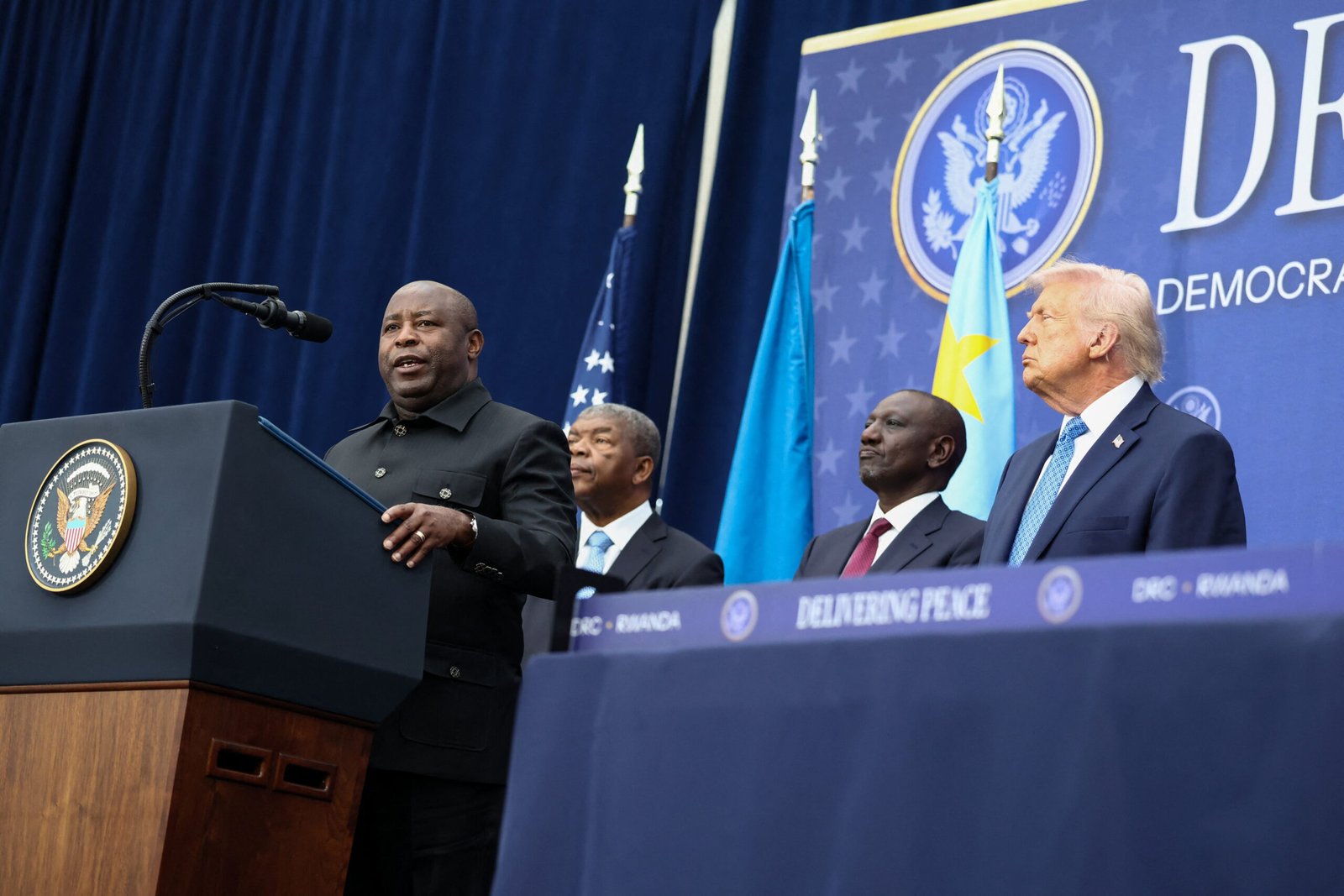
Image: Burundi’s President Evariste Ndayishimiye speaks next to US President Donald Trump, Kenyan President William Ruto, and President of Angola Joao Lourenco during a signing ceremony at the US Institute of Peace in Washington, D.C. Source: Reuters.
