

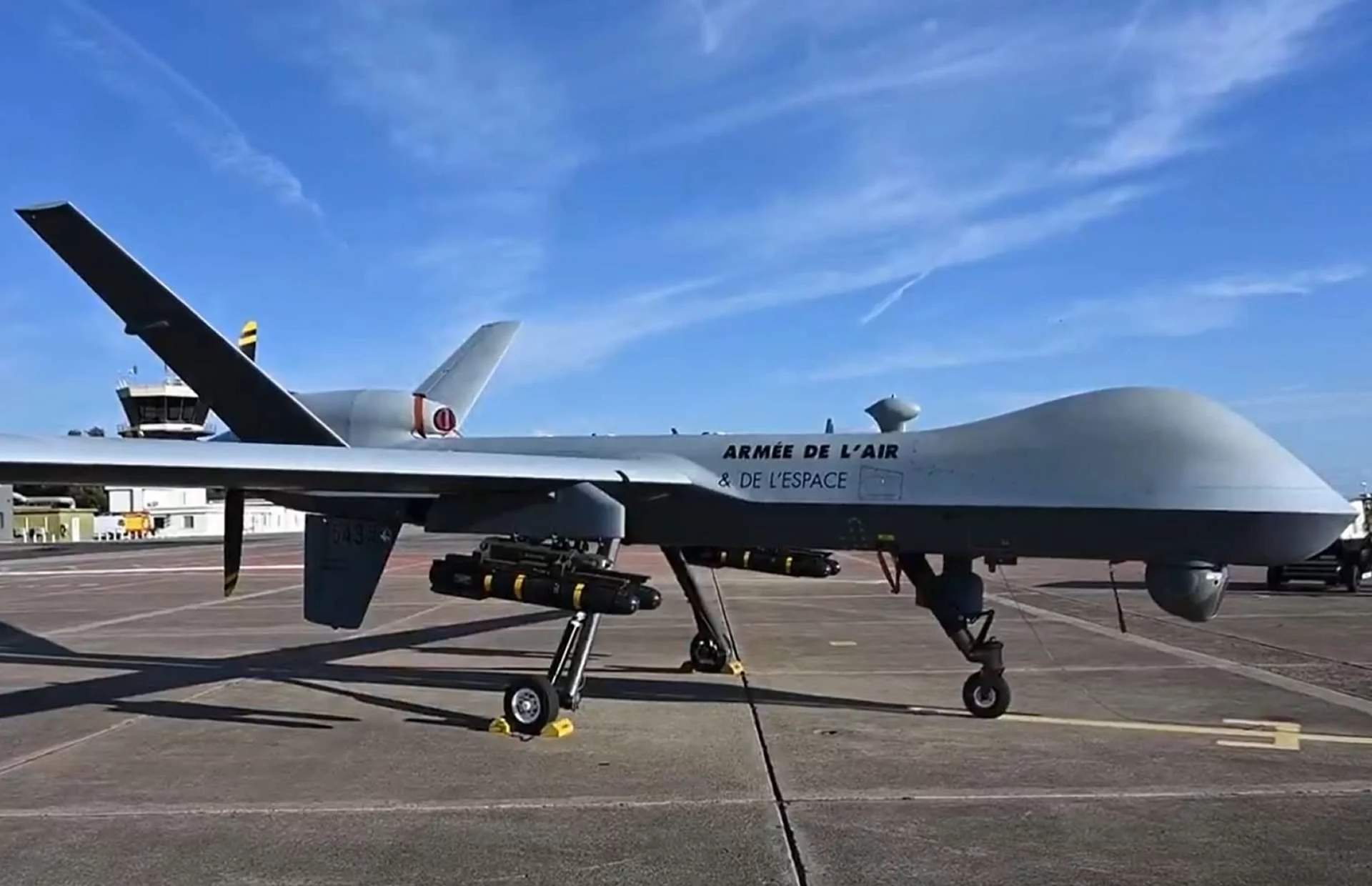
Defense Feeds, Paris – What started as an unconventional idea has suddenly become military reality. The French Air and Space Force pulled off something few European nations have attempted: turning the MQ-9 Reaper into a dedicated anti-drone hunter.
During early April tests at Île du Levant in Var, the AAE working alongside France’s Defence Procurement Agency (DGA) fired Hellfire missiles at unmanned aerial targets. It worked. The Reaper’s mission set just expanded dramatically, shifting from surveillance and precision strikes into air defense territory that was previously the exclusive domain of fighter jets.
What made this remarkable wasn’t just the technical achievement. It was the speed. Three months separated the moment Hellfire integrated onto the Reaper from actual successful live-fire tests.
That matters in military terms. France clearly isn’t waiting around while drone threats multiply. Across multiple regions, hostile unmanned systems are becoming a genuine tactical problem. France chose adaptation over lengthy development cycles, which tells you something about how seriously they’re treating this threat.
Advanced Integration and Tactical Advantages
The integration of Hellfire missiles on the MQ-9 Reaper drone represents more than a simple weapons adaptation. France’s military aviation experts transformed an existing airframe into a specialized air defense asset by leveraging the platform’s inherent advantages.
The Reaper’s extended endurance enables persistent surveillance over vast operational areas, a crucial requirement for detecting and engaging elusive aerial threats before they pose immediate danger to friendly forces or protected zones.
Real-time target identification provides decisive operational advantage in congested airspace. The Reaper’s high-definition thermal camera system enables crew members to distinguish between legitimate air traffic and potential threats with precision that lower-capability platforms cannot match.
The crew structure comprises pilot, sensor operator, intelligence officer, and imagery analyst. Together they create a synergistic team capable of making rapid tactical decisions based on complete situational awareness. This layered analytical capability becomes critical when engaging relatively sophisticated unmanned targets across varying altitudes and environmental conditions.
The Hellfire missile’s proven effectiveness against ground targets translated effectively to aerial engagements during these trials. The missile’s guidance system, originally optimized for stationary terrestrial targets, demonstrated sufficient flexibility to track and intercept moving aerial platforms.
This weapon system flexibility validates the broader French strategy of adapting existing defense industrial capabilities to emerging threat categories without lengthy development cycles.
Expanding France’s Multi-Layered Air Defense Architecture
The France MQ-9 Reaper drone intercept trials fit into a comprehensive air defense strategy designed to address threats across multiple altitude regimes and target types. The Rafale fighter aircraft provides high-speed, high-performance interception of demanding aerial targets, fulfilling the role of quick-reaction interceptor.
The Fennec helicopter specializes in engaging slower-moving or low-altitude threats where conventional fighter engagement would prove inefficient. The newly integrated Reaper anti-drone capability addresses the medium-altitude domain with extended loitering capability and sophisticated sensor integration.
Ground-based systems complement this airborne architecture. The MAMBA SAMP/T and VL MICA surface-to-air missile platforms deliver short to medium-range air defense coverage, protecting fixed installations and troop concentrations.
Emerging anti-drone specialized systems will further enhance this layered defense posture, creating redundancy across multiple threat categories and engagement ranges. This diversified approach reflects military doctrine evolution, acknowledging that no single platform can effectively counter contemporary threats spanning multiple altitude regimes, speeds, and engagement distances.
The integration of Reaper’s persistence and precision into this defensive framework creates unique capability. Extended endurance allows the platform to maintain station over contested areas for extended periods, providing continuous threat detection and immediate engagement capability.
The psychological impact of persistent drone surveillance on hostile unmanned operations should not be underestimated, particularly as adversaries develop sophisticated evasion tactics against conventional air defense.

Operational Implications and Strategic Positioning
This successful testing positions France advantageously within the emerging European air defense landscape. While several allied nations pursue traditional air defense modernization, France has demonstrated innovative adaptation of existing platforms to counter unconventional threats.
This capability development carries implications beyond immediate national defense, as other European nations facing similar drone threats observe French success and adjust their acquisition strategies accordingly.
The rapid integration timeline reveals something important about French defense strategy. Merely three months separated Hellfire operational availability from successful anti-drone testing. That compressed schedule shows mature defense industrial cooperation between the military services and procurement agencies.
Such institutional efficiency in capability development carries strategic value, enabling France to maintain technological relevance in domains where adversaries continuously evolve tactics and capabilities. The demonstration of French innovation in military technology may enhance France’s standing as a defense technology provider within allied networks.
Future anti-drone specialized systems will provide complementary capabilities to this Reaper-based solution. The military aviation expertise established through these trials informs broader European discussions regarding air defense architecture in an era of proliferating unmanned systems.
France’s demonstrated capability to integrate weapons systems with advanced sensor platforms across multiple platforms establishes credibility for future collaborative defense projects.
As unmanned aerial systems proliferate and become increasingly sophisticated, air defense commanders require flexible platforms capable of adapting to emerging threats without requiring extensive new development programs. France’s demonstrated success validates this adaptive approach.
