

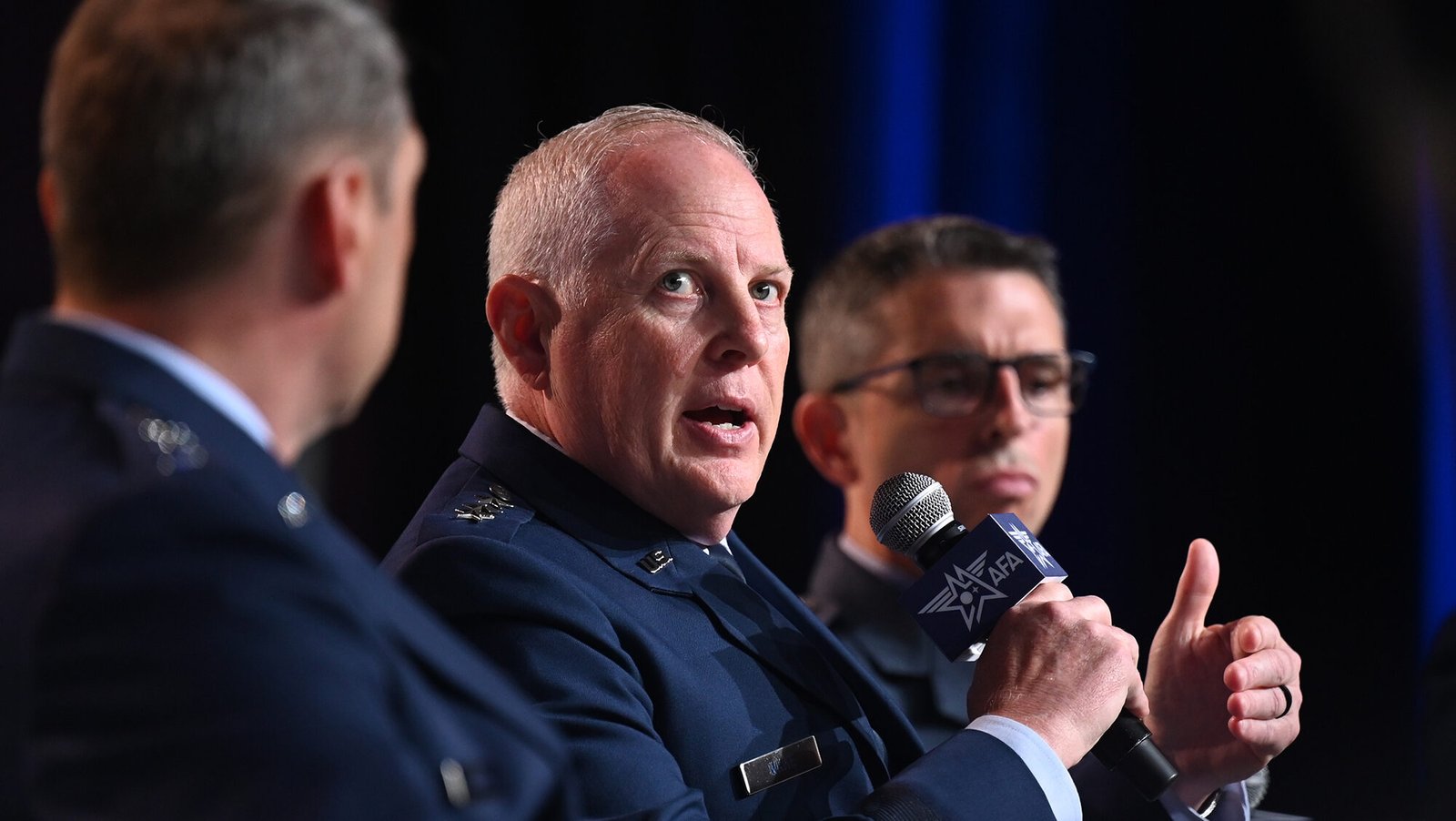
WASHINGTON — The Air Force’s Sentinel nuclear missile program is set to complete a mandated restructuring this year, teeing up the modernized ICBM to become operational early in the next decade, the general overseeing the effort exclusively told Breaking Defense.
“The restructure will be complete in 2026 to include regaining our Milestone B certification,” Air Force Gen. Dale White, the direct reporting portfolio manager (DRPM) for critical major weapon systems, said in his first interview since taking the newly created role. White noted the milestone would “probably” be achieved in the “back half of the year.”
Previously, the troubled Sentinel program was set to clear its Milestone B decision — Pentagon parlance that signifies confidence in proceeding with a weapon system’s design — in mid-2027. But according to White, the Sentinel team consisting of the Air Force and industry partners, including prime contractor Northrop Grumman, are “much further along than even what I would argue they give themselves credit for,” enabling the team to reach the decision more quickly.
“We certainly have not lowered the bar, and we certainly have not taken on any risk by doing this,” White said of the accelerated date.
With the new timeline in sight, White projected the forthcoming ICBM would achieve “initial capabilities in the early 2030s,” earlier than more recent prevailing estimates but still years later than an original forecast of deploying the missile in 2029. The general said the updated timeline is earlier than more recent prevailing estimates.
“Northrop Grumman is partnering with the U.S. Air Force to accelerate the Sentinel Milestone B decision by year-end and targeting initial capability in the early 2030s,” Sarah Willoughby, vice president and general manager of Northrop Grumman Strategic Deterrent Systems, said in a statement.
“The Sentinel team is rapidly progressing toward flight tests and production, having recently completed vital missile component qualification tests, risk reduction, digital engineering and prototyping efforts. In addition, Northrop Grumman will continue devising methods to control costs, accelerate deployment, and field the system faster,” she added.
Pentagon officials in July 2024 revealed that the LGM-35A Sentinel, set to replace decades-old Minuteman III missiles as the land leg of America’s nuclear triad, suffered a steep cost increase of roughly 81 percent, resulting in a new price tag of $141 billion. The mushrooming cost triggered what’s known as a Nunn-McCurdy breach, prompting officials to rescind an already declared Milestone B decision and embark on a restructuring of the program that the Pentagon’s top weapons buyer at the time said would result in a delay of several years.
White said the $141 billion estimate is still being treated as a cap for the program, noting that the number will firm up once Milestone B — where the Pentagon’s Cost Assessment Program Evaluation office and the Air Force Cost Analysis Agency will weigh in — is formally reached. Nevertheless, he said, there’s been no signs of further cost growth.
New Silos And A ‘Choreography’ For Integration
In the time since the Nunn-McCurdy breach, the Air Force has been working to get the program back on track.
Officials have said the primary challenge was unforeseen complications related to modernizing missile silos, one of the largest construction projects in generations. That process revealed the need for a key change: Rather than reuse existing Minuteman III silos, the Air Force now expects it will need to build new ones to house the Sentinel.
With plans to modernize 450 silos and deploy 400 Sentinel missiles, that means hundreds of new holes may have to be dug out — which Air Force officials claim will actually save time and money, relative to renovating existing facilities.
RELATED: Air Force takes first Minuteman III silo offline, in milestone towards Sentinel
The need for new silos further requires a supplementary environmental impact statement, often consisting of a lengthy review process that seeks to fully account for how surrounding communities could be impacted by large-scale projects. White said the environmental review is “going to be a focus area of mine to make sure that we don’t get caught in the environmental impacts of what we’re trying to do. We’re going to be very proactive on that piece.”
Once the environmental review wraps up and construction gets underway, a key change spearheaded as part of the Nunn-McCurdy restructuring will see the Army Corps of Engineers charge telecommunications firms with elements like laying countless miles of new cabling, rather than that work being run through Northrop. White said officials are “still working through” whether to similarly split up more contracting tasks.
All the while the Air Force has continued development of the Sentinel missile itself, a task that’s normally halted during program restructuring. The Air Force now plans to conduct the first flight for the missile via a pad launch in 2027.
Beyond the silo and the missile, there’s also the matter of its payload. The new ICBM will require an updated warhead, the W87-1, and a reentry vehicle dubbed the Mk21A that is being manufactured by Lockheed Martin. White said he had no concerns about how the timelines for the warhead, reentry vehicle and missile will align, reasoning that there’s “been a lot of choreography to make sure everything marries up from NC3 [nuclear command, control and communications] to those systems and making sure that we can get a full-up weapon system.”
While the details on Sentinel are worked out, some have suggested that extending the Minuteman III missiles would serve as a stopgap solution. But while a watchdog report found their lifespan could be extended to 2050, the Air Force has argued that any further delays risk rendering some existing ICBMs — where one failed in a test launch as recently as 2023 — as no longer being an effective deterrent.
For his part, White didn’t seem interested in entertaining the concept.
Asked how he’d rate the need for a new life extension program for the Minuteman fleet, which could mitigate any further delays, the general replied, “I don’t know if I’d rate it all right now, but I wouldn’t call it likely by any stretch of the imagination.”
“We understand that we cannot have a gap in capability,” White said of the transition to Sentinel.
Speaking on the day the New START treaty with Russia formally expired, White added that he had not seen any impacts yet of the arms control treaty’s lapse on the Sentinel project.
With DPRM, ‘There Is But One Person’
One way in which the Pentagon under Defense Secretary Pete Hegseth is attempting to speed the Sentinel program, as well as other high-priority defense projects like Golden Dome, is through bureaucratic restructuring. As first reported by Breaking Defense, White was appointed DRPM for Sentinel and a host of other top priorities including a next-gen fighter for the Air Force.
According to White, the new role, for which he was confirmed in December, has helped effectively consolidate decision-making authority that is usually dispersed across a vast Pentagon bureaucracy.
“The authorities that have been given to me as a direct reporting portfolio manager are: I have security authority, I have technical authority, I have budget authority, I have acquisition authority, I have hiring authority,” White explained.
“Acquisition by its very nature is a distributed set of decision makers, right?” he continued. “That is not true with the DRPM. There is but one person. Now I will leverage all those functions, but I have the authority.”
Still, he emphasized that “I don’t want people to think ‘it’s just because the DRPM showed up, that means everything is okay.’”
“I’m just allowed to focus some of the energy and effort and leverage all of the activity that’s been done up to this point, and will leverage DRPM authorities, if you will, to continue on the path,” he said.
White further emphasized his goal “is to build bridges and build partnerships” across the network of stakeholders in the Sentinel program, especially with the Department of the Air Force, “so that when these programs go back to a traditional sense, there won’t be an information gap there.”
The DRPM role is a microcosm of acquisition reforms being carried out across the Department of Defense, where Hegseth has championed a “portfolio”-based approach that seeks to delegate more authority to program managers.
“The way I kind of perceive the DRPM is, the rest of the department is going to have to endure the acquisition transformation process. It’s going to take some time, right?” White said.
“There were a set of programs out there that we just don’t have time to wait for acquisition transformation.”
Lawmakers are key stakeholders in the process as well, and some have taken a keen interest in Sentinel in the wake of its Nunn-McCurdy breach. White, who has cultivated relationships on the Hill throughout his career in acquisition, stressed that members of Congress can trust he will remain communicative.
“It may be different for Sentinel, but it won’t be different with me,” he said. “They know what they’re getting with me, and it will be complete and total transparency and a proactive effort to communicate all the things that are going on with the program.”
