

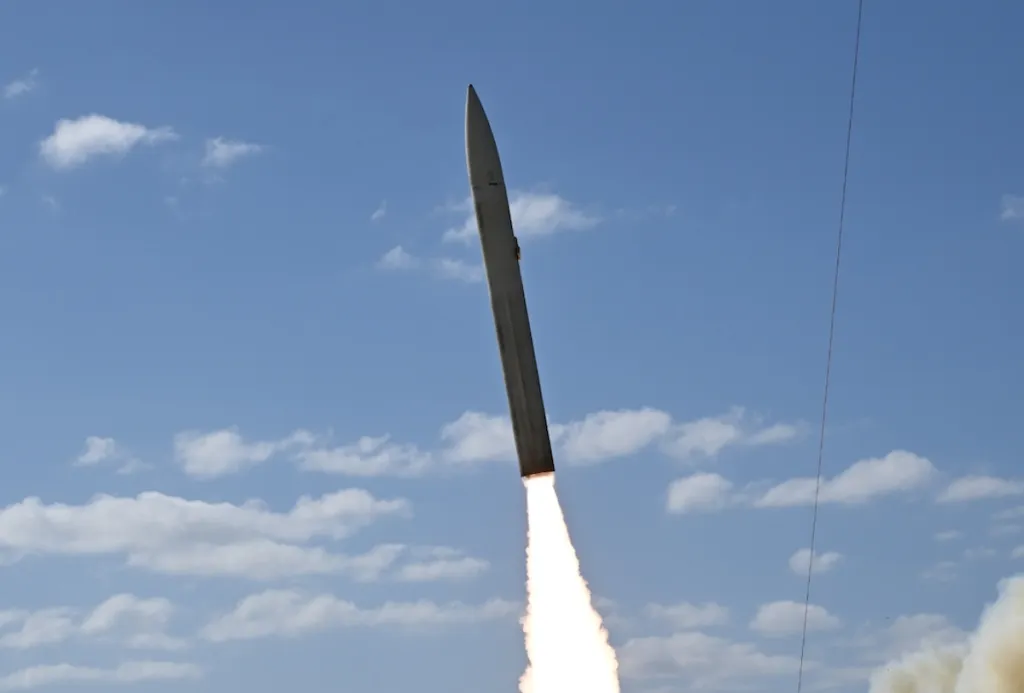
Defense Feeds, Washington — Dark Eagle hypersonic missile authorization was confirmed on April 7, 2026, when the United States transferred operational control to U.S. Strategic Command.
The shift elevates the Long-Range Hypersonic Weapon from a theater-level asset to a strategic weapon directly integrated with national command structures. Despite carrying conventional payloads, Dark Eagle now operates under centralized oversight typically reserved for nuclear-capable systems.
The restructuring establishes a direct command chain from national leadership through USSTRATCOM to operational field units. This separation of execution and authorization ensures every strike receives high-level approval before launch. U.S. Army Multi-Domain Task Forces will operate launch systems, but the National Command Authority retains exclusive strike authorization.
Advanced Hypersonic Specifications and Performance
Dark Eagle hypersonic missile authorization reflects confidence in the system’s maturity after successful test campaigns in 2024 and 2026.
The weapon combines a two-stage solid-fuel booster with a Common Hypersonic Glide Body shared with U.S. Navy programs. The system achieves speeds exceeding Mach 5 and covers operational ranges between 2,700 and 3,500 kilometers.
The booster accelerates the glide body before atmospheric separation, enabling maneuvering flight that complicates detection and interception. Time-to-target estimates range from 15 to 20 minutes at maximum range.
The missile carries a conventional warhead under 14 kilograms that generates energy comparable to roughly 700 kilograms of TNT through hypersonic impact dynamics.
Early development faced multiple setbacks with failed tests during 2021, 2022, and 2023. The program achieved breakthrough success on June 28, 2024, followed by a second successful test in December 2024. A joint Army-Navy validation test in March 2026 confirmed the shared hypersonic architecture across service branches.

Operational Employment and Strategic Role
Dark Eagle hypersonic missile authorization focuses the system on high-value, time-sensitive targets including air defense systems, command nodes, missile launchers, and radar installations. Each battery fields eight operational missiles with limited production capacity estimated at one to two units monthly. This constraint forces strict prioritization of strategic-level missions demanding rapid response capability.
The weapon provides a non-nuclear option for long-range strikes, bridging the capability gap between slower conventional weapons and nuclear systems. By placing Dark Eagle under STRATCOM authority, the United States strengthens rapid global strike capability without escalating to nuclear weapons employment. The system serves as a controlled, high-impact tool of national policy reserved for critical strategic scenarios.
The shift from theater command authority to strategic command oversight aligns Dark Eagle with intercontinental ballistic missiles and submarine-launched ballistic missiles in decision-making frameworks. National-level approval ensures that every hypersonic strike aligns with broader strategic objectives and national security priorities. This centralized control prevents unauthorized employment while maintaining rapid response capability during crises.
Integration with Strategic Deterrence Architecture
Dark Eagle hypersonic missile authorization strengthens America’s conventional deterrence posture against near-peer competitors facing modern air defenses.
The system complements existing cruise missile and air-breathing platforms with superior speed, maneuverability, and penetration characteristics. Hypersonic glide bodies follow non-ballistic trajectories that defensive systems struggle to track and intercept.
The integration with USSTRATCOM command structures indicates long-term commitment to hypersonic weapons as essential strategic assets. Future production increases beyond current monthly estimates will expand operational availability across global command regions. Navy integration through shared glide body technology ensures cross-service standardization and interoperability.
Integrating Dark Eagle into U.S. Deterrence
Dark Eagle’s shift under U.S. Strategic Command embeds hypersonic strike directly into the nation’s top-tier deterrence toolkit, alongside ballistic missile and nuclear forces. This move signals that Washington views conventionally armed hypersonics as a strategic instrument, not just a niche battlefield enabler.
The missile’s speed, maneuverability, and penetration capability give decision-makers a rapid, precise option for neutralizing critical targets inside heavily defended airspace without crossing the nuclear threshold.
By routing employment through the National Command Authority, Dark Eagle becomes a tightly controlled asset reserved for scenarios where timing, distance, and political signaling all matter. Its integration with joint architectures and shared Army–Navy technology lays the groundwork for a wider hypersonic family that can be cued from multiple domains and command regions.
As production ramps up and deployment widens, Dark Eagle will increasingly shape how near-peer adversaries calculate risk, raising the cost of aggression while giving the United States a flexible, non-nuclear means to impose strategic consequences.
